
A leader does not need to predict every turn. The task is to make the next decision clear. Guidance for leaders facing profound challenges begins with honest communication, a steady sense of purpose, and a willingness to adjust as circumstances change.
Uncertainty can make every priority feel urgent. Teams need more than confident words: they need to understand what is happening, why decisions are being made, and how their work matters. Clarity grows when leaders explain their reasoning, even while the answer is still taking shape.
This article explores how leaders can respond to economic, technological, and organizational change; prepare for crises and succession; recognize people’s contributions; and build trust through listening and constructive feedback. It also considers how mission, values, and clear expectations help teams move forward as priorities shift. The work starts by deciding what deserves attention now and what kind of leader the moment calls for.
Key Takeaways
- Separate what is known from what remains uncertain, then make the next decision and its reasoning clear.
- Prepare for disruption by communicating openly, naming immediate priorities, and developing people who can step into greater responsibility.
- Show people how their contributions serve a shared purpose, especially when pressure makes their work less visible.
- Build trust through delegation, active listening, and a willingness to receive constructive feedback.
- Leadership & Life Advisory can offer leaders a space to examine difficult decisions, changing priorities, and the person they are becoming through their choices.
David James Rhodes: Leadership & Life Advisory
Leadership & Life Advisory gives leaders space to examine difficult decisions, responsibilities, and personal questions that can be hard to hold alone. It can be useful when the facts are incomplete, the consequences are serious, or the demands of a role have obscured what matters most. The aim is not to provide a ready-made answer, but to bring greater clarity to the choices ahead and the person making them.
Leadership is often defined by visible actions: setting direction, making decisions, communicating priorities, and taking responsibility for results. Yet the work also has an inner dimension. Leaders must decide what to protect, what to change, when to speak, and when to listen. Those choices are shaped by values, fears, assumptions, and habits, whether or not the leader names them. Advisory creates room to consider this less visible terrain alongside the practical demands of the role.
This matters when an established way of leading no longer fits the moment. Strategy may need to change. A team may have lost confidence. A once-certain leader may now be weighing competing obligations. In such moments, clarity does not mean knowing every outcome in advance. It means seeing the decision honestly, understanding its trade-offs, and acting with care despite what remains uncertain.
When a leader may seek advisory
Leaders need not wait for a public crisis or dramatic failure before seeking another perspective. The need can emerge quietly: a decision keeps returning after meetings end; organizational change demands a response, but every option carries a cost; or a leader is responsible for others while privately wondering whether exhaustion, urgency, or fear of disappointing people has clouded their judgment.
Leadership & Life Advisory may be useful at points such as:
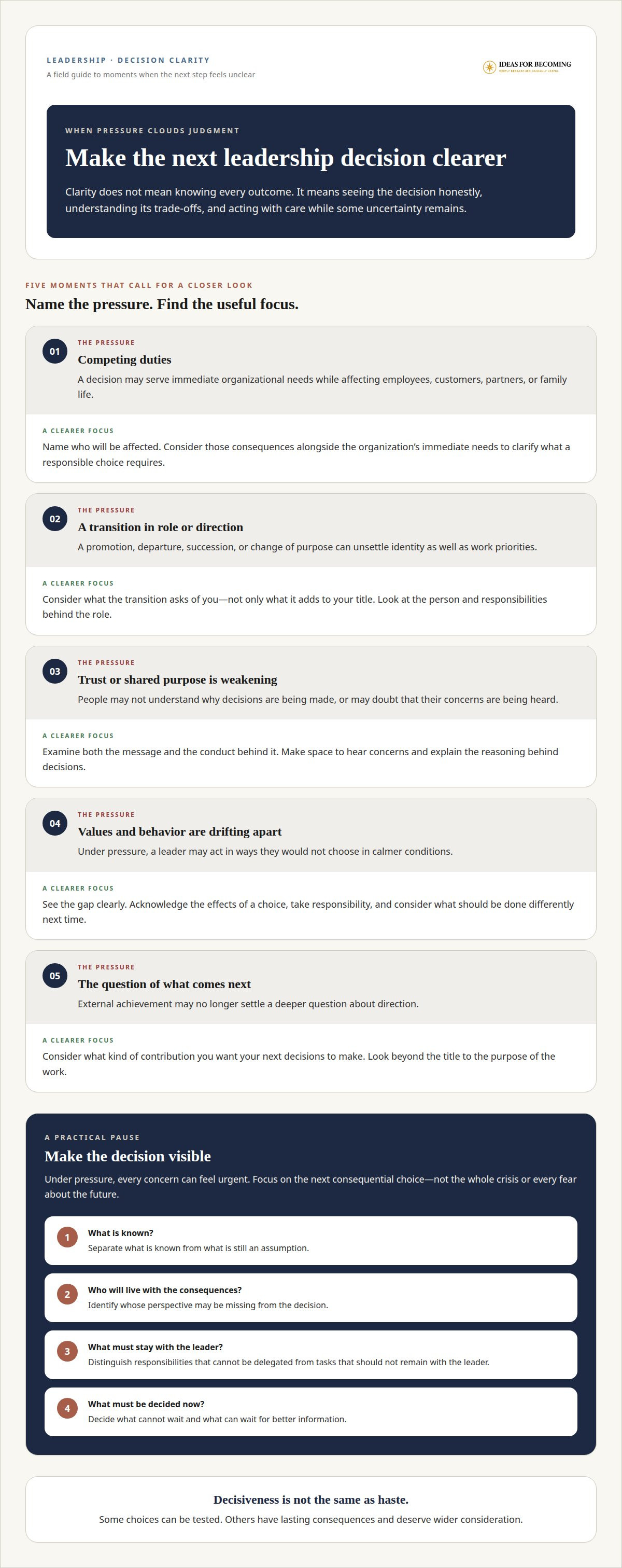
- A decision with competing duties. A leader may need to weigh the organization’s immediate needs against the effects on employees, customers, partners, or family life. Naming who is affected can clarify what a responsible choice requires.
- A transition in role or direction. A promotion, departure, succession, or change of purpose can unsettle a person’s sense of identity as well as their working priorities. It can help to consider what the transition asks of the leader, not only what it adds to their title.
- A loss of trust or shared purpose. When people no longer understand why decisions are being made, or doubt whether their concerns are heard, a leader may need to examine both the message and the conduct behind it.
- A growing distance between values and behavior. Pressure can make a person act in ways they would not choose under calmer conditions. Seeing that gap clearly is a beginning, not a reason to hide from responsibility.
- A question about what comes next. Some leaders reach a point where external achievement no longer settles the deeper question of direction. They may need to ask what kind of contribution they want their next decisions to make.
These situations differ, but all demand more than a quick answer. They ask leaders to separate the problem from the emotions around it, notice who is affected, and decide which principles should guide action. An advisor can help keep attention on these questions when a leader’s usual environment rewards speed, certainty, or the appearance of control.
From pressure to a clearer decision
Under pressure, leaders may treat every concern as equally urgent. That is understandable, but costly. Attention scatters, messages vary from one conversation to the next, and teams struggle to distinguish the essential from the incidental. A more deliberate approach starts by naming the actual decision: not the whole crisis or every fear about the future, but the next consequential choice that cannot be avoided.
Then examine that choice through practical questions. What is known, and what remains an assumption? Who will live with the consequences? Which responsibilities cannot be delegated, and which tasks should not stay with the leader? What must be decided now, and what can wait for better information? This is not about reducing a human dilemma to a formula. It is about making its parts visible enough to consider carefully.
Imagine a leader facing organizational change that will affect how a team works. The first impulse may be to announce a solution quickly, both to reassure people and to ease the leader’s own discomfort. A more considered response separates what has been decided from what remains open, identifies whose perspective is missing, and explains what the team can expect next. The situation may still be difficult, but honesty about its boundaries can keep silence from spreading uncertainty.
Advisory can help leaders distinguish decisiveness from haste. A quick decision is not necessarily sound, and delay is not always a sign of care. The question is what the moment requires. Some choices are reversible and can be tested; others have lasting consequences and deserve wider consideration. Recognizing the difference helps leaders focus attention where it matters, rather than seeking certainty where none is available.
The person behind the role
A leadership title can make it seem as though the role and the person are one and the same. They are not. The role carries obligations, authority, and expectations; the person brings a history, temperament, relationships, and a particular understanding of success. When these become entangled, a workplace challenge can feel like a verdict on the whole self. A setback may seem to erase past achievements, while disagreement may feel like rejection rather than information.
Making this distinction does not excuse poor decisions. It helps leaders take responsibility without collapsing into shame or defensiveness. A leader can acknowledge that a choice caused harm, learn from the consequences, and choose differently next time. That is more useful than protecting an image of flawlessness. Teams do not need leaders who pretend never to be wrong. They need leaders who recognize what happened, speak honestly, and respond with integrity.
This is why leadership questions are also questions of becoming. What kind of person is this pressure bringing forward? Which reactions are habitual, and which are chosen? What should people experience when they work with this leader, especially when the stakes rise? There is no single ideal personality that answers these questions. Self-awareness is not a performance of humility; it is a willingness to see how one’s actions shape the conditions others work within.
David James Rhodes’s perspective is informed by over four decades of experience across 156 countries in sectors including international finance, leadership, entrepreneurship, and behavioral health. Experience can offer perspective, but it does not make one person’s answer right for another. The value lies in bringing a broad view of human and organizational challenges to the particular decision a leader must face, while leaving room for context, judgment, and personal responsibility.
Clarity is not control
Leaders sometimes seek clarity in the hope that it will eliminate uncertainty. It cannot. Markets shift, people respond unpredictably, and careful plans may need revision when new facts emerge. More useful clarity means knowing what the leader is trying to serve, what is understood now, and how to respond if circumstances change.
That clarity can steady communication. Rather than presenting a changing plan as fixed, a leader can explain its direction, the reasons behind it, and the conditions that might prompt a revision. They can distinguish what is settled from what still needs thought. This does not guarantee agreement, but it gives people a more truthful basis for understanding the decision and their role in it.
It also changes how leaders listen. When a decision is treated as proof of competence, feedback can feel threatening. When it is seen as a responsibility to carry and review, other perspectives become useful. Listening does not mean granting every request or avoiding hard choices. It means being willing to learn before deciding, and to reconsider when the facts or effects warrant it.
Trust grows through small, observable actions: keeping commitments, explaining changes, acknowledging mistakes, and giving others meaningful responsibility. These may seem modest beside a major strategic decision, yet people often judge leadership by the distance between words and actions. Advisory can help leaders examine that distance and see where greater consistency is needed.
Values under pressure
Values matter most when they shape choices that carry a cost. It is easy to speak of fairness, courage, or respect when no competing need is pressing. The test comes when a leader must choose between short-term comfort and an honest conversation, holding authority and sharing it, or protecting a familiar plan and admitting it no longer serves its purpose.
Advisory can bring these tensions into view without reducing them to slogans. Respect, for example, does not always mean agreement. It may mean offering a clear explanation, hearing concerns, and being direct about what cannot change. Courage may mean making a difficult call, but it may also mean admitting an earlier decision was wrong. Context matters, as does the conduct a leader chooses within it.
A useful reflection is to compare stated priorities with the attention a leader actually gives them. If people matter is there room to hear how decisions affect them? If learning matters, can criticism be received without punishing the person who offered it? If responsibility matters, does authority stay concentrated at the top, or can others take ownership where they are capable? These questions do not produce instant answers. They show where principles become real and where they remain intentions.
Making space for the next chapter
Not every leadership challenge is solved by returning to a former level of performance. Sometimes the more important task is to reconsider the direction itself. A leader may reach a goal and find that the achievement has not answered the question of meaning. They may be considering a different contribution or asking whether their current role still fits the person they want to become.
These are not signs of weakness. They call for honest thought. The answer may be to stay and lead differently, change responsibilities, prepare someone else to take the lead, or make a deliberate transition. Advisory does not remove the consequences of these choices. It can help leaders consider them without letting fear of change or attachment to status decide by default.
The Way offers a wider philosophical frame for this work: a way to think about becoming through choices, actions, relationships, failure, and purpose. In leadership, the question is not only whether someone can find the right response to a crisis. It is also whether that response is shaping a person able to meet the next challenge with greater honesty and care. This is not a promise of certainty. It is a call to take part in one’s own development.
Leadership & Life Advisory is a natural next step when a leader wants space to think beyond the immediate demand, examine a difficult decision, or better align responsibility with values. It does not replace the leader’s judgment. The leader remains accountable for their choices and their effects on others. The work is to see those choices more clearly and meet them with intention rather than reflex.
If these questions resonate with your leadership, contact David James Rhodes to explore Leadership & Life Advisory.
Choose the Leader You Want to Become
The next challenge will not arrive in exactly the shape you expect. What can endure is how you choose to meet it: with attention, honesty, and a willingness to keep learning. Guidance for leaders facing profound challenges is not about eliminating uncertainty. It is about deciding who you will be as you move through it.
Start with a choice already in front of you. Consider not only what it may solve, but what it asks of you and what it may teach the people who follow your lead. Notice, too, what your decisions make possible for others and what they may ask others to carry.
For organizations seeking a shared conversation about leadership and becoming, David James Rhodes also offers Keynote Speaking. His work returns to a question larger than any single decision: who are you becoming? The answer takes shape through the choices you make.
If you want to continue that reflection, contact David James Rhodes. The next step need not resolve everything. It can simply help you meet what comes next with greater intention.
Frequently Asked Questions
Blog 1: Can Public Leaders Navigate High Winds and Big Waves in Little Boats?
Yes, if leaders are honest about the limits of their position and make disciplined choices. A small public agency, community group, or local institution may not control the forces affecting it, but it can set clear priorities, coordinate with people who have relevant knowledge, and explain what it can do now. A “little boat” cannot calm the sea, but it can choose its course and keep those aboard informed.
What exactly are leadership challenges?
Leadership challenges arise when responsibility exceeds the comfort of familiar answers. They can involve competing priorities, strained relationships, sudden change, limited capacity, or decisions that affect people differently. For example, a leader may need to maintain an essential service while changing how the team delivers it. The challenge is not just the problem itself, but the judgment, communication, and accountability required to respond.
How can leaders build resilience and adaptability in their organizations?
Make learning part of ordinary work, not something reserved for a crisis. After a project or decision, invite those closest to the work to identify what helped, what caused friction, and what should change next time. Give teams room to test improvements within clear responsibilities. When plans shift, explain what changed and what remains steady. Adaptability grows when people can raise problems early without fearing that candor will be punished.
How can leaders measure recovery and organizational resilience after a crisis?
Look beyond whether operations have resumed. Consider whether essential work is dependable, responsibilities are understood, unresolved problems are being raised, and staff can sustain the demands placed on them. Compare current conditions with the organization’s own pre-crisis baseline, using measures suited to its work. Pair those indicators with direct conversations: numbers can show a pattern, while people can explain what drives it.
What crisis leadership frameworks and tools are most effective?
Separate known facts from assumptions, identify the next consequential decision and who it affects, and let the organization’s mission and values guide choices. Communicate clearly about what is settled and uncertain, prioritize dependable data, and mobilize resources. Social sector leaders can co-create risk mitigation plans with stakeholders.
Frequently Asked Questions
Related Articles

Strategic advice for cultivating future leaders
Strategic advice for cultivating future leaders: Spot potential and develop emerging leaders through real responsibility, coaching, feedback, and peer support.

Executive Guidance on Ethical Leadership Principles for Building Trust
Executive guidance on ethical leadership principles shows how honesty, fairness and accountability build trust, credibility and guide everyday decisions.
Purpose-Driven Life Advisory for Professionals: Work With Purpose
Purpose-driven life advisory for professionals connects your values to leadership and daily work, helping you pursue meaningful goals and lasting fulfillment.