
Who are you when the career that shaped your days, status, and sense of purpose begins to change? Identity after career change can feel uncertain because work is rarely just what we do. It can become the language we use to explain ourselves, and the role others still expect us to play. When that role shifts, the next step may not be clear. That doesn’t mean you’ve lost who you are. It means your old description no longer tells the whole story.
This article explores why work can become closely tied to identity, even when a career change is your choice. You’ll find practical ways to distinguish lasting values and abilities from a single professional role, respond when others keep defining you by your past, and test possible next steps without demanding instant certainty. A career can change. The deeper work is deciding what you want to carry forward, and who you are becoming beyond a title.
Key Takeaways
- Feeling unsettled after a career change doesn’t mean you’ve lost yourself. Work is one part of identity, not its full measure.
- Separate your former job title from the abilities, values, commitments, and relationships you can carry into what comes next.
- Identity after career change can take time to clarify. You don’t need a complete plan before taking a thoughtful next step.
- Use focused reflection and small experiments to notice what matters and test possible directions while respecting practical responsibilities.
- Your career can change while your capacity to grow continues. Ask who you are becoming, not only what role you will take next.
Why Identity Can Feel Unsteady After a Career Change
A career can end by choice, redundancy, retirement, or circumstances no one planned. Whatever the cause, the transition may unsettle more than your schedule. You might feel relief and still miss the work. You might be ready to leave and unsure how to describe yourself afterward. These reactions don’t mean you made the wrong decision. They reflect how much meaning can gather around a role over time.
Career identity is the part of your self-understanding shaped by the meaning, responsibilities, relationships, and contribution you associate with work. It is real, but it is not your whole identity. Put simply, your career identity describes one way you have lived; it does not contain the complete person you are.
That distinction matters when identity after career change feels uncertain. Your role may have changed, but the capacities you developed in it do not disappear at the same moment. Judgment, patience, technical skill, care for others, or the ability to take responsibility may still shape how you meet the world. The task is to recognize where those qualities can serve you beyond their former setting.
What changes when a career no longer organizes daily life?
Work often gives time a pattern: meetings, deadlines, shifts, decisions, and the next task. It creates regular contact with colleagues and people who rely on your contribution. It can also provide a familiar answer to “What do you do?” When that structure changes, even ordinary moments may feel different. A former manager may need to build a new daily rhythm; someone retiring may miss the conversations as much as the responsibilities.
Notice which parts of the old structure you miss. Is it the routine, the people, the problem-solving, or knowing that someone needed your judgment? Naming the specific absence gives you a clearer starting point than concluding that you miss your whole career. Some work relationships may change with the role, while others continue. What you carry forward may need a new place to be practiced, not a new identity invented from scratch.
Why can a chosen career change still feel like a loss?
Choosing to leave does not mean you have to feel only positive about leaving. You may have decided that a role no longer fits and still miss its pace, the competence you built, its community, or the recognition. Relief, uncertainty, and attachment can coexist. One feeling does not cancel the others.
People sometimes use “identity crisis” to describe this disorientation. Identity Crisis on Wikipedia offers a broad introduction to the concept, though a career transition should not automatically be treated as a clinical problem. Feeling unsettled, by itself, doesn’t establish that anything is wrong with you.
There is no single emotional sequence everyone must follow, or fixed adjustment period that applies to every life. Redundancy may bring practical pressure alongside questions of self-worth. Retirement may be planned and still leave a sense of absence. An unexpected ending may leave little time to prepare. The circumstances differ. Give yourself room to notice what has changed without concluding that your worth ended with your role.
How Career, Role, and Personal Identity Interact
A person is never made from a single source of meaning. Work may be central, but so may family, friendship, service, faith, curiosity, community, and the standards by which someone chooses to live. These parts of identity can support one another. They can also become harder to notice when a professional role has occupied most of your attention.
Work may shape identity, but it cannot contain the whole of it. A title names a position and its responsibilities. It does not fully describe the person making decisions, keeping promises, learning from failure, or choosing what matters. Ambition and professional pride can reflect discipline, craft, and a sincere desire to contribute. The risk comes when one role becomes the only language you have for describing your life.
Which parts of professional identity may continue across careers?
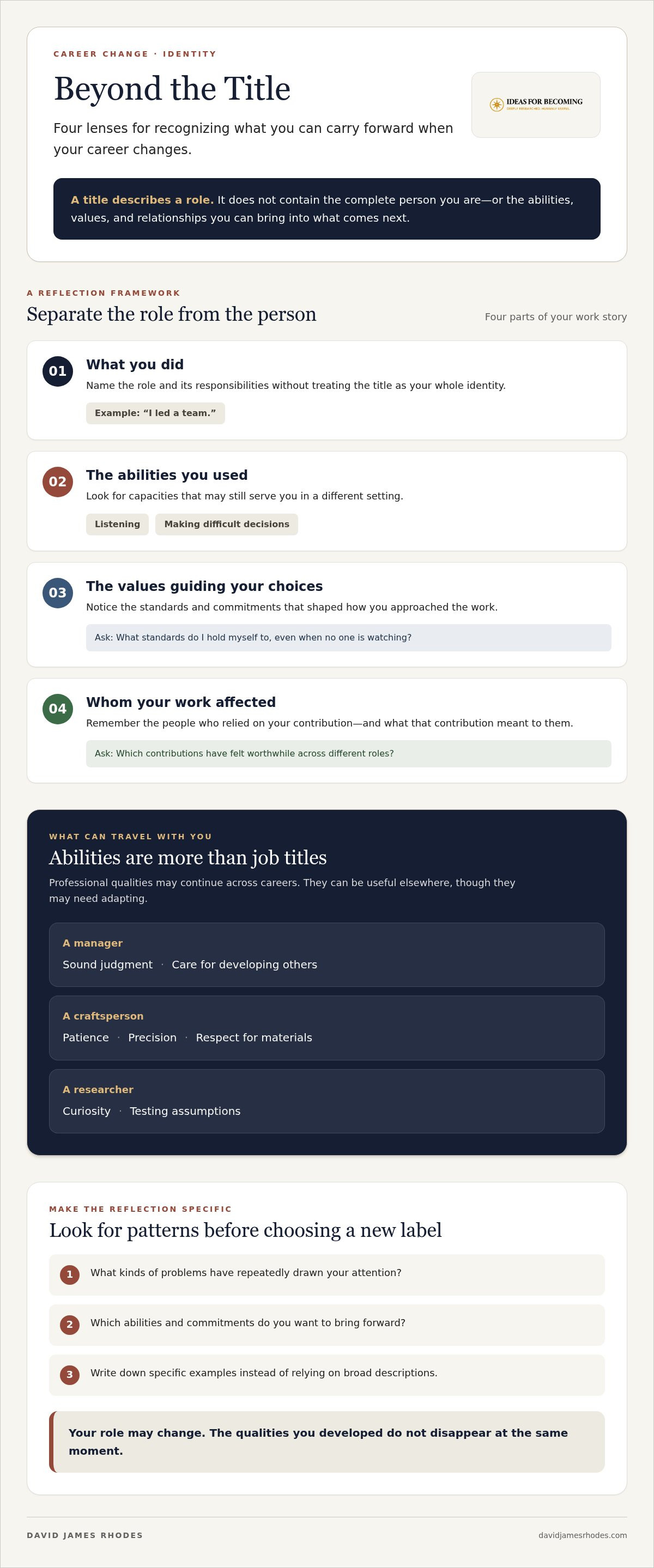
Some qualities travel more readily than job titles do. A manager may bring sound judgment and care for developing others into a new field. A craftsperson may carry patience, precision, and respect for materials into different work. A researcher may retain curiosity and the habit of testing assumptions. These capacities can be useful elsewhere, though they may need adapting. Experience in one setting doesn’t guarantee the same results in another.
Look for patterns before choosing a new label. What kinds of problems have repeatedly drawn your attention? What standards do you hold yourself to, even when no one is watching? Which contributions have felt worthwhile across different roles? Write down a few examples rather than relying on broad descriptions such as “I’m a people person.” Specific moments can help you see which abilities and commitments you want to bring forward without deciding immediately what your next profession must be.
Why can a job title become an incomplete self-description?
Introducing yourself by the same title over and over can make it feel like the clearest account of who you are. Recognition reinforces that shorthand. Colleagues may seek your expertise, and others may praise achievements associated with your position. That recognition can be earned and meaningful. Over time, though, the title may crowd out other truths: the friend who listens carefully, the parent who shows up, the neighbour who contributes, or the person still learning.
Try separating your experience into four parts: what you did, what abilities you used, what values guided your choices, and whom your work affected. For example, “I led a team” describes a role. Listening, making difficult decisions, and helping people coordinate describe actions and abilities. This distinction doesn’t diminish the achievement. It gives you a fuller account of what it involved and what you might carry into a different setting.
This wider view can steady identity after career change. You don’t have to reject your former profession or keep it as your sole definition. You can respect what it gave you, recognize what remains useful, and let your self-description become more accurate as your life takes shape. For further reflection on growth beyond a single role, explore David James Rhodes’s perspective on human becoming.
Career-Change Identity: Misconceptions That Can Keep You Stuck
A career change can make the past feel like a problem to solve. Should you keep identifying with the work you left, or cut ties and become someone entirely new? Both options can seem simpler than a more complicated truth: you can carry parts of your history forward while changing direction. Identity after career change is not a test of whether you can preserve or erase your former self.
Career transitions don’t produce one universal outcome. A new role may bring freedom, pressure, satisfaction, disappointment, or several of these at once. Redundancy can limit choice. A voluntary departure may still bring practical strain. You can value what a career gave you and recognize that you need something different. Neither a triumphant reinvention story nor a story of permanent loss fits everyone.
Does changing careers mean starting your identity from zero?
No. Your former profession remains part of your story, but it doesn’t have to dictate your next role. A teacher moving into a community organization, for example, might carry a commitment to helping people learn while discovering that the new setting requires different knowledge and ways of working. The value continues; its expression changes.
Keeping a useful capability or standard isn’t proof that you’re resisting change. Nor must you preserve everything simply because it took years to build. Ask what still reflects your values, what belongs to a past role, and what you may want to leave behind. The aim isn’t to defend an old identity. It’s to choose consciously what deserves a place in the next chapter.
Must you know who you are becoming before you act?
Clarity can help guide action, but it doesn’t always arrive first. Reflection can reveal what you value; a small, considered step can show how those values meet the reality of unfamiliar work. You might speak with someone in a field you’re considering, take on a limited project, or explore a relevant skill while maintaining current responsibilities where possible. These are ways to gather information, not guarantees of success.
A provisional step is not a permanent declaration about who you are. It is a decision made with the information you have now, which you can review as circumstances become clearer. If finances or caregiving responsibilities narrow your choices, the next step may need to be modest. That is not a failure of imagination. It is a way to respect the life you have while examining what might be possible.
You don’t need to force certainty or perform a dramatic break with the past. Keep what remains meaningful. Question what no longer fits. Then take one action small enough to be responsible and substantial enough to teach you something. The direction may sharpen through that process, or it may need revision. Becoming does not mean every choice will feel right. It means meeting each choice honestly and deciding what to do next.
Practical Ways to Rebuild a Sense of Self During Career Change
Rebuilding a sense of self doesn’t require an immediate reinvention or a perfect career plan. It asks for honest attention, followed by small actions that help you learn. Fit the process around work, caregiving, financial pressure, and other responsibilities. The aim is to make useful observations, not to turn every feeling into a decision.
Identity is rebuilt through deliberate practice, not delivered by a deadline. Use these steps to notice what matters, distinguish what you miss from what you want to keep, and test possibilities without treating every choice as permanent.
- Notice what feels unsettled. For a few days, make a brief note when a change in work brings relief, strain, interest, or a sense of loss. Record what was happening and what the feeling might connect to. For example, if you feel a pang after a former colleague shares a project update, ask whether you miss that person, the work itself, or being part of a team. You’re gathering observations, not judging them or forcing a conclusion.
- Take stock of what the former career gave you. List meaningful responsibilities, relationships, abilities, and moments when you felt you contributed. Include standards you cared about and work you found absorbing. Then ask which elements felt chosen and which were maintained mainly for approval, recognition, or expectation. Concrete examples, such as a decision you made or a problem you enjoyed solving, can make the list more useful than general traits.
- Separate what you miss from what you want to carry forward. Missing a familiar team, status, routine, or sense of competence doesn’t automatically mean you want the old career back. Write down what you miss, then name the need underneath it: connection, mastery, security, service, or something else. Ask a trusted person who knows you beyond work what strengths they see in you. Compare their examples with your own notes rather than treating one opinion as a verdict.
- Choose one manageable way to test a direction. Identify a possible next step that fits your current responsibilities. It might be a conversation with someone doing the work, a modest project, or time spent learning a relevant skill. Before you begin, decide what you want to find out, such as whether the daily tasks interest you or whether the role uses abilities you value. Keep the experiment realistic. A test offers experience, not a promise about what will happen next.
- Record what you learn, and what remains uncertain. After each action, write a few lines: What held my attention? Which values did I get to express? What felt difficult because it was new, and what seemed like a poor fit? Treat one experience as information, not a final verdict. Look for patterns across observations before making larger decisions, and note what you still need to learn.
If income or other practical needs limit your options, let those realities shape the size of the next step. Reflection can happen in short intervals. A careful experiment can sit alongside necessary work; you don’t have to resolve your identity before paying attention to it.
For a wider perspective on growth and change, explore David James Rhodes’s work on human becoming.
Human Becoming: Finding a Way Forward Beyond a Career Title
A career can change. The work of becoming does not stop. The earlier sections have explored how to notice what matters, recognize what you carry, and take considered steps without demanding certainty. These practices aren’t ways to force a new identity into place. They help you keep choosing how you meet the life in front of you.
How The Way connects identity with becoming
It is natural to want the perfect next path, one that makes every past decision feel justified and every future choice feel secure. But no career can promise that kind of certainty. The Way offers a different focus: “The Way is not something you find. It is someone you become.” In this philosophy, the way forward takes shape through character, action, meaning, and the choices a person continues to make.
That idea doesn’t dismiss practical questions about work. Income, responsibility, and opportunity matter. It places them within a larger question: who are you becoming as you respond to them? A new role may give you a setting in which to act, but your title cannot make those choices for you. You can read more about The Way’s philosophy of becoming and its distinction between finding a perfect path and creating a way forward.
A next chapter can honour the person you have been
Your future doesn’t have to erase your past to be genuinely new. Your former career may have shaped your judgment, discipline, relationships, or understanding of meaningful contribution. You can honour that experience without returning to the same role or insisting that it define every choice ahead. Continuity and change can exist together.
David James Rhodes’s perspective is shaped by more than four decades of experience across 156 countries, including work in international finance, leadership, entrepreneurship, and behavioral health. That experience offers perspective, not proof that every person’s transition follows the same pattern. Each life has different demands and possibilities. Explore David’s perspective on identity and leadership for a wider view of how people grow and lead through change.
There may be no single moment when the old description disappears and a complete new one takes its place. For a time, you may be between familiar answers. That space can feel uncomfortable, but it need not be filled with a premature declaration. Let what you’ve learned inform your next choice while leaving room for what you have not learned yet.
As you consider what comes next, ask yourself: Which qualities do I want to carry into my next chapter, whatever my job title becomes?
Let Your Next Step Reflect Who You’re Becoming
A career transition doesn’t require you to settle your entire identity before you move. It asks for a more immediate kind of honesty: what matters enough to guide your next decision, even while the larger picture remains unfinished? Your answer may change as you gain experience. That isn’t a failure of direction. It’s part of making a life rather than merely selecting a title.
As you consider identity after career change, resist measuring progress only by how quickly you can explain yourself to others. A more useful measure may be whether your choices reflect qualities you want to live by: care, courage, curiosity, responsibility, or something distinctly your own. You can move carefully without standing still. You can honour what came before without asking it to decide everything that follows.
David James Rhodes’s work explores this larger idea of human becoming: a way forward is shaped through who you become. Explore The Way and the idea of human becoming, and consider what you want your next choices to express. The next chapter need not be certain to begin with purpose.
Frequently Asked Questions
Is it normal to grieve a career I chose to leave?
Yes. Choosing to leave doesn’t mean you stop caring about what the career gave you. You may miss colleagues, a particular kind of challenge, or the future you once expected in that field. Name what you miss specifically rather than treating the feeling as proof you made the wrong choice. You can respect that loss while still believing your reasons for leaving were sound.
How long does it take to adjust my identity after a career change?
There’s no reliable timetable that applies to everyone. Adjustment can depend on what changed, what else is happening in your life, and how much time and support you have to explore what comes next. Instead of asking whether you should be “over it,” look periodically for small signs of adaptation: a new routine taking hold, a useful connection forming, or a clearer sense of what you want to try.
Can changing careers affect my confidence outside work?
It can. If you’re learning unfamiliar tasks or receiving less feedback than before, it may become harder to trust your judgment in other settings too. Try separating “I haven’t learned this yet” from “I’m incapable.” Keep commitments outside work that let you use familiar strengths, such as organizing a family responsibility or contributing to a community activity. These aren’t career substitutes; they’re reminders that competence has more than one setting.
What if my new career still does not feel like me?
Take that feeling seriously, but don’t treat it as an immediate verdict. Notice whether discomfort appears across the work or only in specific conditions, such as unclear expectations, limited autonomy, or a steep learning curve. Keep brief notes about which tasks feel engaging and which seem persistently misaligned. Those details can help you decide whether to adjust how you work, give yourself more time to learn, or reconsider the direction.
Should I keep my former job title as part of my identity?
You can, if the title still feels like a meaningful part of your history. You might describe yourself as a former nurse, teacher, or engineer when that context matters, without presenting it as your current role or your complete identity. If the label feels constraining, lead with what you do now or what matters to you. You don’t owe everyone a full account of your professional past.
How can I explain a career change without feeling defined by it?
Keep the explanation brief and centered on your decision, not on defending your worth. For example: “I spent several years in design, and I’m now exploring work in education because I want to focus on teaching.” You can share more with people you trust. With casual acquaintances, a simple present-tense answer is enough. You decide how much of your story each conversation deserves.
Can I change careers more than once and still build a stable identity?
Yes. Stability doesn’t have to mean holding one occupation for life. It may come from principles you return to across different roles, such as craftsmanship, service, independence, or learning. After each transition, look for what remains consistent in how you treat people and make decisions, alongside what has changed. That gives you a basis for continuity without requiring every career choice to fit one permanent label.
Frequently Asked Questions
Related Articles

Leadership Insights for Navigating Organizational Change
Gain practical leadership insights for navigating organizational change. Learn to bridge the trust gap, communicate with candor, and guide teams with purpose.

Navigating Life Transitions: A Clearer Way Through Change
Navigating life transitions starts with seeing where you are. Learn practical ways to manage major change, find clarity, and decide who you are becoming next.

Overcoming Burnout for Executives: A Grounded Path to Sustainable Leadership
Overcoming burnout for executives requires more than rest. Discover a grounded approach to clarifying demands, setting boundaries, and leading sustainably.