
Bain & Company reported a sharp divide in how leaders and employees viewed a recent reorganization: 88% of leaders believed it would succeed, compared with 36% of employees. A plan can look clear from the top and feel uncertain everywhere else. Leadership insights for navigating organizational change begin with understanding both perspectives.
If you’re responsible for delivering results while people are still trying to understand what’s changing, the pressure is real. Employees may resist, disengage, or lose confidence, especially when leaders speak with certainty they don’t yet have. Trust depends not on having every answer, but on being honest about what is known, what remains unsettled, and what happens next.
This article explores how to choose an approach suited to the stakes and context, communicate candidly as outcomes evolve, and give people enough direction to act without pretending uncertainty has disappeared. It also considers the responsibility beneath the strategy: helping people move toward a shared purpose while asking what kind of leader the change is shaping you to become.
Key Takeaways
- Leadership insights for navigating organizational change can help you match your approach to the change’s stakes, context, and effects on people.
- Separate what is changing from the operational work it requires and the human consequences employees will experience.
- Use a clear sequence to explain the reason for change, listen to affected people, communicate choices, and review what happens next.
- Compare Kotter, ADKAR, and Lewin by their focus and limitations, then choose the framework that best serves the challenge.
- Before deciding how to communicate, identify who carries the greatest consequences, and make accountability part of the change itself.
Why organizational change tests more than a strategy
Organizational change leadership means guiding both the work that must change and the people who must carry it forward. A strategy can set a destination. Leadership must help people understand what that destination asks of them, what remains uncertain, and how decisions will be made along the way. That responsibility is practical as well as human.
It helps to separate three things that often get compressed into one announcement:
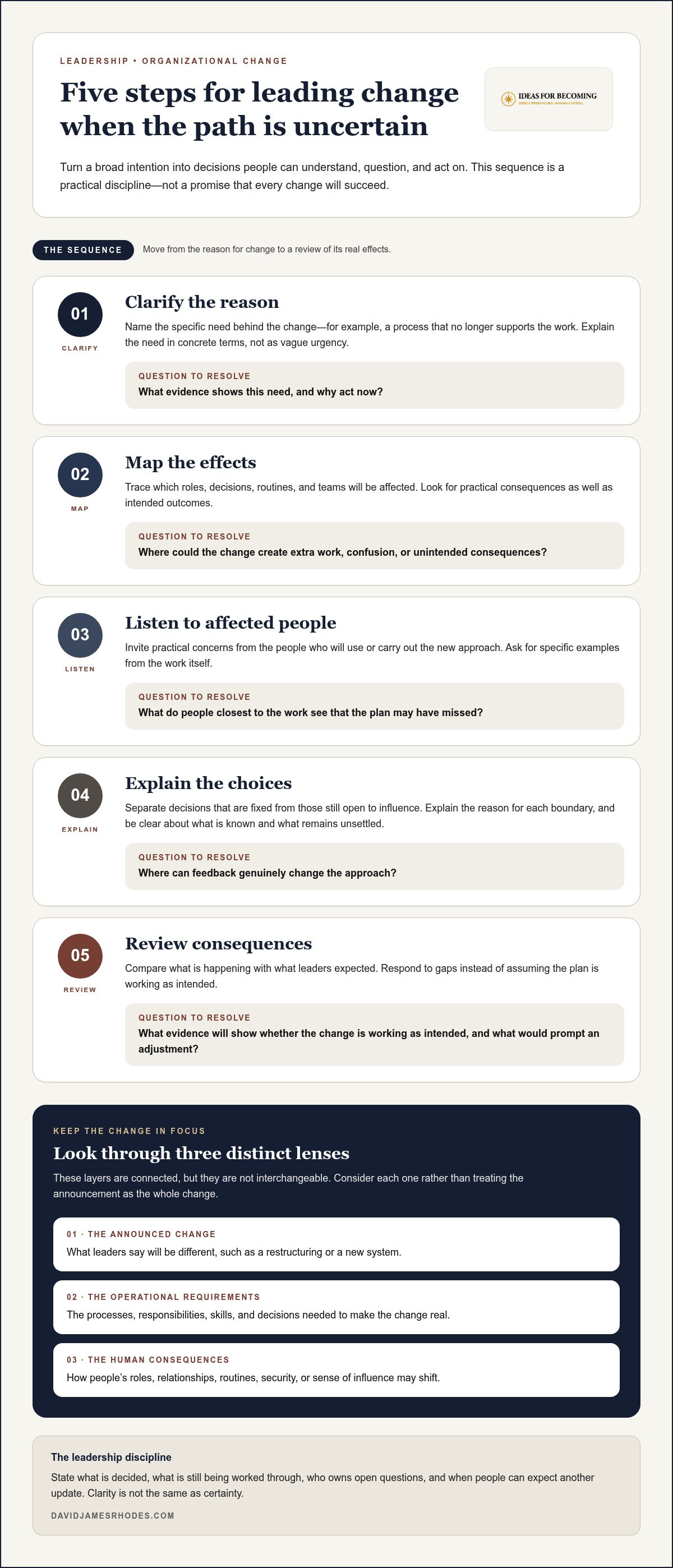
- The announced change: what leaders say will be different, such as a restructuring or a new system.
- The operational requirements: the processes, responsibilities, skills, and decisions needed to make the change real.
- The human consequences: how people’s roles, relationships, routines, security, or sense of influence may shift.
These layers are connected, but they are not interchangeable. An organization may announce a new technology while teams are still working out who will maintain it, which tasks will move, and how performance will be judged. An overview of change management describes the field’s broad, multidisciplinary scope. Leaders still need to examine what that scope means in their organization.
A sound strategy cannot settle every concern. It cannot, on its own, resolve competing priorities or show people exactly how decisions will affect their work. Leaders can give direction without claiming to know every answer. State what is decided, what is still being worked through, who owns the open questions, and when people can expect another update. Clarity is not the same as certainty.
What changes for people when an organization changes?
People may face altered roles, routines, relationships, authority, or expectations. The same change can feel like an opportunity to one group and a loss of influence to another. A new reporting structure, for example, may simplify accountability for executives while leaving a team unsure whose approval it needs to proceed.
Start with observable effects: which duties move, which decisions change hands, and what new skills or routines are required? Then separate those facts from assumptions about how employees will respond. Ask people what is changing in their day-to-day work, listen to specific examples, and follow up to see whether the anticipated effects match their experience. Leaders cannot infer confidence, fear, or support from a project plan.
Why do people question a change they did not choose?
People may question a change because familiar ways of working are ending, their influence feels reduced, or they cannot yet see how the decision affects them. Those questions are not automatically resistance or disloyalty. They may point to practical gaps leaders have not considered.
Trust grows when leaders explain what they know, acknowledge what they don’t, and act consistently with what they’ve said. That standard is demanding. It asks leaders to listen without treating every concern as an obstacle and to respond with evidence rather than reassurance alone. Leadership insights for navigating organizational change begin with this discipline: offer a clear purpose, stay honest about uncertainty, and take responsibility for the consequences of decisions.
How leaders guide change when the path is uncertain
Uncertainty does not excuse silence. It changes what good communication requires. Leaders need a sequence that turns a broad intention into decisions people can understand, question, and act on. These five steps keep attention on evidence and consequences. They are a practical discipline, not a promise that every change will succeed.
- Clarify the reason. Name the specific need behind the change, such as a process that no longer supports the work. Question to resolve: What evidence shows this need, and why act now?
- Map the effects. Trace which roles, decisions, routines, and teams will be affected. Question to resolve: Where could the intended change create extra work, confusion, or unintended consequences?
- Listen to affected people. Invite practical concerns from those who will use or carry out the new approach. Question to resolve: What do people closest to the work see that the plan may have missed?
- Explain the choices. Separate decisions that are fixed from those still open to influence, and explain the reason for each boundary. Question to resolve: Where can feedback genuinely change the approach?
- Review consequences. Compare what is happening with what leaders expected, then respond to gaps. Question to resolve: What evidence will show whether the change is working as intended, and what would prompt an adjustment?
This sequence makes leadership insights for navigating organizational change concrete. It also gives leaders a way to show how decisions were made, rather than leaving people to guess whether their concerns mattered.
How should leaders explain the reason for change?
Explain the organizational need in specific terms, not as vague urgency. If a new system is intended to reduce duplicated work, describe where duplication occurs and what is still being assessed. Say what is known, what remains uncertain, and when the next update will come. Don’t promise savings, improved performance, or a completion date unless evidence supports the claim and the organization can stand behind it.
How can leaders listen without surrendering responsibility?
Listening is a way to improve decisions, not a promise that every request will be adopted. Give affected people a clear way to raise operational concerns. Then distinguish feedback that can shape implementation from constraints leaders must uphold. Close the loop: summarize what you heard, what changed or did not, and why. This respects people’s contribution while keeping accountability with those responsible for the decision.
Evidence matters at every step. Treat forecasts as forecasts, assumptions as assumptions, and observed results as results. If leaders claim a change will reduce workload or improve service, they should be able to explain the basis for that claim and revisit it as implementation unfolds. For a wider perspective on leadership and human becoming, explore David’s leadership insights.
Which organizational change framework fits the challenge?
A framework can help leaders notice what a plan leaves out. It cannot guarantee that people will adopt a change or that the intended result will follow. Kotter, ADKAR, and Lewin direct attention to different parts of the work. Choose among them by considering the change’s scale, urgency, affected groups, and constraints, rather than assuming one model fits every situation.
| Framework | Focus | Useful context | Leadership emphasis | Limitations |
|---|---|---|---|---|
| Kotter’s 8-Step Process | Organization-wide change, from creating urgency and building a guiding coalition to sustaining progress. | Broad initiatives requiring visible sponsorship and coordinated action across groups. | Build alignment, communicate direction, remove barriers, and reinforce new practices. Kotter’s 8 steps outline the process. | Its sequence can appear more linear than real change, where leaders may need to revisit earlier work. |
| ADKAR | Individual adoption through Awareness, Desire, Knowledge, Ability, and Reinforcement. | Changes where people must understand, learn, and use a new way of working. | Identify which condition is missing for a person or group, rather than treating adoption as a single event. Prosci’s ADKAR model describes these elements. | Its individual focus may not, by itself, address organizational power, strategy, or wider structural barriers. |
| Lewin’s Change Management Model | Often summarized as unfreezing existing patterns, changing, then refreezing new ones. | A useful lens for asking what must loosen before a shift and what may help sustain it afterward. | Examine forces supporting or resisting movement, while attending to preparation and stability. | The familiar three-stage account is a simplification, and scholars have contested how faithfully it represents Lewin’s work. See Cummings, Bridgman, and Brown’s historical review. |
What does each change framework help leaders notice?
Kotter looks toward coordinated organizational movement. ADKAR brings the focus closer, to what people need to adopt a change. Lewin’s model draws attention to movement from established patterns toward new ones. These are useful distinctions, not settled predictions. A model can help frame questions, but evidence from the organization must guide conclusions about likely effects.
How should leaders choose or combine approaches?
Start with the problem the framework should help you see. For a company-wide restructuring, Kotter may help organize sponsorship and alignment. For a new process that requires employees to learn unfamiliar tasks, ADKAR may help leaders identify adoption needs. A Lewinian lens may prompt attention to habits or conditions that could keep the old approach in place. These examples illustrate fit, not guaranteed outcomes.
Combining models can be useful, but too many overlapping steps can make the work harder to understand. Use one shared sequence when it gives people clearer responsibilities and decisions. Leadership insights for navigating organizational change depend less on adopting the most elaborate framework than on using a suitable one with judgment. For a broader perspective on leadership and life advisory, consider how leaders’ choices shape both the work and the people asked to carry it forward.
What leaders can do before and during a change
Good intentions are not enough. People need information they can use, a way to raise concerns, and evidence that leaders follow through. Before choosing channels or drafting an announcement, identify who will carry the greatest consequences. A change that alters shift routines, for example, may need direct conversations with affected teams, not only an email written for office staff.
Prepare before announcing change
Map the affected roles, dependencies, unresolved decisions, and practical questions people are likely to ask. Align leaders on an explanation they can give truthfully, including what is still unknown. Then decide how employees can raise concerns and who will respond. Preparation does not mean anticipating every reaction. It means avoiding preventable confusion and making room to learn.
Communicate with a useful cadence
Choose a rhythm that fits the pace of decisions and the level of impact. Set a regular point for updates, even if the update is that a decision remains open. Make it clear how people can offer feedback, when leaders will review it, and where they will share the response. If a material decision changes between scheduled updates, communicate that change rather than waiting for the next routine message.
Use channels that reach the people most affected. A team with limited access to email may need a manager-led briefing and a place to ask questions directly. A written summary can still help everyone refer back to what was said. The channel matters because access matters.
Make decisions and explain their boundaries
Separate choices that are settled from choices people can still influence. For example, leaders may have approved a system change while still deciding how training or handoffs will work. Explain who owns those open decisions, what input can shape them, and when they will be revisited. Listening does not remove leadership accountability. It can reveal consequences leaders need to weigh before acting.
Responsible change communication explains the reason, names what is known and uncertain, reaches affected people through usable channels, invites feedback, and reports what leaders do next. Use this as a quick test before sending an announcement: can employees tell why the change is happening, what it means for them, and where their input can make a difference?
Review actions, not just announcements
After the change begins, compare the intended effects with what people experience. Review operational signs, such as missed handoffs or repeated questions, alongside feedback from affected teams. If the plan creates a burden leaders did not anticipate, acknowledge it and decide whether to adjust the process, support, or timing. Stated values become credible through visible choices, especially when those choices carry a cost.
Leadership insights for navigating organizational change are tested in this follow-through. A communication plan is useful only if leaders honor it. David James Rhodes offers leadership and life advisory for individuals and executives navigating growth, adversity, and the search for meaning. Explore leadership and life advisory.
Leading organizational change while becoming the leader it requires
Organizational change is measured in more than milestones. It also reveals how leaders use authority when decisions carry costs, information is incomplete, and people are watching what happens next. Character appears in ordinary choices: whether leaders tell the truth, listen without defensiveness, keep commitments, and accept responsibility when their judgment needs correction.
That doesn’t replace sound organizational execution. Leaders still need clear decisions, capable teams, realistic plans, and evidence about what is working. Reflection matters because it shapes how those responsibilities are carried out, not because good intentions can substitute for results.
What does responsible leadership look like when outcomes are unclear?
Responsible leadership combines humility with action. A leader can say, “We don’t know yet,” while still making the best decision available and explaining its basis. Humility is not indecision. It means being precise about uncertainty rather than disguising it as confidence.
Accountability continues after the decision. If the effects differ from what leaders expected, they should acknowledge the gap, examine its causes, and correct course where appropriate. That may mean changing a process, adding support, or reconsidering an assumption. The point is not to avoid mistakes at all costs. It is to avoid defending a mistake simply because it was announced with conviction.
How does The Way connect with leadership through change?
David James Rhodes writes from experience as a global executive and advisor, shaped by more than four decades across 156 countries. That experience offers a perspective, not scientific proof or a claim that every organization faces the same conditions. The practical work of leading change still depends on its context, the available evidence, and the people affected.
The Way is the philosophy of human becoming, not a change-management formula. Its central idea is that the way forward is not something a person simply finds; it is someone they become. That distinction speaks to leadership because change may test not only what a leader knows, but how they act under pressure. Explore The Way and human becoming as a guide to that larger question.
For leaders considering how their conduct connects with their wider responsibilities, David’s leadership and life advisory offers a perspective on integrating life and work.
Leadership insights for navigating organizational change can help clarify what to do next. The deeper question remains: Who are you becoming as you lead? The answer takes shape over time through decisions made, promises kept, consequences faced, and changes leaders are willing to make in themselves as well as in the organization.
Lead the change, and choose who you become
Organizational change involves more than a plan. It asks leaders to make decisions with care, speak honestly when answers are incomplete, and remain accountable for what follows. The strongest leadership insights for navigating organizational change are not a promise of certainty. They are a commitment to act with purpose while staying willing to learn and adjust.
That work reaches beyond organizational methods. It touches character: how you use authority, what you protect when pressure rises, and whether your actions match your words. The Way, David James Rhodes’ flagship guide to human becoming is available for readers considering that deeper question. It offers a philosophy, not a change-management formula.
Your next step need not be grand. Choose one decision you can explain more clearly, one consequence you need to understand better, or one commitment you must honor. Then ask yourself: who are you becoming through the way you lead?
Explore The Way and the question of who you are becoming. Read the guide and bring that question into the decisions you make each day.
Frequently Asked Questions
What are the signs that organizational change is working?
Look for evidence that the intended work is happening without unacceptable harm elsewhere. If a new process aims to reduce handoff errors, track those errors alongside delays, rework, and customer complaints. Compare results with a clear starting point, and check whether different teams experience different effects. Attendance at training or system logins may show activity, but they don’t prove the change is useful or sustainable.
How can leaders communicate when the outcome of a change is uncertain?
Separate confirmed decisions from open questions, then explain what information will help resolve each unknown. For example, a team testing a new service process might not yet know whether it improves response quality. Leaders can describe what is being observed, who will review the findings, and when they will share an update. Leadership insights for navigating organizational change depend on making uncertainty specific, rather than hiding it behind confident predictions.
What is change fatigue, and how can leaders respond to it?
Change fatigue is the strain people may feel when repeated or overlapping changes demand attention, learning, and adaptation without enough room to absorb them. Leaders can make the burden visible by listing active initiatives and identifying where the same teams are affected. Then sequence the work, remove lower-priority demands where possible, and make time for people to practise new routines. Fatigue is a signal to examine workload, not a character flaw.
Can leaders pause or reverse an organizational change?
Yes. Leaders can pause, adjust, or reverse a change when evidence shows serious unintended effects, key assumptions prove false, or essential conditions are missing. Before implementation, define what would trigger a review, such as rising errors or a disruption to a critical service. A pause should have an owner and a next decision point. Reversing course is not automatically failure; continuing despite clear harm may be worse.
How can employees contribute to organizational change when they are not decision-makers?
Employees can contribute by describing specific effects on the work: where a handoff breaks, which instruction is unclear, or what customers repeatedly ask. A concise example, its impact, and a possible adjustment are more useful than a general objection. Teams can also keep a shared record of issues and test approved changes in practice. Decision authority may sit elsewhere, but accurate information from daily work can improve decisions.
Should leaders use the same change approach for every organizational transformation?
No. A change affecting one team’s daily procedure may need a different approach from a merger, restructuring, or organization-wide technology shift. Consider the scope, urgency, affected groups, and how much decision-making is still open. A framework that helps leaders coordinate broad sponsorship may be less useful for a change centered on individual skill adoption. Keep the approach simple enough that people understand what is expected and where their input matters.
Frequently Asked Questions
Related Articles

Navigating Life Transitions: A Clearer Way Through Change
Navigating life transitions starts with seeing where you are. Learn practical ways to manage major change, find clarity, and decide who you are becoming next.

Overcoming Burnout for Executives: A Grounded Path to Sustainable Leadership
Overcoming burnout for executives requires more than rest. Discover a grounded approach to clarifying demands, setting boundaries, and leading sustainably.

Integrity in Global Leadership: What It Demands Across Cultures
How do you uphold integrity in global leadership across cultures? Discover practical ways to balance core principles, context, and character under pressure.