
The best inspirational speaker for senior management teams is one whose experience and message match the leadership challenge at hand. A strong speaker addresses the decisions leaders face, the culture they shape, and the responsibility they carry. Relevance matters more than a famous name.
A keynote can do more than fill a place on the agenda. It can give a leadership team a reason to pause, reconsider its assumptions, and return to work with greater clarity. That happens when the speaker’s perspective resonates with the people in the room.
This guide explains how to choose a speaker for senior leaders, which themes can serve a management audience, and what to consider when planning an engagement. Fees depend on the speaker’s experience, event format, preparation, and travel, and are provided after a quote request. The goal is not simply to find an impressive voice, but one who helps leaders reflect on who they are becoming and what their leadership makes possible for others.
Key Takeaways
- Choose a speaker whose experience and message address the leadership challenge your team is facing, not simply one with a prominent profile.
- Look for themes that can prompt honest reflection on accountability, workplace culture, courage, and difficult conversations.
- For events shaped by change or uncertainty, prioritize a speaker who can help leaders consider their responsibilities and next steps.
- Assess the speaker’s previous presentations and explain your event goals during the selection process to judge the fit.
- Fees vary with the speaker and event requirements; understand what the engagement involves before making a booking decision.
Accountability and workplace culture
Accountability shows in what leaders do after setting expectations. A speaker can help senior teams examine whether their daily decisions reflect the culture they want others to experience.
Accountability and High Performance
High performance depends on more than ambitious targets. Senior leaders must clarify ownership, follow through on commitments, and address missed expectations consistently. For example, when reviewing a delayed product launch, a leadership team can identify who owns the next decision, what support is needed, and when progress will be discussed. Look for a speaker who connects accountability to both standards and responsibility, rather than blame.
Tailoring to Leadership Goals and Culture
A useful presentation starts with the company’s actual priorities. Share the leadership goals, current pressures, and cultural behaviors the event should address. The speaker can then shape examples and discussion around those realities, such as rebuilding trust after a difficult decision or clarifying ownership across departments. This makes the message relevant to the leaders in the room, rather than a generic call to perform.
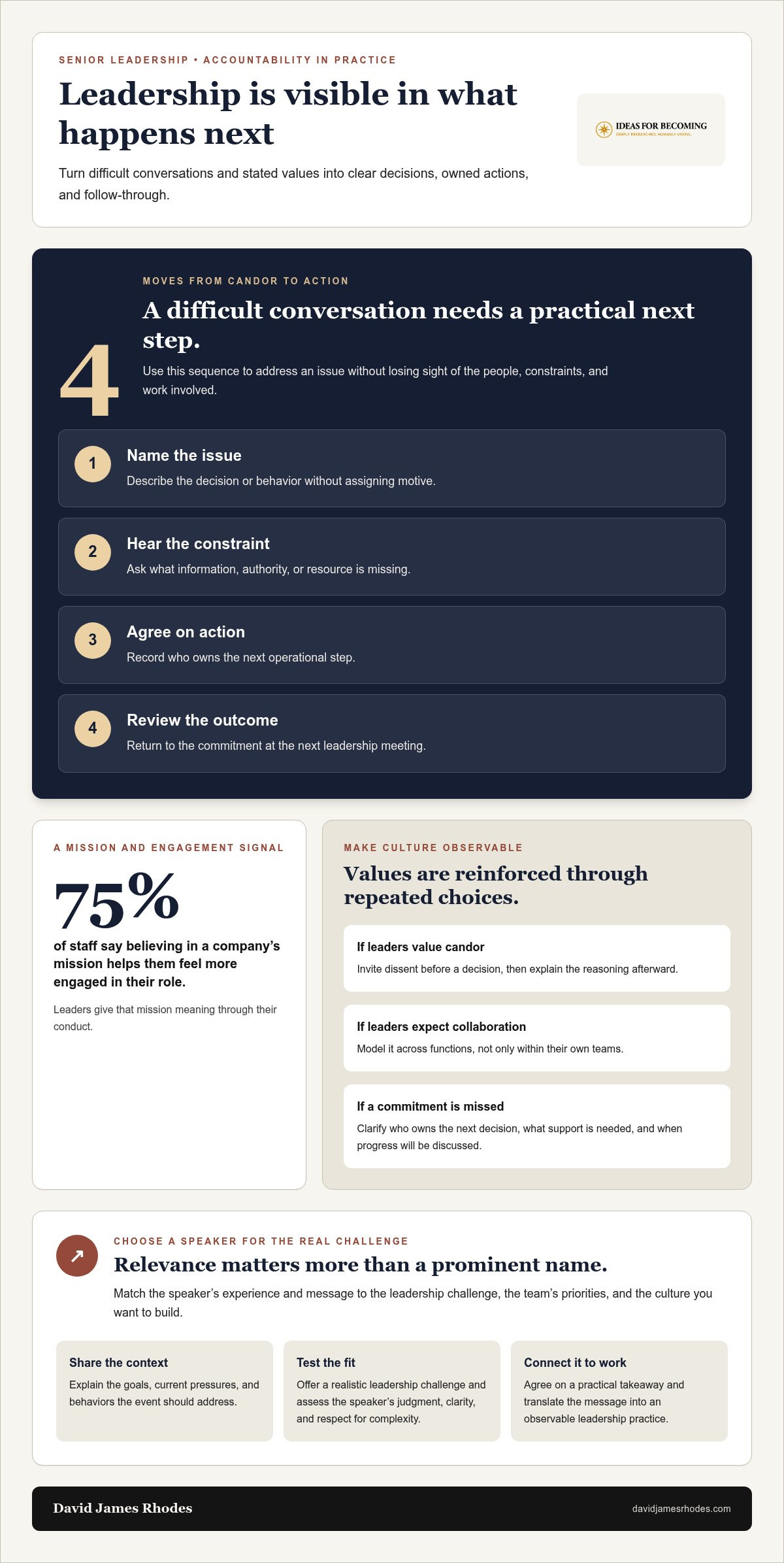
Culture is reinforced through repeated choices. If executives value candor, they need to invite dissent before a decision and explain the reasoning afterward. If they expect collaboration, they must model it across functions, not only within their own teams. One market fact offers context: 75% of staff say believing in a company’s mission helps them feel more engaged in their role. Leaders give that mission meaning through their conduct.
Before booking, identify one behavior the team should reconsider and one action it should take afterward. If accountability fades between strategy meetings, for example, ask the speaker to focus on turning commitments into visible follow-through. Agree in advance on the discussion and practical takeaway. A focused brief connects the presentation to company priorities without asking the speaker to endorse every existing practice.
Consider whether the speaker’s approach fits the culture you want to build. A story about overcoming setbacks may prompt reflection, but its value depends on how it connects to the team’s decisions. Watch a previous presentation and note whether the speaker treats responsibility with nuance. The right contribution should challenge senior leaders while respecting the complexity of their roles.
After the event, translate the message into a leadership practice. The team might record decisions, owners, and follow-up points at its next meeting. This makes accountability observable and gives executives a way to assess whether the culture they describe is becoming the culture their people experience.
Executive courage and difficult conversations
For executive leadership audiences, choose speakers whose experience speaks to decisions, responsibility, and consequences. General Peter Pace brings a military leadership perspective; he served as Chairman of the Joint Chiefs of Staff from 2005 to 2007. Earvin “Magic” Johnson offers a different lens, shaped by competition and achievement. He was a five-time NBA champion. These examples illustrate distinct perspectives, not a single model of leadership.
Courage at the executive level is often quieter than a dramatic speech suggests. It can mean telling a board that a strategy is failing, addressing conflict between senior colleagues, or acknowledging that a decision harmed trust. A speaker should help leaders examine why these conversations are difficult and how avoidance affects people and execution.
For example, a department head may repeatedly miss delivery commitments. The CEO can explain the impact, ask what is obstructing performance, and agree on a specific next step. This names the issue without turning the conversation into a public reprimand. A speaker can help leaders distinguish directness from aggression, and empathy from evasion.
To assess fit, give shortlisted speakers a realistic leadership challenge. Ask how they would address a room divided over a failed initiative or difficult restructuring. Listen for practical judgment, respect for complexity, and clear language. Previous presentations can also show how a speaker handles serious subjects in front of an audience.
Operations reveal whether leadership conversations lead to changed behavior. A presentation may prompt reflection, but execution requires decisions, owners, and follow-up. After a keynote, the team could choose an unresolved operational obstacle, name the person responsible for advancing it, and set a review point. This turns an abstract idea about courage into an observable task.
- Name the issue: Describe the decision or behavior without assigning motive.
- Hear the constraint: Ask what information, authority, or resource is missing.
- Agree on action: Record the owner and the next operational step.
- Review the outcome: Return to the commitment at the next leadership meeting.
These steps matter when a difficult conversation touches status or long-standing relationships. A leader who raises a concern should also accept scrutiny of their own choices. That reciprocity gives candor a practical foundation and helps teams address risk sooner, rather than letting silence shape the decision.
Choose a speaker whose examples hold up against the realities of executive work. A story should lead to a useful question or action, not simply admiration. For a management team, the measure is whether leaders leave better prepared to speak plainly, make decisions, and carry them through.
Leadership during change and uncertainty
During a merger, restructuring, or technology shift, leaders must act before every consequence is clear. A speaker can help executives examine how they communicate direction, make decisions, and respond when plans change.
Evaluate a speaker’s impact by setting a clear leadership objective before the event and observing specific actions afterward. If the goal is clearer communication during a restructuring, for example, assess whether executives explain decisions consistently and address unanswered staff concerns. A keynote cannot prove it caused every change, but agreed observations can show whether its ideas entered leadership practice.
Organizational change becomes difficult when leaders treat a plan as complete while employees still have unanswered questions. Consider a company introducing new software across departments. The executive team may understand the strategic case, while employees need to know how daily tasks, responsibilities, and support will change. A speaker should help leaders consider both the destination and the human experience of getting there.
For an event tied to a real transition, brief the speaker on its purpose, affected groups, known constraints, and decisions still ahead. Avoid asking for a speech that simply celebrates the initiative. Instead, ask for a perspective that helps leaders communicate what is settled, what remains uncertain, and how they will make the next decision. That distinction builds credibility.
A useful framework gives leaders actions they can apply in their next meeting:
- State the reason: Explain why the change is happening and what problem it addresses.
- Name the impact: Identify which teams, roles, or processes will change.
- Separate certainty from uncertainty: Tell employees what leaders know and what they are still deciding.
- Set the next update: Identify who will communicate and what information they will share.
These steps make communication more specific. A leader announcing a revised reporting structure, for example, can explain which decisions remain unchanged and where teams should direct concerns. This helps prevent silence from being mistaken for clarity.
Assess the event by comparing its stated objective with visible evidence afterward. Review leadership messages, meeting decisions, and the questions executives continue to hear. If the goal was stronger alignment, look for consistent explanations across departments. If leaders intended to address uncertainty, notice whether they distinguish known facts from open decisions. Record useful shifts as well as unresolved gaps.
Change also tests a leader’s identity. A chief executive may need to revise a public commitment when new information emerges. A thoughtful speaker can make that tension discussable without treating uncertainty as weakness. The practical measure is whether leaders leave prepared to explain their reasoning, hear concerns, and adapt responsibly as events unfold.
Speaker booking and fee ranges
Booking starts with the event’s purpose, audience, date, and preferred format. A leadership retreat seeking candid discussion needs a different plan from a conference keynote.
Speaker Booking Lead Times
Lead time depends on the speaker’s calendar, event date, travel needs, and preparation. Begin once the event purpose and likely date are clear. A company planning a leadership retreat, for example, can first settle the audience, location, and central challenge, then approach speakers with a focused brief. This gives both sides a practical basis for discussing fit and logistics.
Engagement Formats
A keynote gives the audience a shared message, making it useful for opening or closing a leadership gathering. A fireside chat lets a host explore specific questions in a more conversational exchange. A workshop gives participants time to apply ideas to a defined challenge. Choose the format by asking whether leaders need a common perspective, direct dialogue, or structured practice.
Speaker Fee Ranges
Speaker fees depend on experience, event format, preparation, travel, and engagement requirements. The price depends on the case and is provided after a quote request. Compare proposals by considering what each engagement includes, not only the fee. A tailored presentation and a short, focused appearance, for example, may involve different preparation and logistics.
Before requesting a quote, write a concise event brief. Include the date and location, audience, purpose, format, and leadership issue the speaker should address. If the team is navigating a merger, explain what executives need to communicate and which questions remain. Clear details help shape a relevant proposal.
Then assess the proposed engagement against the event’s actual needs. A keynote may suit a large leadership meeting where executives need a shared point of reflection. A fireside chat may work better when senior leaders want to explore a speaker’s experience through questions. A workshop is more useful when the goal is to practise a defined skill together.
Ask shortlisted speakers how they would approach the brief and what preparation they need. Watch a previous presentation to assess tone, clarity, and connection with an audience. A speaker who relies on broad inspiration, for instance, may not suit a meeting focused on a specific operational decision.
Confirm practical details in the booking agreement, including format, timing, travel arrangements, and preparation responsibilities. Assign one event contact to coordinate them. This keeps the speaker’s contribution aligned with the schedule and gives the organizing team a clear path from initial discussion to event day.
Motivational speaker fees
A speaker’s fee reflects the engagement being planned, not simply the time spent onstage. For a senior leadership event, the scope may include preparation, travel, a tailored keynote, or a conversation with executives. Compare the complete engagement with the event’s purpose and budget.
Start by defining what the organization needs. A company bringing leaders together after a difficult restructuring may need a speaker to address uncertainty and responsibility. A leadership summit focused on long-term direction may call for a different perspective. A clear purpose helps organizers assess whether the proposed contribution merits a place in the event.
Several factors shape the fee. The speaker’s experience and profile matter, as do the format, location, preparation, and requested participation. A keynote tailored to a company’s specific context may require different preparation from a standard presentation. Travel arrangements can also affect the engagement’s overall scope. Ask for a proposal that clearly explains the scope and related expenses.
Compare proposals on substance as well as cost. Consider what preparation is included, how the speaker will use the event brief, and whether the format suits the audience. A short keynote may suit a broad leadership gathering, while a fireside conversation may require a moderator and advance discussion of themes. Similar fees can cover different work.
- Clarify the goal: State what leaders should consider or do after the event.
- Describe the audience: Explain who will attend and what leadership decisions they face.
- Specify the format: Identify whether you are planning a keynote or a moderated conversation.
- Review the scope: Compare preparation, travel, event participation, and any additional requirements.
If an event asks a speaker to address a merger, provide relevant context and questions. Then assess whether the proposal includes enough preparation to make the presentation useful. If the brief remains broad, the proposed talk may be less tailored to executives’ concerns.
Budget decisions also involve opportunity cost. A leadership team might compare a speaker’s appearance with other event priorities, such as time for internal discussion. The better choice depends on the desired outcome. If leaders need a shared point of reflection, a keynote may fit. If they need to examine a live challenge together, another format may make better use of the gathering.
Bring the event date, location, audience, purpose, and preferred format into the initial fee discussion. A focused request makes it easier to understand what the engagement covers. To explore a keynote aligned with your leadership event, discuss keynote speaking.
David James Rhodes: The Way
The Way is David James Rhodes’s guide to becoming someone capable of finding a way forward through change, responsibility, and uncertainty. For senior leaders, its central question reaches beyond strategy: who are you becoming through the choices you make, and what do those choices make possible for others?
Turn to The Way when your team’s challenges call for more than a single event, or when you want to reflect on leadership as a practice of character and action. David’s keynote speaking and Leadership & Life Advisory offer related ways to explore these questions in a leadership context.
To discuss a leadership conversation or learn more, visit davidjamesrhodes.com.
Choose the Conversation Your Leaders Need
A leadership event can create a pause in the ordinary rhythm of decisions. Its lasting value comes from what leaders choose to do with that pause. Before booking an inspirational speaker for senior management teams, consider the conversation your organization has been postponing and the kind of leadership it now requires.
A speaker’s words cannot make those choices for your team, but they can offer a perspective that helps leaders see their responsibilities more clearly. Align the event with the question that matters most to your organization, then decide whether a keynote or a deeper advisory conversation best serves that purpose.
David James Rhodes brings leadership and human becoming into that work through keynote speaking, Leadership & Life Advisory, and The Way. Each offers a distinct way to reflect on character, responsibility, and the person a leader becomes through action.
Contact David James Rhodes to begin a conversation about your leadership event. Let the next step be thoughtful, purposeful, and grounded in the work ahead.
Frequently Asked Questions
How Do You Choose the BEST Speaker for Your Event?
Choose a speaker whose experience, subject, and style fit the event’s purpose. Start by identifying the decision or challenge you want attendees to consider. Then compare each speaker’s relevant experience, approach to audiences, and previous presentations. A leadership retreat focused on trust needs a different perspective from a company gathering centered on a new strategic direction. The right choice makes the event’s purpose clearer, not merely louder.
What makes an inspirational speaker effective for senior management teams?
An inspirational speaker for senior management teams is effective when their perspective respects executives’ responsibility for decisions, people, and consequences. Their message should offer insight leaders can apply to real situations. A speaker discussing resilience, for example, might connect it to how leaders respond after a failed strategy, rather than relying only on a personal triumph story. Credibility, relevance, and a clear connection to the audience’s work help the message resonate.
What topics do keynote speakers cover for senior management teams?
Keynote topics can include leadership character, accountability, workplace culture, courage, difficult conversations, change, and uncertainty. The most useful focus depends on the event’s purpose. A team navigating organizational change may need to examine how leaders communicate decisions and listen to concerns. An executive gathering focused on culture may benefit from exploring how senior leaders’ everyday choices influence employees’ experience. A focused theme gives the audience a shared point of reflection.
How much does it cost to hire an inspirational speaker in the United States?
The fee depends on the speaker’s experience, event format, preparation, travel, and engagement requirements. It is provided after a quote request. To assess the proposed cost, define what the event needs and review the full scope, including the presentation format and any requested participation. A tailored keynote for executives facing a specific challenge may involve different preparation from a standard presentation. Compare what each proposal includes, not just its total.
How do you choose the right speaker for a senior leadership event?
Choose an inspirational speaker for senior management teams by matching the speaker to leaders’ actual work and the event’s intended outcome. Consider whether the audience needs a fresh perspective on strategy, a challenging discussion about culture, or a personal account that prompts reflection. Ask the event team to name the leadership question they want attendees to carry forward. Then assess the speaker’s examples and delivery style against that question.
What questions should you ask a speaker before booking?
Ask how the speaker would approach your event’s purpose, what preparation they need, and how they adapt examples for senior leaders. Clarify the proposed format, timing, travel arrangements, and what the engagement includes. You can also ask how they would handle a sensitive theme, such as a failed initiative or disagreement among executives. These questions reveal whether the speaker understands the context and can shape a meaningful contribution around it.
How far in advance should you book a keynote speaker for a corporate event?
Begin planning as soon as the event date, purpose, and likely format are clear. The time required depends on the speaker’s schedule, travel arrangements, and the preparation your event needs. A keynote tied to a company transition, for example, may require a detailed brief and a conversation with organizers. Starting early gives you more room to align the speaker’s contribution with the event, coordinate logistics, and prepare the audience.
What are the risks of hiring a speaker who is not a good fit for senior executives?
A poor fit can leave executives with a message that feels generic, disconnected, or out of step with their responsibilities. A speaker who oversimplifies a complex challenge may lose the room’s trust. A presentation that entertains without serving the event’s purpose can also consume valuable time without giving leaders a useful idea to carry forward. Review previous presentations and discuss the audience’s context to reduce these risks before deciding.
Frequently Asked Questions
Related Articles

Executive Guidance on Ethical Leadership Principles for Building Trust
Executive guidance on ethical leadership principles shows how honesty, fairness and accountability build trust, credibility and guide everyday decisions.

Purpose-Driven Life Advisory for Professionals: Work With Purpose
Purpose-driven life advisory for professionals connects your values to leadership and daily work, helping you pursue meaningful goals and lasting fulfillment.

Mentorship for Aspiring Global Leaders: Track Outcomes and Impact
Mentorship for aspiring global leaders builds practical skills and sound judgment. Learn to set goals, make cross-cultural matches, and assess impact.