
Global teams don’t become inclusive simply by working across borders. An international leadership insights speaker can help when your people need a clearer understanding of how culture shapes trust, communication, and leadership. A useful perspective prompts teams to examine their assumptions and turn differences into better-informed decisions.
A leadership message needs to feel relevant to the people hearing it. Experience matters, but so does the ability to connect global insight with your team’s realities. The goal is not inspiration for its own sake. It is a more thoughtful conversation about how people lead together.
This article explains what to look for in a speaker’s background, what can influence speaking fees, and how a well-matched keynote can support inclusive, cross-cultural leadership. It also explores how a speaker can help your team move from good intentions to more deliberate choices.
Key Takeaways
- Match a speaker’s regional and professional experience to the decisions your global team is facing.
- Look beyond a résumé: consider how a speaker turns lived leadership experience into practical insight for your audience.
- Understand which event and preparation needs shape speaking fees, then align the format with your goals and budget.
- Build trust across cultures by noticing how leadership behaviors can be interpreted differently in different contexts.
- Use inclusive leadership as an ongoing practice, grounded in emotional awareness, shared responsibility, and deliberate action.
Why Book a Global Leadership Speaker?
A leadership keynote can give executives working across cultures a shared point of focus. Its value depends on the questions your team needs to address and the actions it can take afterward.
Leadership Guides and Keynotes
A leadership guide gives readers time to examine an idea at their own pace. A keynote brings related ideas into a live conversation, where examples and audience questions can make them immediate. The formats serve different purposes: a guide supports reflection before or after an event, while a keynote engages a room around a specific challenge. Consider whether the speaker’s central ideas translate clearly across both formats.
Keynote Benefits and Speaker Selection
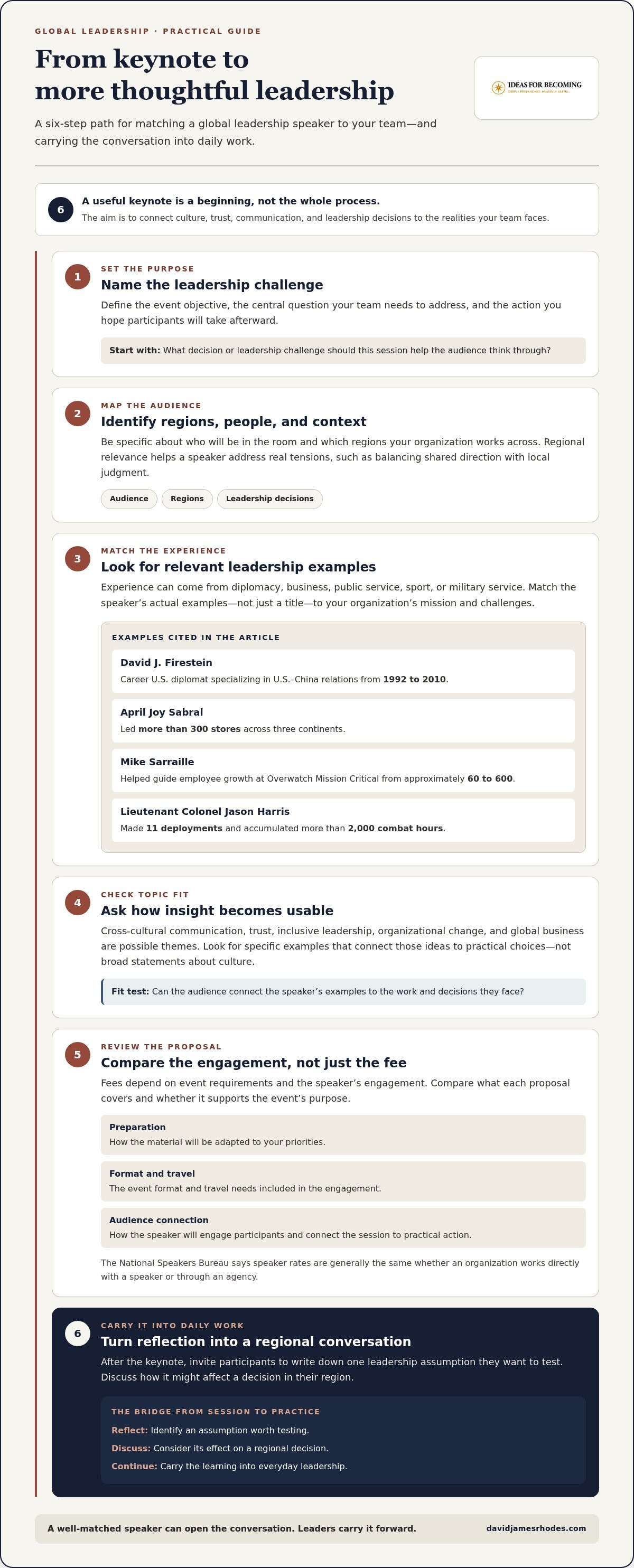
A keynote can give an executive team shared language for discussing leadership, diversity, and decisions across regions. The National Speakers Bureau says leadership speakers can tailor presentations to an organization’s needs and goals. To find and book a global leadership speaker, define the event’s objective, identify the regions and audience, then assess the speaker’s relevant geopolitical experience and topic fit. Request a proposal that connects the presentation to those priorities.
The International Speaker’s Role
An international leadership insights speaker connects leadership experience with the realities of working across borders. The role is not simply to describe different cultures; it is to help an audience consider how context affects communication, trust, and decisions. The National Speakers Bureau defines a leadership speaker as a professional who draws on experience, expertise, and skills to help others become more effective leaders. Look for examples that make those ideas usable.
Regional relevance matters. A speaker whose experience aligns with your organization’s markets can address the tensions leaders actually face, such as balancing a shared direction with local judgment. Before booking, identify the regions your team works across and the leadership decisions that feel difficult. Compare those needs with the speaker’s experience and proposed examples. A compelling story is not enough if the audience cannot connect it to its work.
Fees depend on the event requirements and the speaker’s engagement, including preparation, format, and travel needs. National Speakers Bureau says speaker rates are generally the same whether an organization books directly or through an agency. Rather than choosing on fee alone, compare what each proposal covers and whether the keynote supports the event’s purpose. Ask how the speaker will adapt the material, engage the audience, and connect the session to practical action.
After the keynote, make reflection part of the event rather than an afterthought. Invite participants to write down a leadership assumption they want to test, then discuss how it might affect a decision in their region. This creates a bridge from a shared session to individual practice. A well-chosen speaker can open the conversation; leaders still need to carry its lessons into daily work.
Speaker backgrounds and leadership experience
A speaker’s background matters when it helps your audience make sense of real leadership choices. Match that experience to your organization’s mission, regions, and current challenges.
International Leadership Experience
International leadership experience can come from diplomacy, business, public service, or work across national cultures. David J. Firestein served as a career U.S. diplomat specializing in U.S.-China relations from 1992 to 2010. That experience offers a concrete lens on international relations, negotiation, and leadership across different systems.
For global business and cross-cultural teams, look for speakers whose examples relate to the regions and decisions your people face. Topics may include communication, trust, change, inclusion, and leading across borders. Ask how the speaker connects those themes to practical choices rather than broad statements about culture.
Global Business and Cross-Cultural Expertise
Some speakers bring direct experience leading organizations through growth or change. April Joy Sabral led more than 300 stores across three continents, while Mike Sarraille helped guide Overwatch Mission Critical’s employee growth from approximately 60 to 600. These examples show different leadership contexts. Consider which best reflects your organization’s scale, mission, and dynamic.
The subject matter should also fit the event. Before booking, identify the audience, the central leadership challenge, and the action you want participants to take afterward. Then assess whether the speaker can address those priorities with relevant examples, including how diverse teams work toward a shared vision.
Which international leadership speakers specialize in global business and cross-cultural teams? Speakers with relevant experience in international business, diplomacy, or multinational leadership can address those needs. David J. Firestein’s U.S.-China diplomatic work is one example of a background tied to cross-cultural engagement.
Leadership experience also comes from sport and military service, but the story needs to fit the audience. An Olympic athlete’s experience may illuminate preparation, teamwork, and responding under pressure; military leadership may offer examples involving mission, accountability, and coordinated action. Assess the speaker’s specific examples, not the title alone. Lieutenant Colonel Jason Harris, for instance, made 11 deployments and accumulated more than 2,000 combat hours.
What topics do international leadership speakers cover? Common subjects include global business, cross-cultural communication, inclusive leadership, organizational change, and building trust. The right fit depends on your event’s purpose and the questions your audience needs to explore.
Can international leadership speakers deliver virtual or in-person events? Both formats are used for leadership events. Choose based on how participants will engage, the event’s format, and whether the speaker can adapt examples and audience interaction accordingly.
Speaker fees and booking support
Plan the budget around the full event, not the keynote alone. A speaker’s fee depends on the engagement and is provided after a quote request; factors include format, preparation, travel, and customization. A virtual address and an in-person appearance create different planning needs. Define the event’s purpose first, then request a proposal that explains the scope and responsibilities.
National Speakers Bureau says speaker rates are generally the same whether an organization books directly or through an agency. That makes the proposal’s detail more useful than assumptions about booking routes. Compare what each arrangement covers: presentation length, preparation conversations, audience engagement, and travel coordination. An author may bring developed ideas to a keynote, while a tailored presentation connects those ideas to the organization’s mission.
Booking support is a collaboration, not simply a calendar reservation. Give the speaker a concise event brief with the audience, format, central challenge, and desired action. An executive gathering focused on innovation, for example, may need a different emphasis from a leadership event about organizational change. Agree on who supplies event details, coordinates logistics, and determines how the speaker will engage participants.
International travel introduces practical risks. Flights can be delayed, plans can change, and visa or entry arrangements can affect an in-person appearance. Cancellation terms matter too: document how schedule changes, cancellations, and related expenses will be handled before confirming the engagement. Assign responsibility for travel coordination and prepare a contingency, such as a virtual format, if travel becomes impractical.
Consider the event format early. A virtual keynote can simplify travel coordination, while an in-person session may support direct conversation with attendees. The choice depends on audience participation, event objectives, and the speaker’s ability to adapt the presentation. For a dispersed team, decide how questions will be gathered and answered. For a live gathering, make time for discussion that turns ideas into action.
Use a clear booking sequence to reduce ambiguity:
- Define the audience, event purpose, format, and desired outcomes.
- Share the brief and request a proposal describing preparation and presentation scope.
- Review the fee, travel arrangements, cancellation terms, and responsibilities together.
- Confirm the schedule, communication plan, and contingency format in writing.
These steps help organizers make a deliberate decision and give keynote speakers a clearer path to prepare. They also protect the event’s purpose: strong collaboration should leave the audience with usable ideas, not uncertainty about logistics. Responsibility is shared, but organizers can make expectations clear before the event begins.
Building trust in multicultural environments
Trust is built through behavior, but cultural context shapes how that behavior is interpreted. In a global team, a leader’s intention and a colleague’s experience may differ. That gap matters. It can influence whether people share concerns, challenge a proposal, or commit to a decision.
Bjørn Ekelund’s research compares leadership behaviors across cultural contexts and highlights a difficult truth: actions that build trust in one culture may erode it in another. Direct feedback, for example, may feel clear to one colleague and unnecessarily harsh to another. The lesson is not to label people by culture. It is to notice how a specific behavior affects a particular team.
Leaders can start with a practical distinction: separate intent from impact. If you assume silence means agreement, test that assumption instead of treating it as fact. A participant who says little during a meeting may still have a serious concern. Invite written input after the discussion, then make space to hear it before decisions become final.
Use these steps to make trust visible in daily work:
- Describe the behavior you observed, without assigning a cultural motive.
- Ask how the interaction affected the person or team.
- Agree on a specific adjustment, such as pausing for questions after a proposal.
- Revisit the agreement during the next project review.
A regional team, for example, may interpret quick agreement as a sign that a decision is settled. Another group may expect open debate before commitment. A leader can clarify the process: invite objections, explain how input will be weighed, and state when the decision becomes final. This reduces guesswork without asking anyone to abandon their cultural identity.
An international speaker can help teams examine these moments through relevant examples and questions. The aim is not to provide a universal script, but to help leaders notice patterns, test assumptions, and adapt with care. A useful session connects ideas to action, giving participants a shared way to discuss trust without reducing colleagues to stereotypes.
Trust also depends on consistent follow-through. If a manager promises to respond to a concern, the next step is to report what happened, even when the answer is difficult. That visible responsibility can matter more than a statement of passion or inclusion. Teams learn whether a leader’s words carry weight through repeated choices, especially when disagreement has a cost.
For a global organization, this work is ongoing. Review how decisions are made, whose perspectives shape them, and whether people can raise concerns safely. Small changes, such as inviting dissent before approval, can make cultural differences easier to discuss. The deeper test is whether the team can adapt its habits while preserving mutual respect.
Emotional intelligence and inclusive leadership
Inclusive leadership is visible in the choices a leader makes when people disagree. Harvard Business Review identifies emotional intelligence and inclusive leadership as skills needed for the future of work. For a founder leading a diverse team, that means noticing whose ideas shape the strategy and who remains unheard.
Emotional intelligence begins with attention, not performance. A leader who notices frustration in a meeting can pause before responding, ask what concern lies beneath it, and make room for a considered answer. That pause can foster trust. It does not remove disagreement; it gives people a way to address it without dismissing one another.
Leadership is also relational and developmental. Leaders and followers shape the direction and impact of their work through their interactions, and both share moral responsibility. An executive’s decision may set a course, but team members help reveal its consequences. Inclusive practice therefore requires listening beyond the senior voices in the room.
A practical meeting strategy can make participation more deliberate:
- Share the question or decision in advance, so people can prepare their views.
- Invite contributions before the most senior person speaks.
- Ask whose perspective may be missing, without putting anyone on the spot.
- Summarize what the group heard and explain how input will inform the decision.
These actions matter in a global team because communication styles differ. One colleague may disagree directly, while another may express reservations more carefully. Leaders should avoid treating one style as the measure of commitment. They can ask follow-up questions, reflect back what they heard, and invite correction before deciding.
Development should extend beyond an executive offsite. Harvard Business Review identifies emotional intelligence, digital adaptability, and inclusive leadership as important skills for the future of work. Teams can practise these through meeting routines, feedback conversations, and reflection after a difficult decision. A short podcast discussion can introduce an idea; applying it in the next team conversation makes it practical.
For a speaker, the test is whether the message equips people to act. A useful keynote can give leaders language for noticing exclusion, responding with courage, and sharing responsibility for the team’s direction. The speaker should connect the concept to recognizable moments, such as whose proposal gets attention or how a manager responds to dissent.
Leaders can carry the work forward by choosing one behavior to practise, then revisiting its effects with their team. To explore leadership perspectives grounded in personal growth and responsibility, explore leadership insights for your team.
David James Rhodes: The Way Guide
The Way is David James Rhodes’s guide to human becoming: the choices, habits, and character through which people shape a life and lead others. It offers a wider lens for readers who want leadership to mean more than managing outcomes. The central question is personal and practical: Who are you becoming?
For teams seeking a live conversation about leadership, Keynote Speaking can bring these ideas into the room. Leadership & Life Advisory and Education & Next Generation Advisory offer related perspectives for leaders and emerging generations. Turn to these when your aim is to connect leadership decisions with responsibility, growth, and the people affected by them. The Way is available now.
To explore David James Rhodes’s work, visit davidjamesrhodes.com.
Choose the Leadership Conversation Your Team Needs
The next step is not simply to fill a place on the event agenda. Decide what conversation your team needs to have and what leadership behavior should follow. An international leadership insights speaker can bring attention to the questions that shape how people work across cultures. The lasting value, however, comes from what leaders choose to practise afterward.
Give that choice a clear beginning. Name the challenge, the audience, and the kind of reflection you hope to invite. Then consider whether a keynote or a deeper leadership conversation best serves that purpose. A thoughtful event can create space for people to examine their assumptions and take responsibility for how they lead together.
David James Rhodes’s work connects leadership with the larger question of human becoming: who are you becoming through the choices you make? If you’re considering a speaker or leadership conversation for your team, contact David James Rhodes to discuss your event. The work of leadership continues after the room empties. Begin with one deliberate choice, and let it shape what comes next.
Frequently Asked Questions
Can speakers tailor their presentations to your event?
Yes. Give the speaker a clear picture of who will be in the room and what they already understand about the subject. A session for newly appointed managers, for example, may need different language from one for senior executives. You can also ask how the speaker will make room for audience questions and help participants connect the discussion to their responsibilities.
How do international keynote speakers translate geopolitical risks into corporate strategy?
They can help leaders turn a complex issue into decisions the organization can examine. Start by separating the geopolitical development from its possible effects on customers, partners, or operations. Then identify what would prompt a change in course, who would assess the signal, and which leaders would decide the response. This supports strategic thinking without treating a speaker’s interpretation as a prediction.
What are the costs associated with hiring a leadership speaker?
The speaker’s fee is only one part of an event budget. Organizers may also need to account for venue costs, audiovisual production, and internal staff time. Keep those event expenses separate from the speaker’s engagement fee to make the budget easier to understand. The fee for a particular engagement is provided after a quote request and depends on its scope.
Who are the top international leadership speakers in the United States?
“Top” depends on the subject and audience, rather than one universal ranking. Isabel Aguilera was named by Fortune among its 50 most influential executives in the world. Ambassador Liliana Ayalde served as civilian deputy to the commander and foreign policy advisor for United States Southern Command from January 2017 to September 2019. These are distinct examples, not a definitive ranking.
How much does it cost to hire an international leadership speaker in the US?
There is no single U.S. fee for every international leadership engagement. A specific amount is provided after a quote request, based on the engagement’s scope. For a sound comparison, ensure each proposal describes the same kind of session and level of service. That way, you can judge the value and fit of each engagement rather than compare mismatched assumptions.
What should I look for when comparing leadership speakers?
Look for a clear connection between the speaker’s central idea and the leadership question your audience faces. Notice whether the speaker distinguishes personal experience from established evidence and gives enough context to understand examples. Review a sample of the speaker’s work and consider whether its reasoning feels precise, fair, and relevant to your audience.
What questions should I ask before hiring a leadership speaker?
Ask how the speaker handles disagreement, cultural differences, and audience questions that challenge the presentation. You might also ask whether participants can submit questions privately, helping surface concerns they may not raise in public. Clarify how the speaker avoids reducing a culture to a stereotype. These questions reveal whether the session can create space for honest discussion.
Frequently Asked Questions
Related Articles

Executive Guidance on Ethical Leadership Principles for Building Trust
Executive guidance on ethical leadership principles shows how honesty, fairness and accountability build trust, credibility and guide everyday decisions.

Purpose-Driven Life Advisory for Professionals: Work With Purpose
Purpose-driven life advisory for professionals connects your values to leadership and daily work, helping you pursue meaningful goals and lasting fulfillment.

Mentorship for Aspiring Global Leaders: Track Outcomes and Impact
Mentorship for aspiring global leaders builds practical skills and sound judgment. Learn to set goals, make cross-cultural matches, and assess impact.