
Leadership keynote fees vary with a speaker’s experience, public profile, event format, and preparation. A keynote speaker for emerging generation leaders should bring more than a generational label: look for a perspective that helps people understand one another and work together.
A keynote can capture attention, but its value lies in what people do with the ideas afterward. When planning a session on Generation Z, consider the speaker’s judgment, experience, and ability to address your organization’s real concerns, not just the topic label.
This article explains what shapes keynote fees, how to compare speakers’ perspectives, and what to consider when choosing someone for your audience. It also looks at how a keynote can begin a useful conversation about leadership, collaboration, and who your organization is becoming.
Key Takeaways
- Assess a keynote’s value by its fit with your audience, event goals, and the preparation needed to make the message relevant.
- Choose a Gen Z-focused talk for a specific audience need; consider a broader generational keynote when stronger collaboration across age groups is the goal.
- Look beyond a speaker’s profile. Compare their lived and professional experience, the perspective they bring, and how they tailor the presentation.
- Before selecting a speaker, define what attendees should understand or do differently after the event, then look for practical takeaways that support that aim.
- Consider whether your organization needs a single keynote or a deeper conversation about leadership, growth, and who people are becoming.
How much does a leadership keynote speaker cost?
A leadership keynote fee depends on the event and is provided after a quote request. Key factors include format, audience, travel, preparation, and customization. An address for emerging leaders may call for different examples from a session for senior executives. Defining the event’s purpose helps clarify the scope.
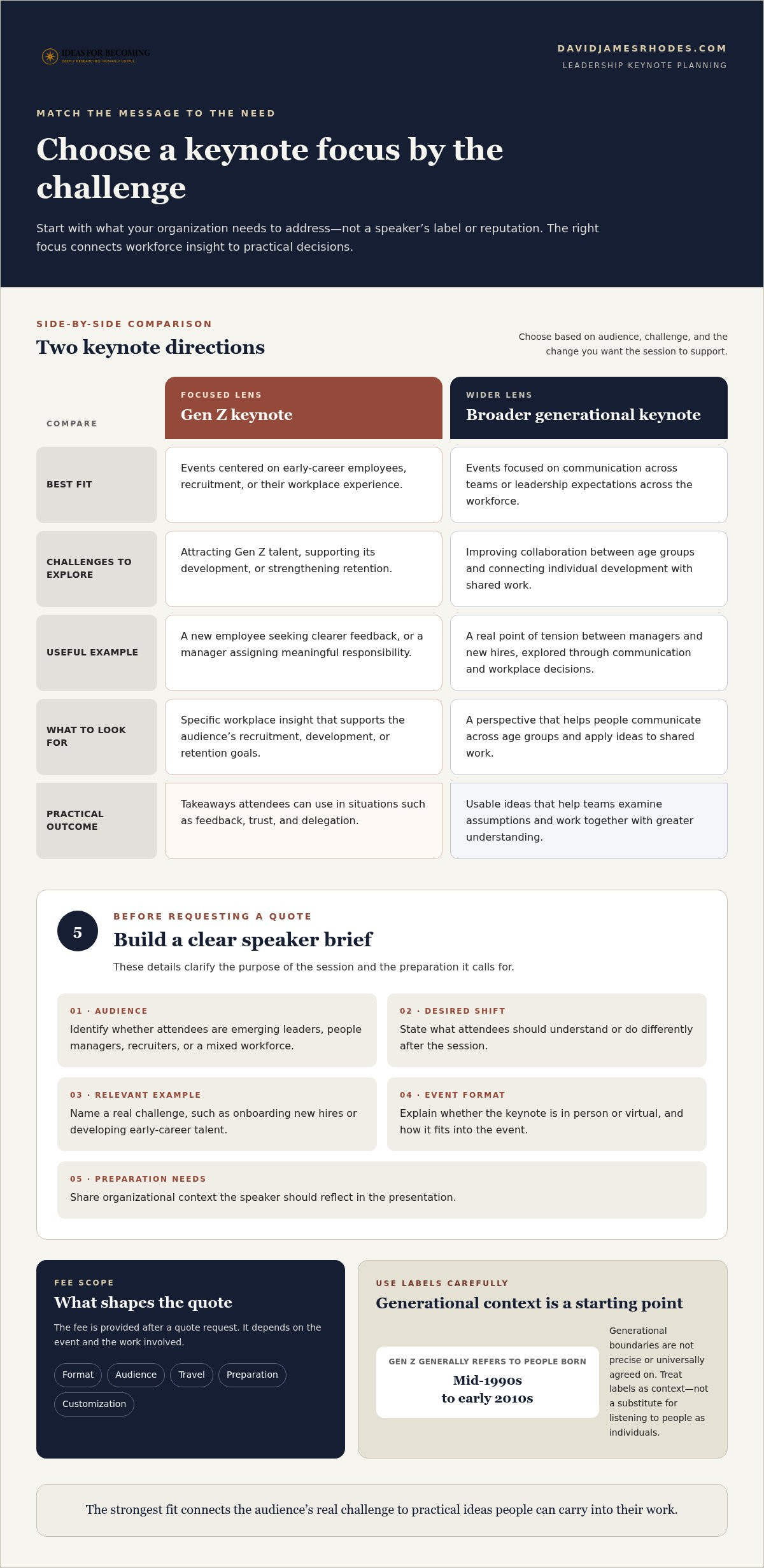
Cost is only one part of the decision. A keynote can help leaders examine how they engage and develop the next generation of talent. Generation Z generally refers to people born between the mid-1990s and early 2010s. That range can help frame a discussion, but it doesn’t explain any individual’s abilities, expectations, or ambitions. A useful speaker moves from broad insights to specific workplace situations, such as a new employee seeking clearer feedback or a manager assigning meaningful responsibility.
Start by naming the challenge behind the event. Are you aiming to attract Gen Z talent, support its development, or strengthen retention? Each goal calls for a different focus. Recruitment may benefit from an honest account of the work and growth available. Development may call for practical approaches to feedback, trust, and delegation. Retention means examining whether everyday decisions reflect the organization’s stated values.
A clear keynote brief helps define both the purpose and the work involved. Before requesting a quote, write down:
- Audience: Identify whether attendees are emerging leaders, people managers, recruiters, or a mixed workforce.
- Desired shift: State what attendees should understand or do differently after the session.
- Relevant example: Name a real challenge, such as onboarding new hires or developing early-career talent.
- Event format: Explain whether the keynote is in person or virtual, and describe its place in the event.
- Preparation needs: Share organizational context the speaker should reflect in the presentation.
These details help distinguish a tailored keynote from a general talk and keep the conversation centered on what the organization needs. If team effectiveness is a priority, ask how the session will connect individual development with shared work. A talk about feedback, for example is more useful when managers and emerging leaders can apply its ideas in their next one-to-one conversation.
Generational language can start a discussion, but it can also limit it. Pew Research Center notes that generational boundaries aren’t precise or universally agreed on. Treat labels as context, not a substitute for listening. A useful keynote helps leaders understand workforce expectations, engage people as individuals, and identify a practical next step in talent development.
Who are the top generational speakers in 2026?
Names are a starting point, not a ranking that applies to every event. Choose based on whether the audience needs focused insight into Gen Z or a broader conversation across generations.
Gen Z-Focused or Broader Generational Keynotes
Choose a Gen Z-focused keynote when the event centers on early-career employees, recruitment, or their workplace experience. Choose a broader generational keynote when the challenge is communication across teams or leadership expectations across the workforce. Match the speaker’s focus to the audience and desired outcome, then look for practical takeaways attendees can use.
Matching a Speaker to the Challenge
Start with the organization’s challenge, not a speaker’s reputation. A conference about tension between managers and new hires, for example, calls for a different focus from an event developing emerging leaders. Look for someone able to tailor the presentation and offer usable insights. A bestselling author may attract attention, but relevance to the audience is the stronger test.
Finding Emerging-Leader Speakers in the United States
In the United States, event planners can find candidates through speaker directories, keynote bureaus, professional associations, and speakers’ own websites. Compare each person’s stated expertise, event experience, and sample materials. Then consider how directly they address your organization’s challenge. Pew Research Center cautions that generational boundaries aren’t precise or universally agreed on, so assess broad claims carefully.
These names represent different perspectives. The right fit depends on the event’s purpose and audience, and on how well the speaker connects generational insight to specific workplace decisions.
Booking takes practical planning, too. The guide recommends arranging top leadership keynote speakers six to twelve months ahead. For live events, it recommends booking celebrity-tier speakers Simon Sinek, Brené Brown, and Adam Grant nine to twelve months ahead. These are planning windows, not a substitute for assessing fit. Brief the speaker on the audience, challenge, and what attendees should carry into their work.
A speaker should offer more than inspiration during a conference. A useful keynote helps people examine assumptions, communicate across age groups, and act with greater understanding. Moving from labels to shared responsibility makes the conversation relevant beyond the stage.
Keynote speaker fees and investment ranges
Virtual keynote speakers can be effective for emerging leaders when the session is designed for online participation. A clear purpose, relevant examples, and structured interaction matter more than delivery format alone.
Fees for Live and Virtual Events
A keynote fee depends on the event and is provided after a quote request. Format, travel, preparation, audience size, and customization shape the scope. A live corporate conference may involve travel and coordination with the event team, while a virtual session may need examples and interaction adapted for a screen. The format changes the work, not the need for relevance.
To assess a virtual keynote, decide how emerging leaders will participate. Organizers might include moderated questions or a prompt tied to a current workplace challenge. Consider the speaker’s ability to engage people online alongside their subject knowledge. Ask how the presentation will connect its ideas to the audience’s work, rather than relying on polished delivery alone.
Speaker profiles vary, too. An emerging thought leader, established author or former executive, and celebrity speaker bring different experience and public recognition. An author may draw attention, while a practitioner may offer examples from direct leadership experience. Compare the perspective and preparation your event requires, then assess each candidate against the reason for gathering.
Fees and Event Budgets
Build a useful budget around the event’s purpose, not the biggest name available. Separate the keynote’s scope from other needs, such as venue, production, travel, and audience support. Match the speaker’s background and preparation to the conference objective. A session on collaboration across teams may need a different perspective from one focused on a leadership transition.
Prepare a concise brief before requesting a quote. Include the format, audience, central challenge, desired message, and organizational context the speaker should reflect. This clarifies the scope and helps prevent a mismatch between the session promised and the one required. A request focused only on a famous name leaves the most important decision unresolved.
For an emerging-leader event, assess the investment against how the keynote will be used. Will attendees leave with a way to approach a difficult conversation, a clearer sense of their responsibilities, or shared language for collaboration? These outcomes help planners compare proposals without treating celebrity or broad popularity as proof of value.
Make the decision in sequence: define the audience, set the event’s purpose, compare relevant speaker backgrounds, and clarify preparation needs. A fee only makes sense in relation to that scope. The measure is not simply the attention a speaker attracts, but whether the address serves the work your organization needs to do.
Leadership keynote speaker selection criteria
Choose a speaker based on what your audience needs to do after the event. A keynote speaker for emerging generation leaders should clarify that work, not rely on broad claims about age or leadership.
Assessing Keynote Speakers
Assess each candidate against your organization’s leadership challenge. A speaker addressing first-time managers, for example, should connect their perspective to decisions those managers actually face. Event planners are advised to select a generational speaker who customizes the presentation and provides practical takeaways attendees can use immediately. Look for a clear connection between the speaker’s experience, the event’s purpose, and the audience’s responsibilities.
Use these criteria to compare candidates:
- Relevance: Does the speaker address the event’s purpose and audience?
- Experience: Can the speaker explain how their background informs the topic?
- Customization: Will the presentation reflect your organization’s challenges?
- Practical value: Can attendees apply the strategies after the event?
- Delivery: Does the speaker communicate clearly with this audience?
An author’s reputation may draw attention, but it doesn’t establish fit. Review the proposed themes and examples. A talk about innovation, for instance, should connect new ideas to leadership choices attendees can influence. Consider whether the speaker can make those ideas relevant to the roles represented in the room.
Questions Before Booking
Ask the speaker, “How will you adapt this keynote to our audience?” Request an example of how the session could reflect your organization’s priorities. Then ask what practical strategies attendees will take away and how they can use the ideas beyond the event. A keynote speaker for emerging generation leaders should explain that connection plainly.
Clarify the session’s purpose before comparing proposals. Is the event meant to develop emerging leaders, improve collaboration, or prompt reflection on organizational change? Ask how the speaker’s perspective supports that aim. A focused answer connects the content to the challenge instead of relying only on broad claims about inspiration.
Discuss preparation, too. Share the event context and audience needs, then ask what information would help shape relevant examples. Confirm the format, session length, and opportunities for audience questions as part of the event plan. These details define the work and reduce the risk of a polished but generic presentation.
Finally, define success in observable terms. Attendees might leave with shared language for discussing leadership expectations or a useful prompt for their next team conversation. A keynote cannot make those choices for them, but it can offer a thoughtful starting point grounded in purpose, perspective, and action.
Leadership speaker backgrounds and perspectives
A speaker’s background shapes the questions they bring to leadership. A young founder, former executive, and coach may each interpret workplace culture differently. That distinction matters when an event aims to influence leadership, talent development, or responses to change. Choose a perspective that expands the conversation rather than simply confirming what the audience already believes.
Justice and Nia Faith are Forbes 30 Under 30 honorees. Their recognition offers one way to understand their public profile, but an event planner still needs to consider the relevance of their perspective. Sally Dominguez, a co-creator of NASA’s 2040 vision, brings a connection to long-range thinking and future-focused work. Those backgrounds may suit audiences exploring innovation, provided the keynote connects broad ideas to decisions attendees can make.
Brilyn Hollyhand was described as the 18-year-old chair of the Republican National Committee’s Youth organization. That experience can introduce a direct youth perspective, but age alone doesn’t explain how someone sees leadership or culture. Ask what the speaker has learned through the role, which examples support the talk, and how those insights relate to the audience. A credible keynote makes the connection clear without presenting one person as representative of an entire generation.
Other speakers bring perspective from distinct paths. Karen McCullough says running four clothing stores taught her to get curious rather than make assumptions when connecting with people. That lesson can prompt managers to listen before assigning motives to younger colleagues. Tony Dungy became the first African-American head coach to win a Super Bowl with the Indianapolis Colts in 2007. His achievement speaks to leadership in a demanding team environment, though the event’s purpose should determine its relevance.
Josh Linkner helped drive over $1 billion in returns as a venture capital investor. For an audience considering entrepreneurship or innovation, that experience can frame a discussion about risk and opportunity. It doesn’t automatically make every keynote a fit. Compare the speaker’s actual subject matter, examples, and ability to make complex experience useful to people leading in different roles.
Use a simple comparison before deciding: note each speaker’s professional path, central message, audience fit, and practical application. Then ask whether the format allows attendees to reflect, discuss, or act on the ideas. A leadership keynote should do more than borrow influence from a famous achievement. It should help people see their own responsibility more clearly and consider how they will lead. To explore a broader perspective on leadership and becoming, consider how experience can shape the person you are becoming.
David James Rhodes: The Way
The Way offers a deeper frame for leadership: growth is not only about finding the right path, but becoming someone able to create a way forward. For organizations, this perspective can take a keynote beyond generational labels and toward character, responsibility, and the choices leaders make each day.
Turn to David James Rhodes’s Keynote Speaking when your event needs a thoughtful perspective on leadership and human becoming. For ongoing organizational questions, Leadership & Life Advisory and Education & Next Generation Advisory offer related avenues for reflection and guidance.
To discuss a keynote or advisory conversation, contact David James Rhodes or visit davidjamesrhodes.com.
Make the Next Leadership Conversation Count
A keynote matters most when it begins a conversation people are willing to continue. For emerging leaders, that means making room for their questions and responsibility, rather than describing them only through a generational label. A keynote speaker for emerging generation leaders can open that conversation when the message connects to the organization’s real work.
Decide what your people need to carry forward: a stronger sense of purpose, a more honest exchange between emerging leaders and experienced managers, or a clearer understanding of who each leader is becoming. That intention can guide the speaker choice and the conversation that follows.
David James Rhodes explores human becoming through The Way and offers Keynote Speaking and Leadership & Life Advisory for leadership questions that call for a thoughtful perspective.
Contact David James Rhodes to discuss your event, and take the next step toward a conversation your people can continue.
Frequently Asked Questions
How do you get the most out of a keynote on Generation Z in your organization?
Connect the keynote to a real decision your organization faces. Before the event, ask managers and early-career employees to share one workplace challenge, such as feedback that feels unclear. Use that example to shape the discussion, then give attendees a simple follow-up prompt for team meetings. A keynote becomes more useful when employees can test its ideas against their daily experience.
How Do You Choose the BEST Speaker for Your Event?
Choose a speaker whose subject, experience, and delivery fit the event’s purpose. For a leadership conference for first-time managers, consider whether the speaker addresses delegation, trust, or communication instead of relying on a broad leadership theme. Also consider how familiar the audience is with the topic. The right speaker makes the subject meaningful to those attendees.
Should I hire a famous leadership speaker or a practitioner?
Hire a famous speaker when recognition supports the event’s aims; choose a practitioner when direct, relevant experience matters more. A company facing a leadership transition, for example, may value a speaker who can discuss decisions made in similar circumstances. Fame alone doesn’t establish practical fit. Compare each candidate’s perspective, examples, and ability to address the audience’s challenge.
Who are the top keynote speakers for emerging generation leaders?
Names identified among leading generational speakers include Chuck Underwood, Lynne Lancaster, Seth Mattison, Neil Howe, Ken Dychtwald, Kelly McDonald, Scott Zimmer, Bruce Tulgan, Hannah Ubl, and Robert Wendover. This is a starting point, not a universal ranking. Compare their public focus with your event’s purpose and assess whether their presentation addresses the leadership questions your attendees face.
What topics do keynote speakers cover for emerging leaders?
Common themes include leading through change, communication across age groups, workplace culture, professional growth, and collaboration. A session might explore how a new manager can build trust with experienced colleagues, or how teams can exchange feedback more openly. Choose a topic based on the audience’s current work. Focusing on one central challenge helps the keynote develop a clear idea instead of skimming across themes.
Which speakers specialize in Gen Z and millennial leadership?
Generational speakers identified for this topic include Chuck Underwood, Lynne Lancaster, Seth Mattison, Neil Howe, Kelly McDonald, Bruce Tulgan, Hannah Ubl, and Robert Wendover. These names are a starting point, not proof that each speaker focuses equally on Gen Z and millennials. Review their stated subjects and examples to see whether their perspective fits the age groups and workplace questions at your event.
How much does it cost to hire a keynote speaker for emerging leaders?
The fee depends on the speaker, event format, travel, preparation, and degree of customization. A live address involving travel and organization-specific examples has a different scope from a virtual session based on a focused brief. For a useful quote, share the audience, event goals, format, and preparation needs together. This makes it easier to compare the proposed work with your event budget.
What credentials and experience should an emerging-leader speaker have?
Look for experience directly related to the keynote’s subject, and the ability to explain what that experience means for attendees. A former executive may offer firsthand leadership examples; an educator may bring insight into young people’s development. Ask how the speaker’s background informs the session and what practical ideas attendees can apply. Credentials matter when they illuminate the topic, not simply decorate a profile.
Frequently Asked Questions
Related Articles

Executive Guidance on Ethical Leadership Principles for Building Trust
Executive guidance on ethical leadership principles shows how honesty, fairness and accountability build trust, credibility and guide everyday decisions.

Purpose-Driven Life Advisory for Professionals: Work With Purpose
Purpose-driven life advisory for professionals connects your values to leadership and daily work, helping you pursue meaningful goals and lasting fulfillment.

Mentorship for Aspiring Global Leaders: Track Outcomes and Impact
Mentorship for aspiring global leaders builds practical skills and sound judgment. Learn to set goals, make cross-cultural matches, and assess impact.