
A keynote speaker for higher education leadership programs should be chosen for the challenge they can help leaders face, not simply for a polished performance. Event planners often book the most in-demand education speakers six to twelve months ahead. Fees depend on the speaker and the shape of the engagement, including its format and preparation.
That decision carries weight. A keynote can give a leadership program a shared point of reflection, but only when the speaker understands the realities of higher education and speaks to the people in the room.
This guide explains how to plan and book a keynote, what can shape the fee, and how to assess a speaker’s experience and presentation style. It will help you focus on the question beneath the event itself: what should your leaders be better prepared to do when they leave?
Key Takeaways
- Begin planning early: the most in-demand education speakers are often booked six to twelve months ahead.
- Define the leadership challenge and audience before choosing a keynote topic or format.
- Assess a speaker’s experience by its relevance to higher education leadership, not credentials alone.
- Compare presentation style with the room and purpose: a keynote should create focus, not merely fill a slot.
- Understand how format, preparation, travel, and event requirements can shape the overall fee.
Booking, contracting, planning, and event hosting
Higher education leadership events work best when the keynote has a defined purpose, audience, and place in the program. Begin by naming the leadership challenge the gathering needs to address.
Speaker Booking and Event Support
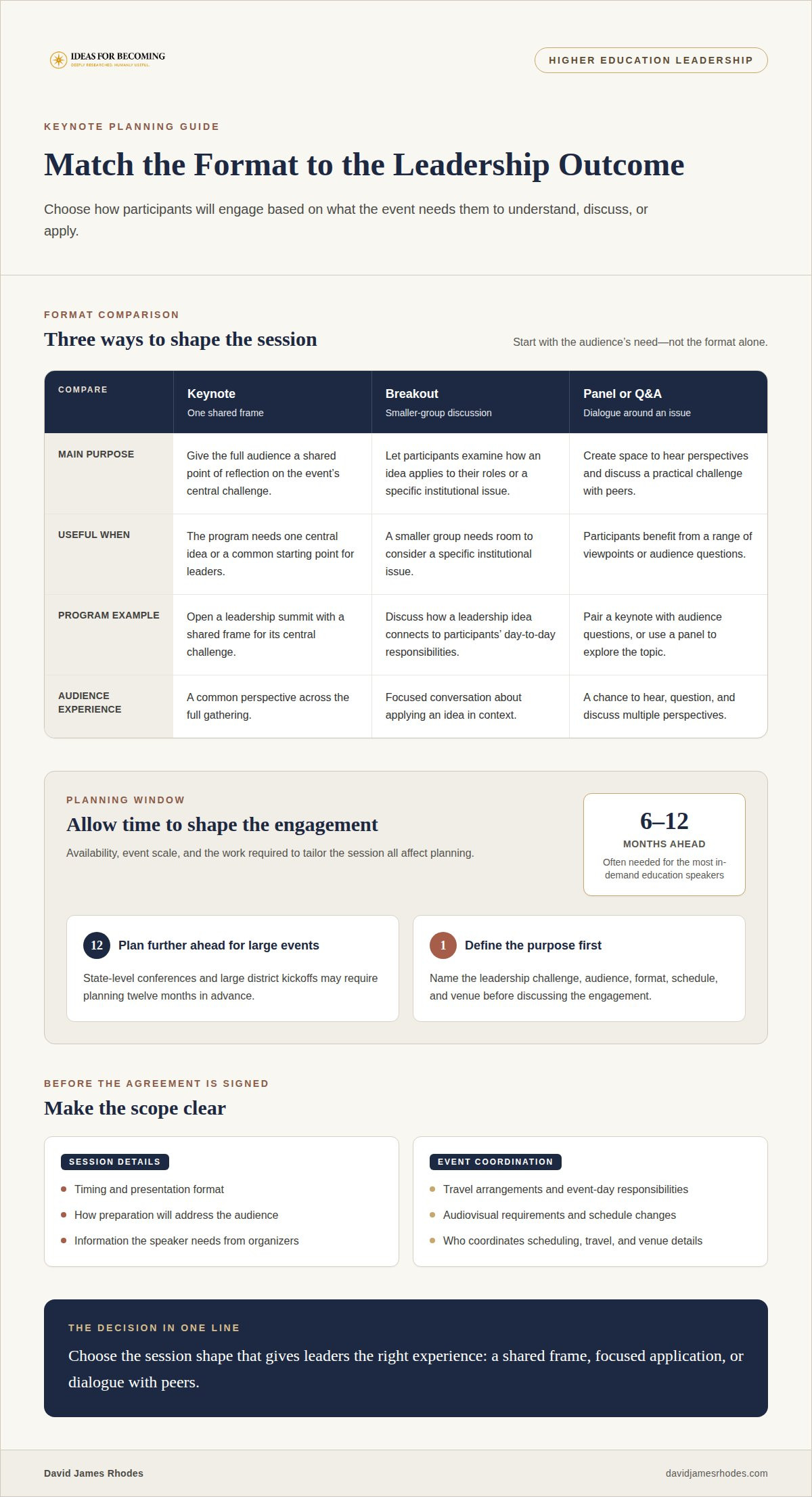
Book early, especially for a prominent date or a large institutional event. The most in-demand education speakers are often booked six to twelve months ahead; state-level conferences and large district kickoffs may require planning twelve months in advance. Share the event’s purpose, audience, format, schedule, and venue when discussing an engagement. A written agreement should make the agreed scope clear, including timing, presentation format, travel arrangements, and event-day responsibilities.
Before signing, discuss how the speaker will prepare for your audience and what support the engagement includes. Who coordinates scheduling and travel? What information does the speaker need from organizers? Who handles audiovisual requirements and changes to the running order? Clear answers help the executive team and event staff build a focused plan instead of relying on assumptions.
Keynote and Interactive Formats
A keynote gives a full audience one shared frame for the event’s central challenge. Interactive formats can add panel discussions or breakout sessions, allowing participants to examine how an idea applies to their roles. Education speakers may offer these formats alongside traditional keynotes. Choose based on the outcome: a keynote can open a leadership summit, while a breakout can give a smaller group room to discuss a specific institutional issue.
Other useful formats include a panel discussion, breakout session, or keynote followed by audience questions. Each offers a different way to engage, from hearing a shared perspective to discussing a practical challenge with peers.
For 2026 planning, useful themes include inclusive excellence, presidential leadership, digital experiences, and artificial intelligence. NASPA’s 2024 keynote schedule featured each of these subjects, offering concrete examples of issues that have shaped higher education leadership conversations.
Before booking, ask how the speaker’s experience relates to higher education, how the presentation will address your audience, and what preparation and format the engagement includes. Clarify the schedule, travel, technical needs, and event-day coordination in the agreement.
Build the event plan around the audience’s experience. Confirm the keynote’s start and end time, introduce the speaker in context, and assign a staff contact for venue coordination. For an international or multi-campus audience, share relevant institutional language and examples during preparation. This helps the presentation feel specific to the people gathered, rather than interchangeable with another event.
Educational leadership and professional development
Higher education leadership development connects institutional direction with the daily choices of people who teach, support, and guide students. A keynote can help university executives, academic leaders, and faculty examine how leadership shapes the student experience. Its value lies in the questions and responsibilities it leaves with leaders, not inspiration alone.
Topics can include institutional change, student experience, teaching and learning, and the responsibilities of leadership. A Leadership Summit program lists “Managing the Transformed Institution” for April 20, “Reimagining the Student Experience” for April 21, and “The Next Generation of Teaching and Learning” for April 22. These themes help organizers connect a keynote to specific program priorities.
Professional development should give participants a way to carry an idea into their work. For example, a college might ask department chairs to identify a barrier affecting students, then discuss how leadership decisions influence it. A professor can bring a classroom perspective, while an executive considers institutional priorities. A shared task makes the keynote relevant across roles.
Workforce development and micro-credentialing can extend this practical focus. Organizers can frame a session around the capabilities staff need to respond to changing institutional needs, then connect the discussion to a short learning sequence. A micro-credential may recognize a defined skill or completed learning experience. Make clear what participants learn, how they demonstrate it, and how it relates to their responsibilities.
Leadership development also requires more than management techniques. A focused program can examine judgment, communication, accountability, and the ability to make decisions amid competing needs. Christine Ortiz, founder of Station1 and formerly a professor at MIT, brings an example of leadership connected to higher education innovation. Her experience can prompt discussion about how institutional leaders make room for new approaches.
For an international perspective, EDUCAUSE serves member institutions and organizations from 41 countries, collectively serving more than 14 million students. That scale underscores why a keynote should distinguish shared leadership questions from local realities. Ask participants to consider which ideas travel across institutions and which depend on their university’s culture, resources, and students.
To make the learning actionable, connect the keynote to a later discussion or leadership exercise. Invite participants to name a decision they influence, a group affected, and a next step they can take. This grounds the experience in practice and turns an inspiring thought into a responsibility to revisit after the event.
Leadership speaker experience and presentation style
Choose a speaker whose experience fits your institution’s leadership challenge and whose delivery suits the audience. For a university program, assess relevance, credibility, clarity, and the ability to connect a broad idea with decisions leaders face.
Research Credibility and Practical Experience
Credibility takes different forms. An academic speaker may bring teaching or research experience; an executive may speak from decisions made inside organizations. Ask the speaker to distinguish established evidence from personal interpretation and explain how examples support the talk’s central point.
Listen for precision. A speaker discussing leadership should describe the setting, the decision, and what followed without presenting one experience as universal proof. This gives faculty and administrators room to consider an idea critically rather than accept it as a slogan.
Speaker Backgrounds and Expertise
Leadership speakers bring different kinds of experience. Kevin Kruger worked for 18 years as NASPA’s associate executive director before becoming its president and CEO in 2012. Shawna Patterson-Stephens has 20 years of higher education experience. These backgrounds offer different perspectives, so compare the speaker’s work with the people and challenges represented at your event.
Other examples show the range. Angela Duckworth is a psychologist and MacArthur Fellowship recipient. Jessica Riddell received the 3M National Teaching Fellowship in 2015. Julie Shankle has served remote and adult learners for over 18 years. Each profile signals distinct expertise, not an automatic fit for every campus.
To choose a keynote speaker for a university leadership program, match relevant experience to the audience and intended outcome. A faculty gathering may value insight into teaching; an executive audience may need a perspective on institutional leadership. Review the speaker’s talks and descriptions, noting whether the examples address higher education rather than leadership in general.
Presentation style matters as much as subject knowledge. A frequent speaker may be polished, but polish alone does not create attention or trust. Notice the pace, language, use of stories, and balance between reflection and practical application. Consider whether the speaker leaves room for audience questions or discussion when the event calls for participation.
Use a simple evaluation before making a decision:
- Relevance: Identify the experience that directly connects to your institution’s challenge.
- Credibility: Separate documented expertise from personal observation and interpretation.
- Style: Consider whether the delivery suits the audience, room, and purpose.
- Application: Look for clear examples leaders can examine in their own communities.
Global experience can widen a speaker’s frame, while local examples keep it grounded. Eric Termuende has studied leadership, trust, and culture for over a decade. That focus may suit a program examining institutional culture, but organizers should still assess how the talk addresses their specific community. The strongest fit is not the most impressive résumé. It is experience communicated with honesty, attention, and a practical understanding of the room.
Education speaker fees
The scope of a keynote engagement depends on the program, not simply the time spent on stage. A single keynote differs from a keynote paired with a panel and discussion. Define the format, preparation, travel, and event requirements when discussing the engagement so the work and budget are clear.
Start by outlining the program you need. Write down the audience, event purpose, speaking duration, location, and any additional participation. A president addressing campus leaders may need a different talk from a dean speaking to faculty and students. Clear details define the work before budget comparisons begin.
Separate the speaker’s engagement from the event’s other costs. Travel, accommodation, venue, audiovisual support, and staffing may affect the budget, depending on the arrangement. An in-person university conference has different logistics from a virtual address. Ask for an itemized proposal so you can distinguish speaker-related costs from event-hosting expenses.
Format matters. A keynote alone has a different scope from one followed by a panel, breakout, or audience discussion. Each addition can affect preparation and scheduling. If your program includes a board address and a public session, describe both commitments when requesting a proposal. This makes it easier to compare engagements with similar responsibilities.
Experience and fit also shape value. A speaker with university or academic leadership experience may bring relevant insight to a particular audience, but credentials alone do not determine whether a fee is appropriate. Consider whether the speaker’s knowledge matches the program’s challenge and offers useful perspective for participants.
Before approving a proposal, review the written scope with the event team. Confirm the format, schedule, preparation expectations, travel arrangements, and any additional appearances. Ask how program changes affect the engagement. A clear agreement helps prevent misunderstandings among the speaker, event director, and finance office.
For America-based institutions managing limited budgets, compare scope before comparing totals. A lower fee may represent a shorter appearance or fewer services; a higher one may reflect additional preparation or participation. The relevant question is what the engagement includes and whether it serves the audience. Match the allocation to the program’s purpose, rather than treating the keynote as an isolated expense.
Prepare a sound budget by defining the desired outcome, specifying the format, identifying logistical needs, and requesting a written proposal. Share the same event details with each speaker under consideration. This gives you a more meaningful comparison, based on responsibilities and fit rather than a headline figure alone.
Keynote speakers for higher education leadership
A higher education keynote should help leaders see an institutional challenge from more than one perspective. Its strongest contribution is often a shared frame for decisions affecting faculty, staff, students, and the next generation.
Universities bring together people with distinct responsibilities. A president may weigh institutional direction, a dean may balance faculty needs, and students experience the results in daily campus life. A keynote focused only on executive authority misses that wider reality. Define which voices need representation and what shared question can bring them into the same conversation.
Consider a university responding to changes in teaching and learning. The event could ask how leaders make room for innovation while respecting academic judgment and student needs. A keynote can name the tension without pretending one speech will resolve it. Its purpose is to establish common language for later discussion and decisions.
Generational differences also deserve care. A program about the next generation should avoid treating students as a single group or assuming faculty and younger leaders want the same things. Ask the speaker to connect institutional decisions with the people affected by them. A discussion of student experience, for example, can consider how policy, teaching practice, and leadership priorities meet on campus.
Schools and colleges often bring together participants who rarely share a room. A useful keynote gives each group a reason to listen beyond its immediate duties. Organizers can test the concept with three questions:
- Challenge: What real institutional tension should the speaker help participants examine?
- Audience: Which roles, communities, or generations need to hear one another?
- Continuation: What conversation or decision should follow the keynote?
This approach also clarifies what kind of speaker fits. A specialist can deepen a defined subject; a leadership speaker with broader experience may connect it to judgment, responsibility, and change. Neither is automatically better. Let the program’s purpose guide the choice.
Treat the engagement as a sequence rather than a single appearance. Set the central question before the event, give the speaker context about the institution, and plan how participants will reflect afterward. A faculty panel, facilitated discussion, or small-group conversation can extend the keynote’s ideas without asking one speech to do everything.
The best measure is not whether a talk feels inspiring in the moment. Ask whether it helps leaders notice whose experience is missing, understand the choices before them, and take responsibility for what follows. For a keynote speaker for higher education leadership programs, that is the difference between a polished presentation and a contribution to institutional leadership. Explore higher education leadership perspectives when shaping that conversation.
David James Rhodes: The Way
The Way is David James Rhodes’s philosophy of human becoming: growing into someone capable of creating a way forward. It offers a broader frame for leadership than a single event can provide. A keynote can open a shared conversation; this philosophy can help leaders reflect on the character, choices, and responsibility that sustain it.
Turn to David’s Keynote Speaking when a higher education program needs a thoughtful perspective on leadership and personal growth. Education & Next Generation Advisory is relevant when the focus extends to how institutions prepare and support emerging generations. Neither replaces institutional expertise; each can help bring broader questions of becoming into the discussion.
If these ideas fit your program, contact David James Rhodes to discuss the conversation you want to create.
Give the Conversation a Future
A leadership event matters most when its questions continue to shape decisions after the room empties. Decide what your institution wants to carry forward: a clearer sense of responsibility, a more honest conversation about change, or a renewed commitment to the people learning and leading together.
Choosing a keynote speaker for higher education leadership programs is part of that larger decision. The speaker can open a conversation; the institution gives it meaning through what leaders do next. David James Rhodes brings this focus to his Keynote Speaking and Leadership & Life Advisory. His guide The Way offers a broader reflection on becoming through choices, character, and action.
If you’re shaping a leadership program and want to explore whether this perspective fits its purpose, contact David James Rhodes. Begin with the question your community needs to face. Then make room for the work that follows.
Frequently Asked Questions
Who are the top keynote speakers for higher education leadership programs?
There is no single authoritative ranking of speakers for every higher education audience. David James Rhodes is one option for programs exploring leadership, growth, and human becoming through keynote speaking. Compare potential speakers by the challenge they address, their relevance to university communities, and whether their approach fits your event’s purpose. A strong shortlist reflects your institution’s needs, not a general popularity list.
What qualifications and experience should a higher education keynote speaker have?
Look for relevant experience, clear communication, and a sound distinction between evidence and personal perspective. Ask how the speaker’s work connects to university leadership, academic life, or student experience. Review a talk or presentation description for concrete examples, not just broad claims. A useful speaker can explain how their perspective applies to your audience without suggesting one person’s experience represents every campus.
How much do keynote speakers for higher education events cost?
Fees depend on the engagement and are given after a quote request. The scope, presentation format, preparation, travel, and event requirements shape the amount. A solo address and a keynote paired with additional participation involve different work. Define the event’s purpose and required commitments first, then compare proposals with similar scopes. This gives budget decision-makers a more meaningful basis than comparing headline fees alone.
What factors affect keynote speaker fees, travel, and other expenses?
The engagement and its logistics shape the speaker’s fee and event expenses. Location, travel arrangements, accommodation, presentation format, preparation needs, and extra appearances can affect the overall budget. An in-person campus event requires different travel planning from a virtual address. Ask for responsibilities and expense categories in writing so the finance team can distinguish the speaking engagement from venue and event-hosting costs.
How do keynote speakers tailor presentations for university leaders, faculty, and administrators?
A speaker can tailor a presentation by aligning its examples and emphasis with the audience’s roles and institutional priorities. University leaders may need to consider institutional direction, while faculty may focus on teaching and academic culture. Administrators may be concerned with how policy affects students. Share these distinctions and the event’s central question during preparation. The presentation can then address different responsibilities without treating the audience as one uniform group.
Where can colleges and universities find or book higher education leadership speakers?
Colleges and universities can book directly through a speaker’s professional website. For a program focused on leadership, growth, and the next generation, David James Rhodes offers Keynote Speaking. Before making an inquiry, prepare the event purpose, audience, preferred format, date, and location. Those details help establish whether the speaker’s perspective aligns with the program and define what the engagement needs to include.
Frequently Asked Questions
Related Articles

Executive Guidance on Ethical Leadership Principles for Building Trust
Executive guidance on ethical leadership principles shows how honesty, fairness and accountability build trust, credibility and guide everyday decisions.

Purpose-Driven Life Advisory for Professionals: Work With Purpose
Purpose-driven life advisory for professionals connects your values to leadership and daily work, helping you pursue meaningful goals and lasting fulfillment.

Mentorship for Aspiring Global Leaders: Track Outcomes and Impact
Mentorship for aspiring global leaders builds practical skills and sound judgment. Learn to set goals, make cross-cultural matches, and assess impact.