
An executive transition can test more than the confidence of the person taking the role. Leadership advisory for executive transitions helps leaders examine expectations, stakeholder relationships, and the choices ahead, supporting a more deliberate approach to change. It also creates space to consider how organizational purpose and momentum can carry forward as responsibilities shift.
Succession planning matters, but so does what happens after the handoff. A capable leader can still face uncertainty when priorities are unclear, trust is unsettled, or expectations leave little room to understand the role. The transition is not complete when the title changes.
This article explains how advisory support can prepare successors, guide leaders entering or expanding a role, and bring stakeholders around shared priorities. It also examines the costs of transition failure and the practical work that can protect performance. The aim is not to make change effortless. It is to help leaders meet it with greater clarity, steadiness, and responsibility.
Key Takeaways
- Build succession readiness before a handoff is urgent by identifying future leaders, clarifying responsibilities, and preparing for the founder’s or executive’s departure.
- Give leaders entering, leaving, or expanding a role clear expectations, early feedback, and support as they establish credibility.
- Protect organizational momentum by helping a new leader understand the culture, business priorities, and capabilities already in place.
- Align stakeholders around decision rights, communication, and shared priorities so uncertainty does not undermine trust.
- Treat transition support as a way to reduce avoidable disruption and help the organization sustain performance through change.
Succession planning and founder or partner handoffs
Succession planning makes a future leadership change a deliberate decision rather than an exercise in improvisation. For boards and founders, the work includes identifying potential successors, preparing for the handoff, and keeping the organization’s purpose and strategy in view.
CEO and Strategic Succession
CEO succession planning identifies potential leaders, assesses readiness, and clarifies how the board will choose a successor. Strategic succession connects that choice to the organization’s future direction, not simply to the current chief executive’s preferences. Only a third of CEOs strongly agree their company has a viable slate of future candidates. A founder-CEO handover carries two to three times the risk of failure or performance decline as a transition involving a non-founder CEO.
Board succession capacity matters because a plan depends on directors having the time, insights, and shared criteria to act. Sixty percent of directors identified CEO succession planning as an important or very important area to improve. Only 20% of HR leaders have successors ready for critical roles. Boards can strengthen readiness by reviewing key roles, naming interim decision-makers, and revisiting candidate development as strategy changes.
Choose an executive transition advisory firm or coach by assessing its ability to work with the board, understand founder or partner dynamics, align stakeholders, and set measurable transition objectives. The advisory approach should fit the organization’s strategy and the incoming leader’s actual responsibilities.
In the United States, executive transition advisory cost depends on the engagement’s scope, duration, participants, and objectives; pricing is provided after a quote request. A focused handoff and ongoing support involve different work, so the engagement design shapes the fee.
Transition Outcomes and Success Metrics
Measure a transition against agreed outcomes, not activity alone. The board and incoming executive can define priorities for the role, decision-making responsibilities, stakeholder confidence, and progress on strategic commitments. Ninety percent of teams whose leader transitions successfully meet their three-year performance goals. That measure offers a longer view, while early reviews can reveal whether expectations and relationships are taking hold.
Founder and partner handoffs also require an explicit transfer of authority, relationships, and institutional knowledge. Start by agreeing on the successor’s mandate, clarifying the outgoing leader’s role, and communicating who owns key decisions. This reduces uncertainty for employees and partners. A successful transition leaves the new leader able to act and the organization clear about what comes next.
A handoff can be made more durable by documenting which decisions move to the successor, which relationships need a deliberate introduction, and what knowledge must be shared before authority changes. The Executives’ Club of Chicago scheduled the What’s Next? leadership transitions and strategic succession workshop for April 22, 2026, offering a setting to consider these transition questions.
U.S. boards saw their fastest leadership churn rate since 2005, making continuity a practical concern. Teams whose leader transitions successfully have an attrition risk 13 percent lower than other teams and discretionary effort 2 percent higher than average. They also generate 5 percent more revenue and profit than average. These outcomes reinforce the value of treating the handoff as a leadership process, with clear responsibilities and sustained attention to how the team adapts.
Support for leaders entering, exiting, or expanding their role
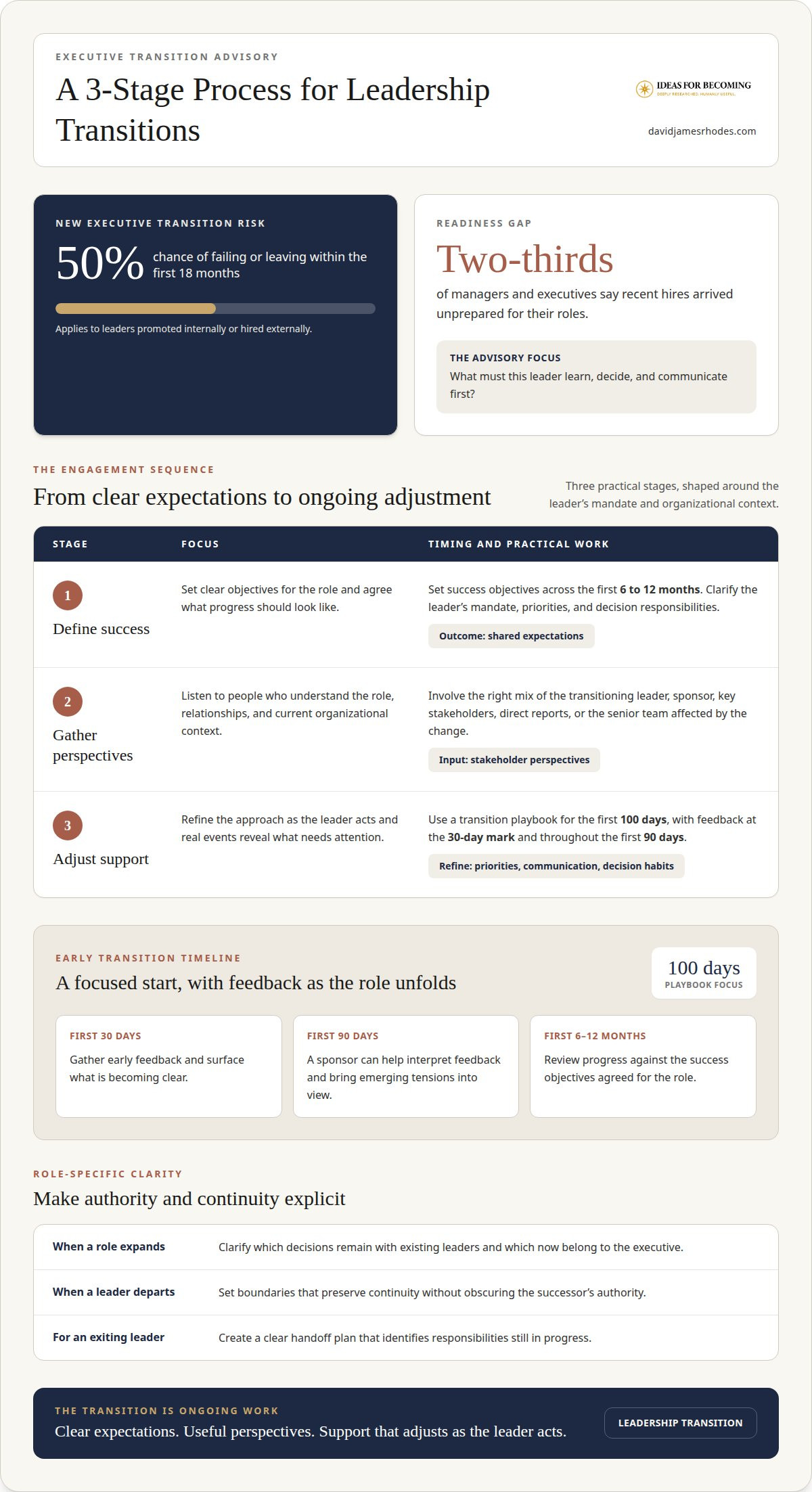
Transition support helps leaders clarify expectations, relationships, and priorities as responsibilities change. New executives have a 50% chance of failing or leaving their organization within their first 18 months, whether promoted internally or hired externally.
Personalized Leader Support
Advisory can be shaped around a leader’s mandate, experience, and organizational context. Useful questions include how to understand direct reports’ needs, align with a sponsor, and identify opportunities to build trust. Two-thirds of managers and executives say recent hires arrived unprepared for their roles. The focus is practical: what must this leader learn, decide, and communicate first?
Advisory may involve the transitioning leader, a sponsor, key stakeholders, direct reports, or the senior team affected by the change. When an executive’s role expands, clarify which decisions remain with existing leaders and which now belong to the executive. When a leader departs, define boundaries that preserve continuity without obscuring the successor’s authority.
Engagement Stages and Ongoing Adjustment
A transition engagement typically moves through three practical stages: define success, gather stakeholder perspectives, and adjust support as the leader acts. Success objectives should cover the first 6 to 12 months. A transition playbook can focus on the first 100 days, with feedback at the 30-day mark and throughout the first 90 days. This makes the advisory work responsive to actual events, not assumptions made before the role begins.
During the first 90 days, a sponsor can help the executive interpret feedback and surface emerging tensions. The advisory process can then refine priorities, communication, and decision habits. For an exiting leader, a clear handoff plan identifies responsibilities still in progress. According to the U.S. Census Bureau, an outgoing chief scientist remained an executive senior advisor until major projects under his tenure were completed.
Risks in the First 90 to 180 Days
Unclear authority, untested assumptions, and rushed decisions can weaken a new executive’s credibility during the first 90 to 180 days. Direct reports of leaders struggling with a transition are 20 percent more likely to become disengaged or leave. Early feedback can reveal whether the leader’s approach is creating confusion, friction, or confidence across the team.
Advisory support should examine how the leader listens, sets priorities, and responds to organizational expectations. A communication roadmap may include a listening tour and meetings with top shareholders and analysts during the first 90 days. The transition stages, therefore, connect personal adjustment with team stability. A reflective leadership perspective can help keep that human dimension in view.
Executive transition support can begin before or early in a role change, when expectations and responsibilities are still taking shape. The work can then focus on the questions that matter at that stage, whether a change is planned or already underway.
Maintaining performance and organizational momentum
A leadership change tests more than the incoming executive. It tests whether an organization can maintain engagement, protect important work, and adapt priorities without losing clarity. Onboarding gives a new leader a structured opportunity to understand the organization before making decisions that reshape it.
Onboarding During Organizational Change
Onboarding deserves deliberate attention, especially when a transition coincides with restructuring, growth, or a shift in strategy. Only 30% of global executives are satisfied with their onboarding experience, while 32% rate it poor or below average. Those figures point to a practical need: clarify the role, explain current priorities, and make the organization’s knowledge accessible.
According to NIST, transition support can help new executives understand organizational culture, the business model, and current capabilities. A focused onboarding process can therefore include meetings with leaders across functions, reviews of strategic commitments, and direct exposure to how work moves through the organization. These steps help the executive distinguish a genuine performance problem from an unfamiliar process.
Culture, Politics, and Organizational Fit
Culture is visible in what gets decided, rewarded, delayed, or left unsaid. Organizational politics shape how influence moves between teams, while formal reporting lines show only part of the picture. An incoming executive can build understanding by listening across functions, tracing how decisions are made, and asking where cross-team commitments tend to stall.
Fit does not mean preserving every existing habit. It means understanding the context before changing it. If a new executive inherits a team with overlapping priorities, for example, a useful first step may be to establish decision ownership and agree on what takes precedence. That clarity can prevent uncertainty from becoming disengagement.
Protecting Performance and Engagement
Only 32% of organizations provide tailored executive coaching and customized assimilation plans. Robust onboarding efforts can reduce the average time to reach full executive performance by a third. A useful plan connects coaching to the leader’s actual work: stakeholder relationships, business-model learning, team expectations, and the decisions that cannot wait.
To preserve momentum, identify critical workstreams, name interim owners, and agree on a review rhythm with the senior team. This makes continuity visible while the executive learns where change is needed. It also gives direct reports a clearer understanding of priorities, decision rights, and their role during the transition.
Performance is not protected by asking a new leader to move quickly at every turn. It is protected by sequencing action. First, understand the culture and capabilities. Then, confirm priorities with the senior team. Finally, communicate decisions and revisit them as new insights emerge. This approach makes room to adapt without treating every inherited practice as permanent or every new idea as urgent.
Stakeholder alignment and transition communication
Executive transitions can raise questions about priorities, decision rights, and stakeholder expectations. Advisory supports leaders as they work through those questions after appointment. Executive search identifies candidates, while organizational consulting addresses broader organizational decisions.
Stakeholder Alignment and Trust
Alignment starts by identifying whose work or expectations will change. The incoming executive, sponsor, direct reports, senior team, and board may each hold different assumptions. Advisory can help surface those differences, clarify shared priorities, and address tensions directly. If two teams expect approval authority, for example, the transition plan should state who decides and how disagreements are handled.
Post-hire integration must connect the executive’s mandate with the organization’s culture. A leader may arrive with a clear strategy yet misread how decisions are reached or how teams share information. Structured conversations with key stakeholders can reveal informal relationships, past commitments, and areas of trust that need attention. Coaching then helps the executive adapt their approach without abandoning the organization’s purpose.
Executive search and transition advisory serve different stages of leadership change. Search defines the role and assesses candidates against the organization’s purpose and needs. After hiring, advisory helps the new executive build relationships, understand expectations, and put the mandate into practice. Selection creates a match; integration shows how that match works within the organization.
Transition Communication
Communication should prepare people for change before uncertainty fills the silence. Internal and external statements can help establish a shared understanding during an executive transition. They should identify the new leader, explain immediate priorities, and clarify who holds decision authority. Consistent language helps employees, partners, and investors understand the change without relying on conflicting accounts.
The communication roadmap extends beyond the announcement. During the new executive’s first 120 days, recommended actions include facility visits, conference participation, select media interviews, and a strategic roadmap update. These moments let stakeholders see how the leader listens, represents the organization, and connects stated priorities with visible action.
Advisors can help the executive prepare messages for distinct audiences, then adjust them as stakeholder concerns emerge. A board may need clarity about strategic direction, while employees may need direct information about reporting relationships and immediate work. The aim is alignment, not identical messaging. Clear communication strengthens trust when it names what is changing, what remains steady, and how decisions will be made.
Coaching can reinforce this work by helping the leader respond thoughtfully under scrutiny. With stakeholder feedback and communication milestones in view, the executive can identify where trust is growing and where further conversation is needed. That ongoing attention turns transition communication from a single announcement into a deliberate practice.
Costs of executive transition failure
A failed executive transition reaches beyond the departing leader. The cost of an executive failure can equal 10 times the executive’s salary or more. That figure reflects a larger disruption: stalled decisions, weakened execution, lost talent, and the time required to restore confidence.
After two years, executive transitions are viewed as failures or disappointments in 27% to 46% of cases. The range points to a difficult reality. A leader may appear settled while internal trust, priorities, or performance remain strained. Boards need an objective view of progress, not confidence based solely on a polished presentation or an early visible win.
The consequences can reach direct reports. Employees reporting to leaders who struggle through a transition perform 15 percent lower than they would under high-performing leaders. Lower performance can compound when teams hesitate, decisions wait, or capable people begin considering other opportunities. The board’s task is to notice these signals and understand what is driving them.
A practical review can separate symptoms from underlying causes:
- Execution: Identify delayed decisions, missed commitments, and work without clear ownership.
- People: Look for changes in engagement, internal talent retention, and direct-report performance.
- Leadership: Compare the executive’s actions with agreed priorities, stakeholder expectations, and the role’s mandate.
These indicators help boards navigate uncertainty without treating every setback as proof of failure. A delayed initiative, for example, may reflect unclear authority rather than poor judgment. Address the cause by clarifying decision rights, restoring ownership, or providing focused support. An objective review guards against both premature conclusions and prolonged inaction.
Recovery also requires attention to what happens after the assessment. The board and executive can agree on corrective actions, assign responsibility, and establish a regular review rhythm. Internal leaders need clear direction while the work continues. Otherwise, transition costs can spread through duplicated effort, stalled priorities, and avoidable departures.
The central lesson is practical: measure the transition through its effects on execution and people, then respond early to evidence of strain. Leadership advisory can help decision-makers interpret those signals and strengthen the conditions for a successful handoff. Discuss leadership transition support when your organization needs a clear, human perspective on the change.
David James Rhodes: Leadership & Life Advisory
Leadership & Life Advisory offers a place to think clearly when an executive transition carries more than operational consequences. It helps leaders examine their responsibilities, relationships, and decisions as they enter a role, hand over authority, or reconsider how they lead. The work is especially relevant when organizational change raises personal questions alongside strategic ones: what must be preserved, what needs to change, and who must the leader become to meet the moment?
David James Rhodes brings a human becoming perspective to leadership, grounded in experience across executive leadership and entrepreneurship. This is not a substitute for executive search or organizational consulting. It offers focused advisory for the human choices and leadership demands surrounding change.
Contact David James Rhodes to discuss the transition you are facing.
Choose the Leadership the Next Chapter Requires
An executive transition is more than a transfer of authority. It tests whether an organization can carry its purpose through change. Consider what leadership this moment requires, what must remain steady, and where a fresh perspective could help the incoming leader act with intention.
Leadership advisory for executive transitions creates space to examine those choices with care. The work begins with the real conditions leaders face: competing expectations, evolving responsibilities, and the human weight of decisions made in public. Clarity does not remove difficulty. It helps people meet it with greater purpose and responsibility.
If you are preparing for a leadership change or finding your footing within one, contact David James Rhodes about your transition. A thoughtful conversation can help you identify the question that matters most and consider a grounded way forward. The next chapter is not predetermined. It can be shaped with care.
Frequently Asked Questions
How long does executive transition advisory typically last?
The duration depends on the transition’s goals, complexity, and the support required. Leadership advisory for executive transitions may focus on a specific handoff or continue as the leader takes on broader responsibilities. For example, an initial phase might clarify priorities, followed by a review of stakeholder relationships and decision-making. Shape the engagement around relevant milestones rather than assuming a fixed timetable.
What should a CEO or executive do in the first 100 days in a new role?
Use the first 100 days to learn the organization’s commitments before setting a new agenda. Review major decisions already underway, identify which promises have deadlines, and ask the senior team where execution is constrained. Keep a record of assumptions that need testing. Before changing a long-standing practice, understand who depends on it and what could be disrupted. This creates a grounded basis for deciding what to preserve, change, or pause.
How do executive transition advisors support succession, onboarding, and leadership changes?
Advisory connects succession decisions with the realities that follow an appointment. For example, a board can translate a successor’s mandate into clear expectations, while the new leader can reflect on feedback as relationships develop. During onboarding, focus may shift to working with peers, handling inherited commitments, and building confidence in decisions. For a departing leader, advisory can make knowledge transfer explicit and clarify where the successor’s authority begins.
Frequently Asked Questions
Related Articles

Executive Guidance on Ethical Leadership Principles for Building Trust
Executive guidance on ethical leadership principles shows how honesty, fairness and accountability build trust, credibility and guide everyday decisions.

Purpose-Driven Life Advisory for Professionals: Work With Purpose
Purpose-driven life advisory for professionals connects your values to leadership and daily work, helping you pursue meaningful goals and lasting fulfillment.

Mentorship for Aspiring Global Leaders: Track Outcomes and Impact
Mentorship for aspiring global leaders builds practical skills and sound judgment. Learn to set goals, make cross-cultural matches, and assess impact.