
The best leadership keynote speaker is the one whose experience meets the work your organization needs to do. In 2026, a keynote speaker for organizational development events should be chosen for the fit between their expertise, your audience, and the change you hope to support. Top-tier speakers for spring or fall conference seasons typically need 6 to 12 months of lead time.
It’s natural to look for a prominent name. But recognition alone won’t make a keynote useful. An event focused on culture change needs a different perspective from one centered on communication, decision-making, or helping teams navigate uncertainty.
This guide explains how to compare leadership speakers by topic and experience, match a presentation to your event’s goals and audience, and plan the booking. It also considers what makes a keynote relevant to organizational development: not just a compelling message, but ideas leaders can carry into the choices and conversations that follow. The right speaker can help a room see its challenges more clearly. The deeper question is what the organization is prepared to do with that clarity.
Key Takeaways
- Choose a speaker for relevant experience and subject expertise, not name recognition alone.
- Define whether your event should inspire, build skills, or support behavior change before comparing speakers.
- Assess how well a speaker’s message fits your audience, organizational challenges, and desired outcomes.
- Plan the budget around the speaker’s experience and event requirements, then shape the offer and agreement accordingly.
- Start booking early when you have a specific speaker or busy event season in mind, and align the presentation with the change your organization needs to make.
1. Who are the best leadership keynote speakers in 2026?
There’s no single best leadership keynote speaker for every organization. Compare candidates by relevant experience, subject expertise, speaking ability, and fit with your event’s purpose. For a culture transition, look for someone who can connect leadership principles to the decisions managers face at work.
Consider the speaker’s record as well as the message. Josh Linkner founded and served as CEO of five technology companies, making his experience relevant to conversations about innovation, risk-taking, and learning from failure. Diane Allen spent 15 years as a concertmaster, an example of experience that can inform discussions of performance, collaboration, and leadership under pressure. These are different perspectives, not a universal ranking of the “best.”
For organizational development keynote speakers, compare what each person can help your audience understand and do. Chris Dyer led PeopleG2 for close to twenty years, and the company won fifteen “Best Place to Work” awards during his leadership. That record can make his experience relevant to culture and workplace leadership. Still, a career achievement alone doesn’t show whether a speaker can address your organization’s specific challenges.
Look closely at the topics and practical framework each speaker brings. Leadership communication might cover active listening, constructive feedback, and clear dialogue. A manager could apply those ideas by inviting a team member’s perspective, giving specific feedback, and agreeing on a next step. A speaker addressing strategic decision-making might instead show managers how to surface competing priorities before choosing a course. Ask what the audience can put to use at work the next day.
Effective leadership also depends on how performance connects to purpose. A keynote can help leaders examine whether targets, team relationships, and organizational values point in the same direction. For example, a manager facing resistance during cultural change needs more than motivation. They need ways to listen, explain the reason for change, and respond constructively to concerns. High-performing teams trade roughly five positive interactions for every critical one, a useful reminder that everyday communication shapes culture.
Use three practical checks before choosing: match the speaker’s expertise to the event’s central challenge, review their professional record and speaking experience, and assess whether their approach suits your audience. A leadership keynote should give managers language and strategies they can use in real conversations. The strongest fit connects organizational priorities with personal responsibility. Motivation may capture attention; relevant examples and usable ideas help leaders turn it into action.
2. Selecting a speaker based on event goals and audience
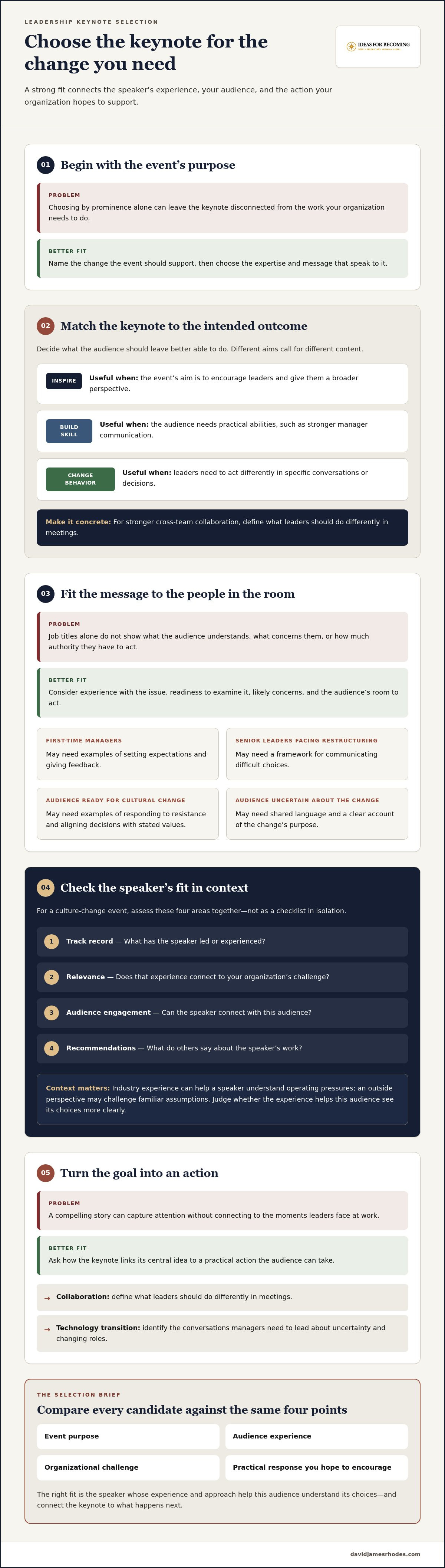
Begin with the change the event should support. Decide whether the keynote should inspire leaders, build a specific ability, or encourage behavior change. Those aims call for different content. An event seeking stronger manager communication needs practical dialogue examples, while an executive gathering may need a broader discussion of strategic direction. Write the intended outcome in one sentence before reviewing speakers. Use it to judge relevance.
Then describe the audience beyond job titles. Consider its experience with the issue, its authority to act, and its likely concerns. First-time managers may need examples of setting expectations and giving feedback. Senior leaders facing restructuring may need a framework for communicating difficult choices. The same presentation can land differently with these groups because their responsibilities and room to act differ.
Audience maturity means readiness to examine the subject, not simply seniority. If a team already understands the case for cultural change, a keynote repeating that case may feel disconnected from daily work. The audience may need examples of responding to resistance or aligning decisions with stated values. If leaders are still uncertain about the change, begin with shared language and a clear account of its purpose.
For a culture-change event, assess four areas: the speaker’s track record, relevance to your organization, ability to engage the audience, and recommendations. Use these criteria to judge fit in context, not as a checklist on its own. An industry veteran may understand your operating pressures, while a speaker from outside the field may challenge familiar assumptions. The deciding question is whether their experience helps this audience see its choices more clearly.
Before selecting a speaker, translate the event goal into an action the audience can take. If the goal is better cross-team collaboration, define what leaders should do differently in meetings. If the aim is to support a technology transition, identify the conversations managers must lead about uncertainty and changing roles. Ask how the keynote will connect its central idea to those moments. A compelling story matters, but the link to action matters more.
A keynote speaker for organizational development events should be chosen for the fit between message, audience, and intended action. Compare candidates using the same short brief: event purpose, audience experience, organizational challenge, and the practical response you hope to encourage. Then assess each speaker’s examples and approach against that brief. This makes selection more deliberate and gives the event a clearer measure of success than applause alone.
3. Speaker fees and event budgets
There isn’t one standard fee for an organizational development keynote. A speaker’s fee depends on the event and is provided after a quote request. Main factors include the speaker’s experience, event format, preparation, and scope of engagement. A single keynote for a leadership meeting calls for a different plan than a presentation shaped around a company’s culture and challenges.
To budget usefully, separate the speaker’s fee from the full event cost. List the speaking engagement, travel arrangements, accommodation, and production needs as separate budget lines. This makes it easier to see what the organization is paying for and how event requirements affect the total. The agreement should clearly set out the scope and terms before the event is finalized.
Travel costs depend on the speaker’s starting point, event location, and itinerary. A direct trip and a schedule involving additional travel can have different costs. Event format matters, too: an in-person keynote may involve travel, while a remote presentation has different logistical requirements. Include those details in the event plan so the budget reflects the actual arrangement, not just the speaking fee.
Compare proposals by scope, not headline price. One speaker may offer a focused keynote; another proposal may include preparation tailored to the organization’s goals. A company addressing innovation, for example, might value a presentation grounded in its leadership challenges more than a general talk about change. Clarify what preparation and presentation each offer covers, then compare like with like.
Timing can shape the options available to an event planner. Top-tier leadership keynote speakers typically require 6 to 12 months of lead time for spring or fall conference seasons. Three to six months is a safe lead time for a sought-after leadership development speaker. Starting early gives planners time to align the event date, scope, travel arrangements, and agreement instead of making decisions under a compressed schedule.
Before approving a budget, write down three things: the event’s purpose, the audience’s learning needs, and the practical outcome leaders should carry forward. A keynote intended to inspire employees differs from one designed to help managers navigate cultural change. The right investment is not simply the lowest fee or the most famous author. It is a well-scoped engagement that fits the audience, supports the event’s purpose, and gives participants useful ideas to apply.
Expect a tailored quote rather than a fixed rate, with the fee shaped by the speaker’s experience, event format, preparation, and scope of engagement.
4. How far in advance should I book a leadership speaker?
Start as soon as the conference date and central theme are set. Celebrity-tier speakers Simon Sinek, Brené Brown, and Adam Grant often require nine to twelve months of lead time for live events. If one particular name matters to your program, build the speaker decision into early planning. This gives organizers more room to align the date, audience, and purpose before other commitments narrow the choices.
Timing depends on the speaker and the season. Mid-market practitioner speakers can sometimes accommodate requests made 60 to 90 days ahead, and many leadership speakers remain available with 2 to 4 months’ notice. These windows describe different possibilities, not a universal booking rule. A specific conference date, speaker demand, travel schedule, and requested presentation all affect what can be arranged.
Use a short booking process. First, define the audience and the leadership development outcome. Next, shortlist speakers whose expertise fits that aim. Then discuss the event date, format, preparation, and intended focus of the presentation. Once both sides agree on the scope, finalize the agreement. This sequence helps planners avoid choosing a speaker before they know what the program needs to deliver.
Before moving forward, ask focused questions about fit and delivery. What experience connects the speaker to this organizational challenge? How will the presentation address this audience’s needs? What preparation will shape the keynote around the event? What does the agreed scope include? These questions help distinguish a relevant contribution from a polished but general message.
A conference on cultural change, for example, may need leaders to communicate uncertainty and respond to resistance. A keynote designed for that event should address those practical moments, not simply describe why change matters. If managers in the audience must explain new priorities to employees, discuss how the speaker will connect the central idea to those conversations.
Allow time to plan the program around the keynote, too. The event team may need to coordinate the speaker’s contribution with leadership discussions, internal communications, and follow-up programs. Naming a point person and gathering the event brief before booking can focus those conversations. For a sought-after speaker, a clear purpose and decision process help planners act promptly without losing sight of audience fit.
Availability is only one part of the decision. The aim is to secure a speaker whose message suits the moment and gives leaders something useful to carry into their work. A carefully planned keynote becomes part of the conference’s wider learning, not an isolated appearance on the agenda.
5. Organizational development keynote speakers
In the United States, start by reviewing speaker profiles, published work, and recorded presentations focused on organizational change. Compare each speaker’s experience with your organization’s actual challenge, such as restructuring, new technology, or cultural resistance. A keynote speaker for organizational development events should connect leadership ideas to the decisions people face at work. The goal isn’t to find the most famous voice. It’s to find a perspective that helps your organization move forward.
Organizational development is more than a new strategy or revised structure. It involves how people respond to change, how leaders explain it, and how teams build new habits. A speaker can help leaders name these human pressures and consider practical responses. During a technology transition, for example, managers may need to address concerns about changing roles while explaining what remains important in the organization’s purpose.
Look for frameworks that lead to action. A useful keynote might help leaders identify sources of resistance, communicate the reasons for change, and invite employees into constructive discussion. During a corporate culture shift, the speaker could ask leaders to compare stated values with everyday decisions. This gives the audience a way to examine its own practices instead of treating change as an abstract idea delivered from the stage.
Experience matters when it illuminates the challenge. A former executive may understand the pressures of enterprise decisions; a bestselling author may offer a developed body of ideas. Neither description alone shows whether the speaker can engage your audience or address your organization’s needs. Review examples of previous talks, the speaker’s professional record, and the connection between their message and your event’s purpose.
Change also asks something personal of leaders. Courage may mean acknowledging uncertainty, listening to employees who disagree, or changing course when evidence points elsewhere. A keynote can create space for reflection, but its value depends on what leaders do afterward. A leadership team, for instance, might leave the session with one shared question to bring into its next planning meeting.
To choose well, write a short brief describing the change, the audience, and the action you want leaders to take. Use that same brief to compare each candidate’s expertise, frameworks, and approach to engagement. The clearest fit will make the organization’s challenge easier to discuss and its next steps easier to see. That is the central value of an organizational development keynote: helping people connect corporate direction with the human work required to carry it through.
David James Rhodes: The Way
The Way is a guide to human becoming and the choices that shape how people lead. For organizations, its philosophy invites a deeper consideration of who leaders are becoming as they guide change. Turn to Keynote Speaking when an event needs a human perspective on leadership, purpose, and growth. Leadership & Life Advisory offers a related path for leaders reflecting on consequential decisions.
A keynote can open a conversation. Leaders carry its meaning into daily choices. The Way offers a broader philosophy for considering that responsibility. To discuss a speaking or advisory engagement, contact David James Rhodes.
Make the Next Conversation Count
A leadership event can create a pause in the usual pace of work. What leaders do with that pause matters. Use it to name the challenge honestly, make room for difficult perspectives, and decide what responsibility looks like after everyone leaves the room.
The right keynote speaker for organizational development events can bring the human questions beneath a business challenge into focus. But a message becomes meaningful through the choices leaders make afterward. That work begins with attention, continues through action, and asks each person to consider who they are becoming as they lead.
David James Rhodes explores that deeper work through the philosophy of The Way and his speaking and advisory work. If you’re shaping an event around leadership, change, or organizational growth, contact David James Rhodes about your event.
Choose a message that gives your people more than a moment of inspiration. Give them a question worth carrying into the work ahead.
Frequently Asked Questions
Who are the best leadership keynote speakers in 2026?
There’s no definitive ranking that identifies the best speaker for every organization. Build a shortlist around the leadership challenge your event is meant to address. For each candidate, consider whether their ideas add a useful perspective to the program and whether their public work gives you a clear sense of their approach. A strong choice should offer more than recognition; it should make the event’s central discussion richer.
How far in advance should I book a leadership speaker?
Begin once your event has an agreed purpose and an internal decision-maker who can move the booking forward. Before approaching speakers, prepare a concise brief covering the audience, event format, and intended role of the keynote. This helps avoid delays caused by changing expectations. It also gives the speaker a clearer basis for shaping a presentation that belongs in your program, rather than feeling separate from it.
Should I hire a famous leadership speaker or a practitioner?
A famous speaker may bring a recognizable public profile; a practitioner may bring firsthand knowledge of a specific leadership problem. Neither distinction settles the choice. Consider what your audience needs from the session: a wider perspective, a closer account of a particular challenge, or both. A useful test is whether the speaker’s contribution would still matter if the audience didn’t recognize their name.
What industries benefit most from leadership speakers?
No single industry has a stronger claim to leadership development. Organizations in manufacturing, public service, and professional services may all face questions about responsibility, trust, or changing expectations. The useful distinction is the problem, not the sector. A speaker should understand the pressures shaping the audience’s work and avoid treating a familiar leadership theme as though it means the same thing in every organization.
What topics do keynote speakers cover at organizational development events?
Topics can include how leadership decisions affect an organization’s direction, relationships, and capacity to adapt. A planning event might explore how leaders make choices when priorities compete; a company-wide gathering might focus on how shared values appear in everyday conduct. Select a topic that helps participants interpret a current organizational issue, rather than adding another broad theme to an already crowded agenda.
How do I find a keynote speaker specializing in organizational development?
Start with the organizational question you need the keynote to illuminate, then look for speakers whose work engages with it. Ask shortlisted candidates for a proposed session summary. Review whether it identifies a clear central idea, connects with your audience, and leaves room for reflection. This gives you a concrete basis for comparing their proposed contributions before finalizing the program.
What credentials and experience should an organizational development speaker have?
There isn’t one required credential that establishes a speaker’s suitability. Look for relevant responsibility, a clear account of how their experience relates to organizational development, and the ability to distinguish personal observation from broader evidence. A speaker discussing leadership through disruption, for example, should explain what they learned without presenting one organization’s story as a universal rule.
How far in advance should I book a keynote speaker?
Leave enough room for the keynote to shape the event, not merely fill a slot. Once the date is set, consider how the speaker’s contribution will sit alongside other sessions and what context participants need beforehand. Share the event’s purpose and audience details as planning develops. This gives the presentation a clearer place in the program and helps the event feel coherent from beginning to end.
Frequently Asked Questions
Related Articles

Executive Guidance on Ethical Leadership Principles for Building Trust
Executive guidance on ethical leadership principles shows how honesty, fairness and accountability build trust, credibility and guide everyday decisions.

Purpose-Driven Life Advisory for Professionals: Work With Purpose
Purpose-driven life advisory for professionals connects your values to leadership and daily work, helping you pursue meaningful goals and lasting fulfillment.

Mentorship for Aspiring Global Leaders: Track Outcomes and Impact
Mentorship for aspiring global leaders builds practical skills and sound judgment. Learn to set goals, make cross-cultural matches, and assess impact.