
What if the silence following your divorce isn't an empty space, but a necessary clearing? You've spent decades building a shared narrative. The story ended. You remain. It's a heavy weight. Even for those who've reached the heights of professional success, this specific silence feels like a failure. You aren't just looking for a life after divorce book to fill the time. You're looking for a way to occupy the void left by a former version of yourself.
The transition is brutal. It demands more than survival. It requires a deliberate process of human becoming. We understand the exhaustion of decision fatigue in the wake of trauma. This article offers a philosophical framework to help you select a guide that challenges your character rather than just soothing your ego. We'll explore a curated list of resources, including my work, THE WAY,. You'll find a practical method to process this disruption through the lens of Life After Anything. There's a path forward. It begins with the question of who you're becoming now.
Key Takeaways
- Recognize that divorce is the collapse of a shared narrative. You must now navigate the silence of an identity void.
- Shift your objective from "recovery" to "human becoming." There is no path back to who you were; there is only the forward motion of who you are capable of being.
- Select your next life after divorce book using a framework that audits your emotional capacity and identifies your primary need for identity, purpose, or logistics.
- Discover how the "Life After Anything" series and the forthcoming philosophy of THE WAY (,) provide a steady foundation for rebuilding after major disruption.
The Silence After the Storm: Why the Right Book Matters
The storm ends. The legal filings are complete. The house is quiet. This is the moment when most people realize that divorce is not merely a legal dissolution. It's the total collapse of a shared narrative. You spent years, perhaps decades, writing a story with another person. Suddenly, the pen has been taken away. The pages are blank. The silence isn't empty. It's heavy.
Finding the right life after divorce book is not about finding a set of instructions. You don't need a map for a world that no longer exists. You need a witness. Standard recovery literature often fails because it leans too heavily on toxic positivity. It tells you to "move on" or "find your spark." These phrases are hollow. They ignore the existential gravity of what has been lost. While the legal and social aspects of divorce are handled by courts and contracts, the internal collapse is handled by the soul. A book should help you face that collapse, not look away from it.
The Weight of Unwritten Chapters
A broken covenant leaves a specific kind of scar. It's a weight that professional success cannot lighten. I've seen executives lead global corporations with precision, only to find themselves paralyzed by the silence of their own living rooms. Success in the boardroom doesn't insulate you from the identity void. When the "we" becomes "I," the foundation shifts. You aren't just losing a partner. You're losing the version of yourself that existed in their eyes. A guide for this period must respect that complexity. It must acknowledge that you aren't just hurting. You're unanchored.
Beyond Survival: The Goal of Becoming
Most people settle for survival. They want to "get through it." They want the pain to stop so they can return to "normal." But there is no normal to return to. The goal isn't to get back to who you were before the marriage. That person is gone. The focus must shift to the process of human becoming. Literature should help you re-anchor your soul in something more permanent than a relationship status. It should force you to look at your internal character. Are you looking for a way back to a comfortable past, or are you looking for a way forward into an unknown future? The choice defines everything that follows.
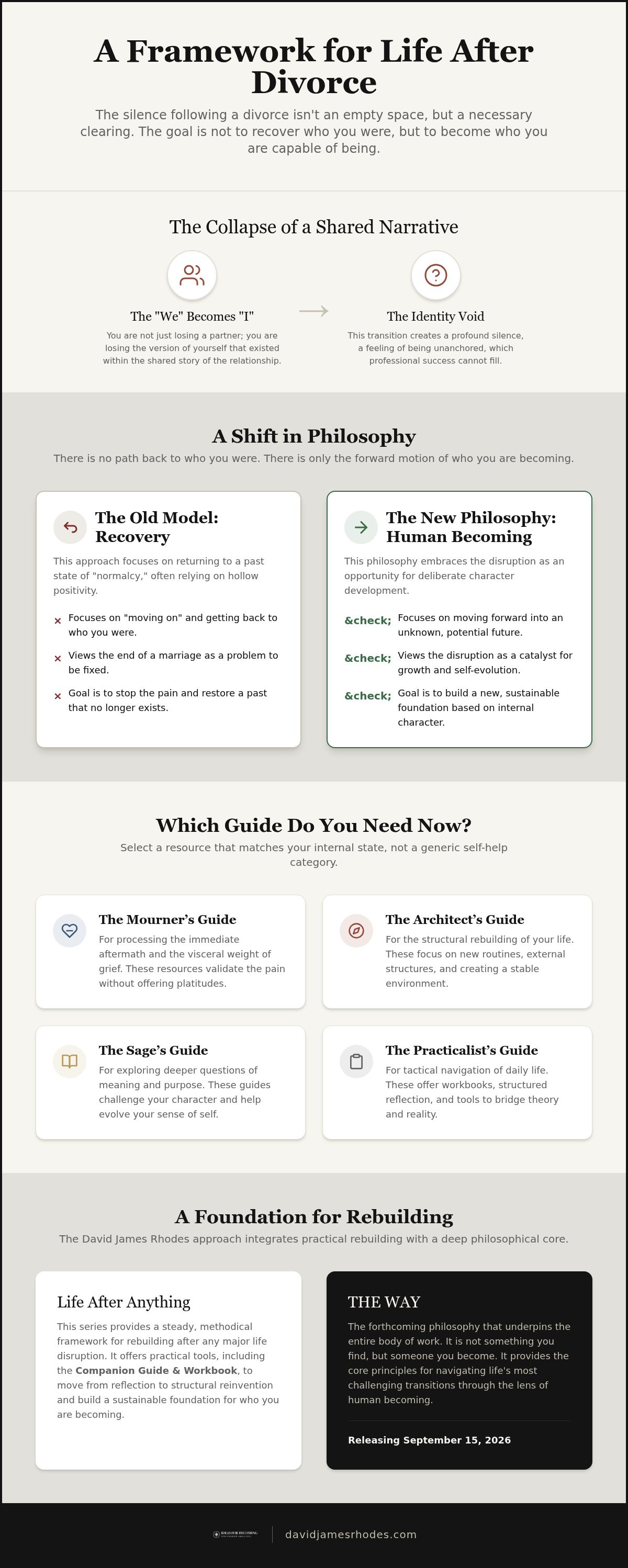
Categorizing the Journey: Which Guide Do You Need Now?
Standard bookstores often fail the divorced reader. They categorize resources under broad labels like "Relationships" or "Self-Help." These labels are too shallow for the weight you carry. To find the right life after divorce book, you must categorize the journey by your internal state rather than a retail genre. The void is not a monolith. It changes as you move through the silence. You need a guide that matches the specific frequency of your current struggle.
Consider these four archetypes of literature:
- The Mourner’s Guide: Focuses on the immediate aftermath and the visceral weight of grief.
- The Architect’s Guide: Focuses on the structural rebuilding of routines and external life.
- The Sage’s Guide: Focuses on the deeper questions of meaning, purpose, and the evolution of the self.
- The Practicalist’s Guide: Offers tactical workbooks and tools for daily navigation.
Processing the Trauma of Transition
The initial phase of dissolution is characterized by intense psychological distress and a sense of profound disorientation. You aren't looking for a strategy yet. You're looking for validation of the raw human experience. A "Life After Loss" framework is often more useful than a standard divorce manual because it respects the gravity of the broken covenant. The Mourner’s Guide serves as a vital instrument for emotional stabilization during the initial collapse. It provides the language for a pain that feels unspeakable, allowing you to acknowledge the loss without being consumed by it.
Tactical Rebuilding and Workbooks
Passive reading has its limits. Eventually, the mind requires a bridge between theory and the high-stakes reality of a new life. This is where structured reflection becomes essential. Workbooks force a pause. They demand that you answer the difficult questions of identity that you might otherwise avoid. This tactical approach is not about "fixing" a problem; it's about building a sustainable foundation for who you're becoming. Integrating daily practices is the only way to ensure that your evolution is permanent rather than performative. For those ready to move from reflection to action, the Life After Anything Companion Guide & Workbook offers a methodical framework for this structural reinvention.
The transition is not a race. It's a slow, deliberate process of character development. By identifying the specific guide you need now, you stop reacting to the trauma and start navigating the void with intention.
Comparing Philosophies: Recovery vs. Human Becoming
Most literature on the subject suggests recovery. Recovery implies a return. It suggests that if you work hard enough, you can find the person you were before the contract was signed. This is a fallacy. Life doesn't move backward. The long-term effects of divorce reach into the very structure of your character, altering your focus and your internal dialogue. To seek recovery is to chase a ghost. Instead, we must look toward the process of human becoming.
You aren't looking for a life after divorce book to help you return to the status quo. You're looking for a way to occupy a new reality. Divorce is not a detour. It's a catalyst. It's the invitation to finally begin the most important work of your life. This shift in perspective changes the fundamental question from "What happened to me?" to "Who am I becoming?". The first question leads to a dead end of resentment. The second question opens the door to a new chapter of character and identity.
The Myth of the Perfect Path
You won't find a linear checklist for this transition. Many books offer ten steps to happiness or a fixed timeline for grief. These are comforting fictions. The path isn't a pre-built road; it's a clearing you make as you walk. This is the core of The Way book David James Rhodes, a forthcoming philosophy,. It suggests that the path is found by walking it. You aren't fixing a broken machine. You're cultivating a landscape that has been cleared by fire. It's a slow, rhythmic process that requires patience and a quiet authority over your own choices.
Identity After the Label
Society loves labels. "Divorced." "Single." "Ex-spouse." These terms are anchors. They keep you tied to the event of the dissolution rather than the reality of your presence. Stripping away these old narratives is a surgical process. It requires the same discipline I've observed in global leadership across 156 countries. When a corporation collapses or a market shifts, the best leaders don't ask how to get back to the old quarterly targets. They ask what the new reality demands of their character. Personal rebuilding is no different. It's an executive function of the soul. You must shed the labels to find the essential self that remains when the noise stops.
A Selection Framework: How to Choose Your Next Read
Selecting a life after divorce book is a strategic act. It requires more than a casual glance at a bestseller list. You must first audit your current emotional capacity. Are you in a state of acute crisis, or are you ready for the deep work of reconstruction? Next, identify your primary void. Is it a loss of identity, a lack of purpose, or a struggle with logistics? Each void requires a different frequency of guidance. If you're struggling with the basic structure of your day, an architect's guide is more valuable than a philosopher's treatise. You don't need a map for a city you've already left. You need a compass for the one you're building.
Auditing the Author’s Perspective
You must seek authors with existential skin in the game. Does the guide understand the high stakes of significant life transitions? Many resources offer a "quick fix" that dissolves under the pressure of real-world complexity. Look for a global, timeless perspective. You want a witness who has seen the world from multiple angles and understands that character is forged in the extremes of human success and failure. Avoid the superficial. Seek the deep work that challenges your current state of being. The right author doesn't just tell you how to survive. They show you how they survived, providing a quiet authority that anchors your own effort.
The Role of Daily Reflection
A book read once is rarely enough for total transformation. Information is not evolution. To bridge the gap between theory and character, you need a structural anchor. This is the purpose of a daily practice. It creates a sanctuary of silence where you can confront the question of who you're becoming. Utilizing a resource like 365 Days of Becoming ensures that your growth is methodical rather than reactive. It forces a pause. It demands focus. It turns the act of reading into an act of construction. Without this rhythm, insights are lost to the noise of daily survival.
Finding the right life after divorce book is only the first step. The second is applying it. Balance your consumption with active reflection. Passive reading is often a form of hiding from the work. Workbooks and guides, such as those found in the Life After Anything series, turn the author's insights into your own identity. Commit to a daily practice of becoming. It's the only way to ensure that the "next chapter" isn't just a repeat of the last one. The void is not something to be filled with noise. It's a space to be occupied with intention.
Navigating Life After Anything: The David James Rhodes Approach
The search for a life after divorce book often begins with a desire to stop the pain. It's a natural reaction to trauma. But true navigation requires more than comfort. It requires a strategy for the self. The Life After Anything series is designed for these high-stakes transitions. It treats the end of a marriage not as a solitary event, but as a specific instance of a broader human experience. The collapse of a narrative. The silencing of a shared world. My observations from 156 countries suggest that while the context changes, the internal architecture of rebuilding remains the same.
This approach isn't about recovery in the traditional sense. We aren't trying to find the person you were before the dissolution. That person was part of a different story. Instead, we focus on the process of human becoming. We use the silence as a foundation. We use the void as a clearing. It's a methodical, deliberate reconstruction of identity that honors the gravity of your experience while demanding a new level of character.
Life After Divorce as a Subset of Life After Anything
Divorce is a profound disruption. It is a loss of a covenant. When you look for a life after loss book, you're looking for universal principles of rebuilding. These principles apply to any moment where the ground has shifted beneath your feet. Divorce offers a unique clearing. It's a space where the "we" has been removed to reveal the "I." This isn't a failure of your life. It's an opportunity for a deeper evolution. You are no longer defined by the contract. You are defined by the character you forge in the aftermath. The principles of rebuilding after a corporate collapse or a global shift are the same ones that will help you occupy your new reality.
The Call to Action: Who Are You Becoming?
The void is not empty. It's fertile. It's the place where the new self is born. But you must take ownership of the evolution. Who are you becoming? This isn't a rhetorical prompt. It's a challenge to your character. For those who require deeper, personalized guidance through this transition, my Leadership & Life Advisory provides a steady, experienced presence. We move beyond temporary symptom removal to build a sustainable, intentional life. The forthcoming philosophy, THE WAY, will provide the final anchor for this journey.
The storm has passed. The clearing remains. It's time to build. Start with the Life After Anything Companion Guide & Workbook to move from passive reading to active construction. The silence of the void is your sanctuary. Use it to become who you are capable of being.
The Silence is Your Sanctuary
The end of a marriage is a heavy weight. It's the collapse of a shared world. Yet, the clearing it leaves behind is the most fertile ground you'll ever occupy. Finding the right life after divorce book isn't about finding a way back to a previous self. It's about identifying a guide that respects your complexity and challenges your character. We've explored a selection framework that prioritizes existential skin in the game and the necessity of daily practice.
I've observed these patterns of disruption and rebuilding across 156 countries over four decades. The principles of human becoming are universal. You aren't just surviving a transition. You're constructing a new identity from the silence. This is the focus of my work and the foundation of the forthcoming philosophy, THE WAY,. Every word I write is intended to provoke internal change.
Take the next step in your evolution. Explore the Life After Anything series and Companion Guides to begin your structural reinvention. The void isn't something to fear. It's the space where your next chapter is written with intention. You're capable of becoming much more than you were.
Frequently Asked Questions
What is the best book for a man going through a divorce?
The best book is one that addresses the loss of a shared narrative and the collapse of identity. For men who've built their lives around professional success and family structures, the void is often existential rather than just emotional. I recommend the Life After Anything series. It provides a framework for rebuilding character when the external pillars of your life have been removed.
Are there workbooks specifically for rebuilding identity after divorce?
Structured reflection is essential for moving from passive reading to active construction. The Life After Anything Companion Guide & Workbook is designed specifically for this purpose. It forces a pause. It demands that you answer the difficult questions about who you are apart from your former partner. This isn't about filling time; it's about building a sustainable foundation for your next chapter.
How do I choose a divorce book that isn’t too religious or too clinical?
Look for resources that focus on character and philosophy rather than dogma or diagnosis. A high-quality life after divorce book should offer a worldly perspective grounded in the reality of human struggle. Seek authors who speak from personal observation and executive experience. You need a witness who understands the high stakes of transition without resorting to clinical labels or religious prescriptions.
Can a book about leadership help me with my divorce recovery?
Leadership is essentially the management of self through disruption. The principles of leading a global organization through a merger or a collapse are the same principles required to lead yourself through a divorce. Both require a quiet authority and a commitment to character. Rebuilding after a broken covenant is an executive function of the soul. It requires a strategy for the self.
What should I read if I feel like I’ve lost my identity after divorce?
You must read literature that challenges the labels society places on you. When the "we" becomes "I," the old narrative ends. Focus on the process of human becoming rather than just searching for a generic life after divorce book. My book, THE WAY, addresses this specific void by focusing on internal character rather than external paths.
Is there a guide for "life after anything" that covers multiple types of loss?
The Life After Anything series provides a comprehensive framework for rebuilding after any major disruption. Whether you're facing divorce, professional failure, or personal loss, the internal architecture of recovery remains consistent. The series focuses on universal truths about transition. It acknowledges that while the context of loss varies, the requirement for character development and structural reinvention is a constant human reality.
How often should I use a reflection workbook during divorce recovery?
Daily practice is the only way to ensure that transformation is permanent. I recommend a rhythm of daily reflection, as outlined in 365 Days of Becoming. Use your workbook in a sanctuary of silence for at least twenty minutes each morning. This consistency anchors the soul. It turns the act of reflection into a methodical process of construction. Growth doesn't happen in bursts; it happens in the quiet repetition of daily choices.
What are some philosophical books that help put divorce in perspective?
Seek books that offer a global, timeless perspective on the human condition. Philosophical guides should help you see your divorce as a subset of a larger story of evolution. They should move you away from resentment and toward responsibility. The goal is to find a sense of scale. When you understand your personal struggle within the context of human history, the void becomes a space for purposeful direction.
Frequently Asked Questions
Related Articles

Best Leadership Guides for Executives: A Thoughtful 2026 Selection
Searching for the best leadership books for executives? Discover thoughtful leadership guides matched to real executive challenges, strategy, and character.
Executive Coach vs. Advisor: Which Kind of Support Does a Leader Need?
Choosing between an executive coach vs advisor? Learn how to match the right support to consequential leadership decisions and the leader you are becoming.

Executive Advisory on Purpose and Fulfillment: A More Human Way Forward
Seek executive advisory on purpose and fulfillment to align leadership choices with values and character. Discover who you are becoming beyond outward success.