
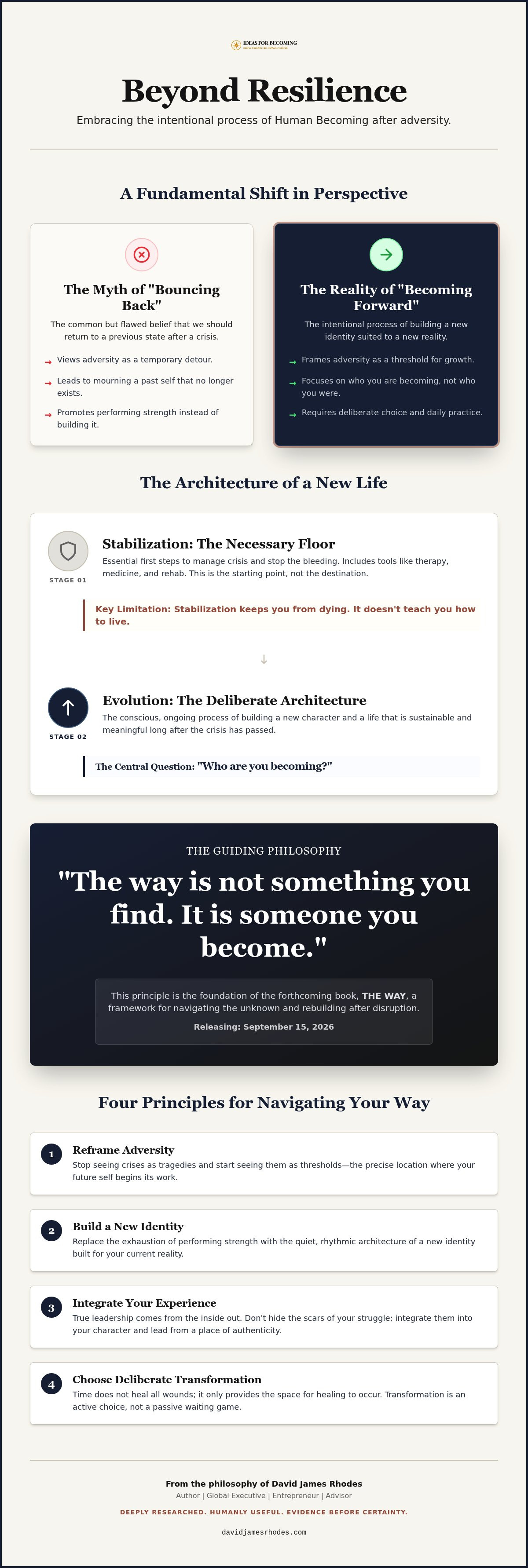
What if the person you were before the crisis is never coming back? Most advice focuses on "bouncing back" or returning to a previous state of being. But for many, that version of the self died with the loss, the failure, or the trauma. You're likely exhausted from performing a version of resilience that feels like a mask. Navigating life after adversity often feels like being stuck in a hallway where the door behind you is locked and the one ahead hasn't appeared yet. It's a heavy, quiet space where your old identity no longer fits.
You don't need to find your way back. You need to understand who you are becoming. This article explores how to shift your perspective from merely surviving a disruption to engaging in the intentional process of human becoming. We'll examine the difference between stabilization and evolution, drawing on David James Rhodes’ experience across 156 countries. We'll look at how his book, The Way, offers a framework for those who are ready to stop looking for a path and start becoming one. The way is not something you find. It's someone you become.
Key Takeaways
- Reframe adversity as a threshold rather than a tragedy, marking the start of a deliberate process of human becoming.
- Understand why the myth of resilience fails and why navigating life after adversity requires moving forward instead of attempting to return to the past.
- Learn to replace the exhaustion of performing strength with the quiet, rhythmic architecture of a new identity.
- Establish sustainable growth by shifting your focus from solving immediate crises to the daily practice of who you are becoming.
- Explore the framework of The Way, as a roadmap for those navigating the high-stakes reality of the unknown.
The Disruption of the Known: Understanding Adversity as a Threshold
Adversity is often framed as a tragedy or a detour. It’s seen as a broken piece of a life that was otherwise whole. But after observing human struggle across 156 countries over four decades, I’ve seen that adversity is actually the sudden absence of the familiar. It is a threshold. It's the moment the ground vanishes. You're forced to confront the reality that the person you were was built for a world that no longer exists. Navigating life after adversity isn't about fixing a problem. It's about engaging in the process of human becoming.
Most people treat identity as a destination. They spend their lives trying to "find" themselves, as if they are a lost set of keys. But who you are isn't a static object. It's a movement. In high-stakes environments, from the boardroom to the front lines, I've watched as the most effective leaders realized they couldn't just endure. They had to evolve. They understand that identity is a journey of becoming, not a point on a map. This is the core of my philosophy. It's the foundation of my book, The Way,. The path isn't something you find. It's the person you become through the navigation of your own reality.
The Illusion of Certainty
We cling to previous identities like life rafts. In a crisis, the instinct is to scramble back to "normal." But "normal" is a ghost. In finance or global leadership, the fear of the unknown can be paralyzing because it threatens our sense of control. We try to force the present into the shape of the past. This is a mistake. Trying to return to a previous state ignores the internal shift that has already occurred. You aren't the same person you were before the disruption. You can't go back to a house that has burned down. You must build something new.
Adversity as a Witness
To navigate this space, you must stop being a victim of your circumstances and start being a strategist of your soul. This requires a shift in perspective. While psychological resilience is often defined as the ability to cope, human becoming goes further. It doesn't just ask how you'll survive. It asks: who are you becoming because of this? Raw human experience is the forge. It strips away the non-essential. It leaves only the core. Adversity is the precise location where your current capacity meets its limit and your future self begins its work.
Beyond Resilience: Why 'Bouncing Back' is a Myth
The concept of "bouncing back" is a mechanical lie. It suggests that the human spirit is like a spring. Compressed by weight, it waits to return to its original shape. But you aren't a machine. When a life is disrupted, the original shape is gone. Trying to return to the past is an exercise in futility. It leads to a state of being "stuck" where you are perpetually mourning a version of yourself that can no longer survive the present. Navigating life after adversity requires an admission: the old you is gone. The person you were before the crisis doesn't live here anymore.
Many believe that time alone will fix the damage. It won't. Time is a neutral medium. It provides the space for change, but it doesn't do the work. Transformation is a choice. It's a deliberate construction. If you wait for time to heal you, you'll only find that you've grown older, not wiser. My Life After Anything philosophy centers on this reality. It's a framework for rebuilding when the disruption is total. It's about moving into the new rather than trying to salvage the old. You can explore these concepts further through my work on human becoming.
The Limits of Clinical Resilience
Clinical models are vital for stabilization. Medicine, rehab, and therapy provide the necessary floor. They stop the bleeding. The American Psychological Association offers useful frameworks for building resilience and managing stress. However, removal of a symptom is not the same as the presence of a life. Stabilization keeps you from dying. It doesn't tell you how to live. Professional recovery is the start. Personal evolution is the requirement. You must build a life that is worth staying sober or healthy for.
The Evolution of Character
Adversity doesn't just change your circumstances. It changes your character. It forces an integration of your professional identity and your raw human experience. You can't lead effectively if you're hiding the scars of your struggle. True leadership comes from the inside out. Navigating life after adversity is the ultimate test of character because it demands that you lead yourself before you lead others. This is the focus of my book, The Way,. It's a guide for those who realize that the crisis wasn't an interruption. It was the beginning of who they are becoming.
The Architecture of Becoming: Rebuilding Identity After Crisis
Rebuilding a life is not an act of willpower. It is an act of architecture. When the familiar structures of your world collapse, you're left with the raw materials of your character. The process of human becoming is slow. It is deliberate. It requires a rejection of the exuberant, hollow motivation that promises quick fixes. Navigating life after adversity demands a somber, intentional reflection on the ruins. You aren't looking for a silver lining. You're looking for the truth of what remains.
The central question is simple but heavy: Who are you becoming? This isn't a query about your next job title or your recovery status. It's a question of essence. To answer it, you must engage in the quiet work of self-witnessing. Tools like the Life After Anything Companion Guide & Workbook are designed for this specific labor. They provide the structure for a conversation with yourself that most avoid. This isn't about feeling better. It's about seeing clearly.
Dismantling the Old Narrative
Before the disruption, you likely defined yourself by your roles. Executive. Parent. Partner. Success. These labels provide a false sense of permanence. When they're stripped away, the vacuum is terrifying. Most people rush to fill it with new labels. They call themselves "survivors" or "victims." Both are traps. They anchor you to the event. You must embrace "the pause." This is the intentional space where you allow your old ideas to breathe and eventually die. Only in the silence of the pause can you stop reacting to what happened and start responding to who you are now.
Constructing a New Path
Construction begins with universal truths. These are the principles that don't shift when the world does. My book, The Way, serves as a compass for this navigation. It isn't a set of rules. It's a mode of being. When you anchor yourself in character rather than circumstances, you find a steady center. Identity is not a fixed point you reach. Identity is a process of movement through time and experience. You're never "finished." You're always in the state of becoming. This realization is the key to navigating life after adversity without losing your soul. It's the difference between being a person who happened to survive and a person who is intentionally evolving.
Navigating the Unknown: Practical Rhythms for Daily Growth
Philosophy remains abstract until it's lived. To move beyond the threshold of crisis, you need more than a mindset. You need a rhythm. Navigating life after adversity is not a project to be completed or a problem to be solved. It's a practice. Most people spend their energy trying to fix the external wreckage of their lives. They want the chaos to stop. But the chaos is often outside of your control. What remains within your reach is the intentional process of practicing becoming. You don't wait for the storm to pass to find yourself; you become the person capable of standing in it.
This is the foundation of 365 Days of Becoming. It's a framework for daily practice. It's designed to move you from the macro perspective of global struggle to the micro reality of your morning. My work across 156 countries has shown me that the most effective individuals aren't those with the most resources. They're the ones with the most disciplined internal rhythms. They understand that evolution happens in the quiet, repetitive moments between the high-stakes events. You can begin this discipline today by exploring the 365 Days of Becoming practice.
The Daily Practice of Becoming
A morning rhythm forces a pause. It's a refusal to be rushed by the demands of a broken world. This isn't about productivity. It's about presence. Start by asking the provocative, open-ended questions that shift your focus from survival to evolution. Who are you becoming in this moment? What part of your old self are you still trying to carry? Repetition is the anchor. By returning to these central themes daily, you create a new gravity for your life. You stop drifting. You start navigating.
Managing High-Stakes Transitions
In the world of global leadership, setbacks are inevitable. Transitions are high-stakes. When an executive or entrepreneur faces a significant disruption, the temptation is to sacrifice integrity for a quick recovery. This is a failure of character. Maintaining integrity under extraordinary pressure requires a commitment to the long game of human becoming. For the next generation of leaders, adversity is not a sign of failure. It's the training ground. Practical growth comes from integrating your struggle into your leadership style. You lead with authority because you've navigated the depths. You don't hide the scars; you use them as a map for those who follow.
Choosing Your Way: The Path Forward After Adversity
The disruption is over. The debris has settled. Now comes the choice. Navigating life after adversity is not a passive event. It's a deliberate direction. You've survived the worst. But survival is a biological achievement. Becoming is a human one. Survival is the floor, not the ceiling. Most people want to return to the safety of the past. They want the familiar. But the familiar is gone. You're standing in a new landscape. It requires a new way of walking. The real work is moving from the macro story of global struggle to the micro responsibility of your own character. Who you are now is not who you were. That's a fact. Who you will be is a choice. You must embrace the existential gravity of this moment. It's heavy. It's quiet. It's entirely yours.
The Forthcoming Philosophy
My book, The Way, releases September 15, 2026. It serves as a roadmap for those navigating the unknown. It's a distillation of high-stakes reality. It's built on four decades of experience across 156 countries. Before that release, engaging with Life After Anything provides the necessary foundation for rebuilding. You must clear the ground before you can build the architecture of a new identity. This process isn't about recovery in the clinical sense. It's about evolution in the human sense. It's the difference between being a victim of your history and a strategist of your future. I don't offer a cheering section or a motivational speech. I offer the perspective of a witness and a strategist. I've seen the extremes of human success and failure. I've returned with a singular insight: the crisis is the crucible of your evolution.
The Invitation to Become
The path ahead is not something you find in a map. It is someone you become. This is the central promise of The Way - Book by David James Rhodes. It's an invitation to take responsibility for your own becoming. Your crisis was not a mistake. It was a stripping away of the non-essential. You're left with the core of your character. Who are you becoming? The answer isn't found in a lecture. It's found in the rhythm of your daily life. It's found in the integrity of your choices when no one is watching. The way is open. It's waiting for you to inhabit it. Don't look for a path. Become one.
The Choice to Inhabit the New
Adversity is not an interruption. It's a threshold. We've explored why the myth of "bouncing back" often leads to stagnation and how the architecture of identity requires a slow, deliberate construction. Navigating life after adversity is the ultimate test of character. It demands that you move from the macro story of human struggle to the micro responsibility of your own evolution. The disruption has cleared the ground. Now, you must decide what to build.
My observations across 156 countries and four decades of leadership have taught me that the path forward is not found; it's built. As the author of Life After Anything, I've seen that the most effective individuals are those who stop looking for a path and start becoming one. The way is not something you find. It's someone you become. Prepare for the next phase of your evolution. Discover 'The Way',. The question remains, and it's the only one that matters: Who are you becoming?
Frequently Asked Questions
How do I start navigating life after adversity when I feel completely lost?
Start by acknowledging the threshold. You aren't lost; you're between versions of yourself. The first step in navigating life after adversity is "the pause," a deliberate cessation of the rush to return to normal. This space allows you to witness your current reality without judgment. Use tools like the Life After Anything Companion Guide & Workbook to begin the architecture of your new identity. It's a slow, quiet construction.
What is the difference between resilience and the process of human becoming?
Resilience is often defined as "bouncing back" to a previous state, which is a mechanical impossibility for a human being. The process of human becoming is about "bouncing forward." It accepts that the old self is gone and focuses on the evolution of a new character. While resilience seeks restoration, human becoming seeks navigation. It's the difference between surviving a storm and being transformed by it. You don't return. You evolve.
Can I really find meaning after a major life crisis like divorce or loss?
Meaning is not something you find; it is something you build through the navigation of your reality. Loss strips away the non-essential, leaving only the core of your character. This core is the site of your potential evolution. By engaging in the daily practice of who you are becoming, you integrate the pain into a larger story of growth. Meaning emerges from the integrity of your response to the crisis. It's earned.
How does David James Rhodes' philosophy of 'The Way' differ from traditional self-help?
Traditional self-help often relies on exuberant motivation and quick fixes that ignore existential gravity. The Way is a philosophy of navigation grounded in four decades of high-stakes experience across 156 countries. It doesn't offer a destination or a "better you." It focuses on the ongoing process of human becoming. It's a somber, intentional roadmap for those who realize the path is not something you find, but the person you are becoming.
Is it possible to rebuild my leadership career after a significant professional failure?
Professional failure is often the crucible where true leadership is forged. Rebuilding requires moving from a macro focus on status to a micro focus on character. Navigating life after adversity in a professional context means leading from the inside out. Your failure becomes your authority. It provides a unique perspective that the "successful" lack. Use this disruption to evolve into a leader who values integrity over mere performance and possesses a global perspective.
What role does daily practice play in recovering from life-altering events?
Daily practice is the rhythm that anchors you when the world feels chaotic. Recovery is larger than symptom removal; it requires a sustainable life built through repetition. 365 Days of Becoming provides a framework for this practice. By forcing a pause and asking provocative questions every morning, you shift from solving problems to practicing becoming. Rhythms create the steady center necessary for navigating long-term transitions. They turn philosophy into reality through consistent action.
How can I help the next generation navigate adversity and identity?
Guide them to see adversity as a site of potential evolution rather than a sign of failure. Through Education & Next Generation Advisory, we emphasize that identity is a journey of becoming, not a fixed point to be reached. Encourage them to value character over certainty. Model the quiet authority that comes from navigating your own struggles. Show them that the most important question they can ask is: "Who are you becoming?"
When is David James Rhodes' new book 'The Way' available for purchase?
My book, The Way is scheduled for release on September 15, 2026. This work serves as the definitive roadmap for navigating the unknown and engaging in the process of human becoming. Until its release, you can begin the work through the Life After Anything series and the 365 Days of Becoming daily practice. These resources prepare the ground for the deeper philosophical shift that The Way invites. Character is built in the waiting.
Frequently Asked Questions
Related Articles
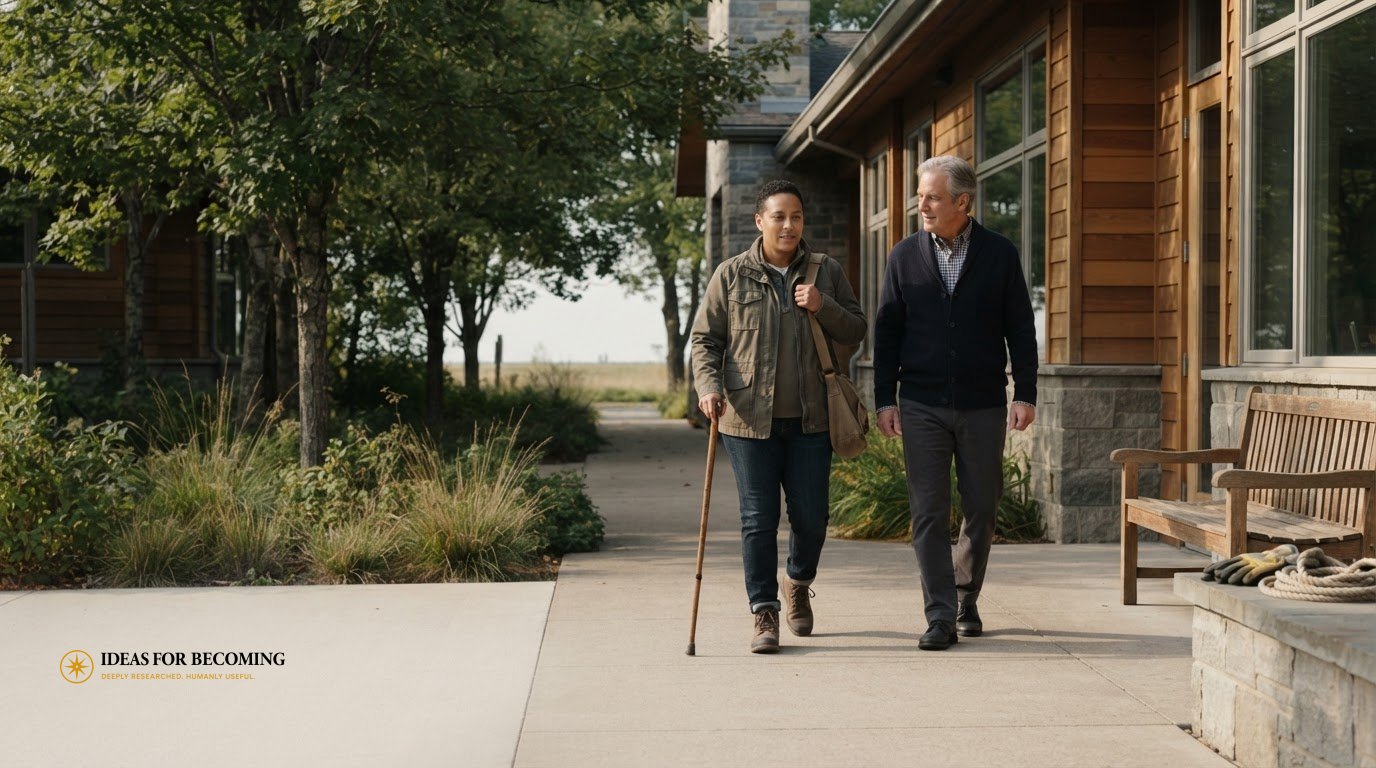
Explore resilience tools for thriving after major setbacks
Hear from a speaker on thriving after major setbacks. Discover practical resilience tools, rebuild routines, and find your way forward with quiet purpose.

Speakers on Navigating Significant Life Changes for Leadership Conferences
Hire the right speaker on navigating significant life changes for your leadership event. Learn how to guide teams through disruption with clarity and purpose.

Best Leadership Guides for Executives: A Thoughtful 2026 Selection
Searching for the best leadership books for executives? Discover thoughtful leadership guides matched to real executive challenges, strategy, and character.