
What if the energy of a keynote speech isn't meant to lift you up, but to ground you? Most audiences are tired of the noise. They're weary of the exuberant cheerleader who promises a breakthrough in sixty minutes. You've likely seen the hollow impact of traditional motivation in your own organization. It's reflected in the 2026 Gallup data showing only 21 percent of employees feel engaged. When searching for a speaker on meaning and purpose, you aren't looking for a temporary high. You're looking for a witness to the human experience.
This article provides a checklist to move beyond cliches. You'll learn how to identify an authority who addresses the deeper process of human becoming. We'll examine the difference between a performer and a strategist who has navigated the extremes of success and failure across 156 countries. We'll also preview the frameworks found in the book, The Way,. It's time to shift the focus from what your team does to who they are becoming.
Key Takeaways
- Understand why modern audiences are rejecting hollow motivation in favor of messages that address the deep crisis of meaning and engagement.
- Learn to vet a speaker on meaning and purpose by prioritizing the philosophy of human becoming over temporary emotional highs.
- Identify the critical markers of authority that distinguish a seasoned sage from a typical performer, focusing on raw experience and quiet confidence.
- Apply a specific five-point checklist to ensure your chosen message is grounded in high-stakes reality and the internal landscape of the individual.
- Discover how to integrate a legacy-focused keynote into a broader framework of leadership advisory for lasting organizational impact.
The Crisis of Meaning: Why the Modern Audience Needs More Than Motivation
The modern workforce is not merely tired. It is searching. We've moved past the era of "quiet quitting" into a deeper, more unsettling period of existential questioning. People aren't just asking for better benefits or flexible hours. They're asking if their work matters. They're asking who they are becoming within the structures we've built. A traditional speaker might offer a temporary spark. They might provide a "boost" to morale that lasts until the next Monday morning. But when you look for a speaker on meaning and purpose, you're looking for something that survives the first sign of friction. Does your current strategy address the soul of the organization, or just its output?
The Limits of the Motivational High
Motivation is a drug. It has a short half-life. Adrenaline-based speaking often fades within 48 hours because it relies on external energy rather than internal evolution. Leadership is often a somber reality. It involves grief, transition, and the weight of responsibility. To ignore this is to insult the intelligence of the audience. We must move from the question of "how to do" more toward the reality of "who to be" in the face of uncertainty. This shift is grounded in the psychology of a meaningful life, where purpose is not a target but a state of being. Why settle for a temporary high when you can begin a permanent shift? Real change requires a pause. It requires an intentional look at the gaps between our performance and our character.
The Search for Existential Authority
Audiences today have a keen eye for the artificial. They don't want a cheerleader. They want a witness. They crave existential authority. This authority isn't granted by a title. It's earned through the grit of high-stakes reality. David James Rhodes has navigated these complexities across 156 countries over four decades. This global perspective reveals a universal truth: meaning isn't found in a destination. It's found in the process of human becoming. The Way is not something you find. It's someone you become. A true guide has lived the transitions they describe. They don't just speak about change; they carry the marks of it. This is the foundation of the philosophy explored in the book, The Way,. Who are you becoming when the lights go down? The answer to that question determines the legacy of your leadership.
Purpose vs. Becoming: Understanding the Philosophical Shift
Purpose is often treated as a destination. A coordinate on a map. A prize to be won. This is a mistake. When you engage a speaker on meaning and purpose, you're usually asking for a map. But maps are useless in a shifting landscape. You need a compass. You need a philosophy of navigation. Meaning isn't something you find hidden under the floorboards of your career. It's something you build through the integrity of your presence. It's the difference between a static goal and an active process. Are you looking for a reason to work, or a way to be?
The Way: A Philosophy of Navigation
In the forthcoming The Way book, the focus shifts from the path to the traveler. The Way is not something you find. It's someone you become. This distinction matters. It changes the goal from achievement to evolution. In corporate strategy, it means the integrity of the process is as vital as the quarterly result. In life, it means that even in the wreckage of disruption, there's a person to be built. This philosophy applies whether you're leading a global team or navigating the quiet halls of personal recovery. The question isn't where you're going. It's how you're moving. Integrity is the only true north in a world that won't stop changing.
Identity as the New Strategy
Leadership is an extension of identity. You cannot lead others where you have not gone yourself. This is why identity is the new strategy. Before a leader asks "What should we do?", they must answer "Who are you becoming?". Character isn't forged in comfort. It's formed in the navigation of transition. It's found when we try to find meaning and purpose in your work not as a checklist of tasks, but as a reflection of our internal values. Work and life aren't separate rooms. They're a single, cohesive path. The struggle you face in the boardroom is often the same struggle you face at the dinner table. It's the struggle of becoming. A seasoned advisor doesn't offer shortcuts. They offer a mirror. They ask the questions that force a pause. If you're ready to explore these questions more deeply, consider how leadership advisory can anchor your organization's growth.
Vetting for Depth: Authority Over Exuberance
Credentials aren't enough. A title doesn't grant the right to speak on the human condition. When selecting a speaker on meaning and purpose, you must look for the scars. A guru performs. A sage witnesses. One offers a script. The other offers a presence. Trust is built in the gaps where certainty fails. It's found in the raw human experience of someone who has stood at the edge of failure and returned with a steady hand. We must prioritize authority over exuberance. Is the speaker offering answers, or are they inviting you into a deeper question?
The editorial standard here is "Evidence Before Certainty." This means distinguishing personal philosophy from established research. It means being honest about what we don't know. A speaker who respects the gravity of human struggle won't offer a three-step plan to happiness. They'll offer a framework for navigation. They'll acknowledge the challenges of cultivating meaningful work in a world that often prioritizes the mechanical over the human. Meaning is not a luxury for the elite. It's a requirement for anyone trying to build a life of integrity.
The Weight of Global Experience
Perspective is a product of proximity. David James Rhodes has spent forty years navigating the extremes of human success and failure across 156 countries. This isn't just travel. It's immersion. It's seeing the universal threads of struggle in the high-stakes world of international finance and the quiet, raw reality of behavioral health. This global lens helps avoid the "western-centric" trap. It reveals truths that remain constant regardless of the zip code. When a speaker has seen the world from every possible angle, their message carries a different kind of weight. It's a message grounded in reality, not theory.
Resilience Beyond Survival
Survival is the baseline. It's not the goal. A Keynote Speaker on Resilience: Moving Beyond Survival to Human Becoming understands this distinction. Bouncing back suggests returning to who you were before the disruption. But true transition changes us. We don't just return. We evolve. We become something new. Meaning requires more than just surviving a setback. It requires the courage to let the old self go so the new self can emerge. This is the heart of the philosophy in the book, The Way,. Character is formed in the navigation of these transitions. It's not about getting through the storm. It's about who you are when the sky finally clears.
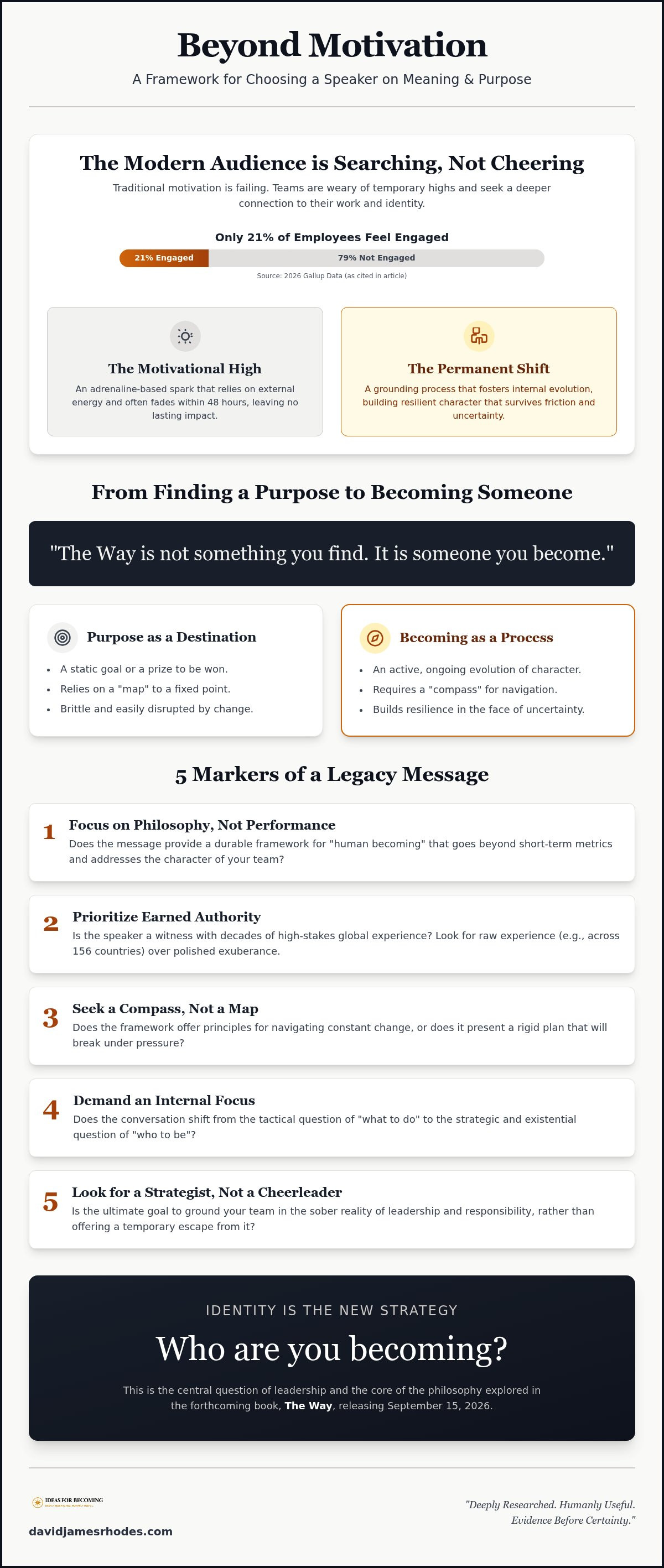
The Selection Checklist: Five Markers of a Legacy Message
Selecting a speaker on meaning and purpose is a strategic decision. It requires a lens that filters out the temporary noise of a performance. You aren't just booking an hour. You're introducing a catalyst for internal change. This requires a checklist grounded in reality. Does the speaker address the identity of the person before the output of the role? Is their message a product of decades spent in high-stakes environments? Planners often guess based on short bios. This tool is designed to stop the guessing.
Marker 1: Philosophical Grounding
A legacy message survives the stage. It requires a flagship body of thought that the audience can return to long after the event ends. Ask if the speaker has a coherent philosophy, such as the one found in the book, The Way,. This isn't just theory. It's a structure for the human journey. A true authority invites the audience into a daily practice of becoming. The work 365 Days of Becoming serves as this model. It provides a rhythm for growth that exists outside the spotlight. If a speaker cannot point to a practice, they're offering a performance, not a path.
Marker 2: Authentic Rebuilding
Wisdom is earned. It cannot be borrowed from a book of quotes. You must ask if the speaker has navigated their own Life After Anything. There's a profound difference between surviving a crisis and evolving through it. A speaker who understands recovery knows it's larger than symptom removal. It's about building a sustainable life from the wreckage. This requires a quiet authority that only comes from having lived the transitions described. Does the speaker sound like a witness or a salesperson? Authenticity is found in the willingness to be somber and intentional about the struggle. They must respect the gravity of the rebuilding process.
To ensure your next event leaves a lasting mark, look for these five markers:
- Identity First: They prioritize who the listener is becoming over what they're doing.
- Reality Tested: Their insights were forged in 156 countries and the high-stakes realities of global leadership.
- Human Language: They avoid manufactured profundity and generic AI jargon in favor of raw, intelligent conversation.
- Extended Philosophy: Their message is part of a larger framework, like The Way, that offers ongoing guidance.
- Daily Practice: They provide practical tools for the slow, methodical work of internal change.
If you're ready to bring this level of depth to your team, explore our options for keynote speaking to start the conversation.
The Path Forward: Bringing "The Way" to Your Organization
Bringing a message of depth to an organization requires more than a stage and a microphone. It requires preparation. You must signal to your team that this is not a traditional pep rally. It's a somber, intentional conversation about the reality of the human journey. When you introduce a speaker on meaning and purpose, you're opening a door. The goal's not to close it when the session ends. It's to integrate that message into the very identity of the culture. This integration's where the real work of human becoming begins. It requires a move from consumption to practice.
From Keynote to Advisory
A keynote's a beginning. A catalyst. But the integration of work and life requires a longer view. This is where leadership advisory becomes essential. A speaker who understands the intersection of elite performance and raw experience doesn't just leave after the applause. They transition into a strategic partner. They help navigate the messy reality of global transitions. This is especially vital for the next generation of leaders. They don't want corporate jargon. They want a compass. A long-term advisory role allows the philosophy of The Way to take root in the daily habits of the organization. It shifts the focus from quarterly output to the character of the people producing it.
Invitation to the Journey
The Path Forward's personal. It begins with a single, honest question: Who are you becoming? The Way's not a destination you reach. It's the quiet authority of the present step. It's the integrity you bring to the navigation of your own transitions. As you look toward the future, consider the resources that sustain this growth. The book, The Way, releases September 15, 2026. It'll serve as a permanent guide for those ready to move beyond cliches. It's grounded in forty years of experience across 156 countries. It offers a steady presence in an unsteady world. Every word's chosen to provoke internal change. Every insight's earned through high-stakes reality.
The search for meaning's not a luxury. It's a strategic necessity for any organization that intends to last. If you're ready to move beyond traditional motivation and explore the art of human becoming, we invite you to start that conversation today. The journey's long. The stakes are high. But the person you become along the way's the only legacy that truly matters.
The Integrity of the Next Step
The search for existential relevance isn't a trend. It's a return to what's essential. We've explored why traditional motivation fails and how to vet for genuine depth. Selecting a speaker on meaning and purpose requires looking for the marks of reality. It's about finding a witness who understands that The Way is not something you find. It's someone you become. This shift from performance to presence is what creates a lasting legacy in any organization.
David James Rhodes brings more than four decades of insight from 156 countries to this vital conversation. His work provides a framework for navigating high-stakes transitions and the quiet work of internal change. You can inquire about David James Rhodes for your next keynote to begin this intentional dialogue. His book, The Way, offers a roadmap for those ready to move beyond cliches. The person you're becoming is the only result that truly lasts. Trust the slow, steady work of your own evolution.
Frequently Asked Questions
What is the difference between a motivational speaker and a speaker on meaning?
A motivational speaker focuses on temporary emotional highs and external energy. A speaker on meaning and purpose addresses the internal landscape and the slow, methodical process of character evolution. While motivation fades within 48 hours, a message on meaning is designed to stick. It invites the audience into a somber, intentional conversation about who they are becoming. It moves beyond cliches to offer a framework for navigating high-stakes reality and transition.
How do I know if a speaker on purpose is right for a corporate audience?
Look for a track record in high-stakes environments like international finance or behavioral health. A corporate audience respects authority earned through experience rather than borrowed quotes. With disengagement costing the global economy an estimated 10 trillion dollars in 2025, leaders need a strategist who understands the crisis of meaning. If the speaker has navigated the extremes of success and failure, they can speak to the integration of life and work as a single, cohesive path.
Does a speaker on meaning need to have a specific religious background?
No, a specific religious background is not required. The philosophy of human becoming is a universal, secular inquiry into the nature of identity and character. It's rooted in the grit of raw human experience across 156 countries. While it addresses deep existential questions, it remains grounded in practical reality. The focus is on the integrity of the journey and the person the leader is becoming within their professional and personal roles.
Can a keynote on meaning actually help with employee retention?
Purpose is a primary driver of retention for younger generations. According to Deloitte's 2025 survey, 92 percent of Millennials state that purpose is important to their job satisfaction. A keynote that addresses meaning directly helps combat the disengagement that drains organizational energy. When employees feel connected to a deeper sense of becoming, they're four times more engaged. This connection transforms work from a series of tasks into a meaningful practice that people want to sustain.
What should I look for in a speaker’s "global experience"?
Global experience should represent more than a passport full of stamps. It should reflect immersion in diverse cultures and high-stakes systems across 156 countries. When vetting a speaker on meaning and purpose, look for someone who has navigated the universal threads of struggle on a global scale. This depth helps avoid a narrow, western-centric perspective. It ensures the message resonates with the diverse identities present in a modern organization and offers truths that remain constant in any culture.
How do I follow up a keynote on meaning to ensure it sticks?
A one-off event is rarely enough to create a lasting shift. You can ensure the message sticks by transitioning the keynote into a long-term leadership advisory role. This strategic partnership allows the philosophy to integrate into the organizational culture. Utilizing daily practices, such as those found in 365 Days of Becoming, provides a rhythm for continued growth. It moves the conversation from a single moment on stage to a consistent practice of human becoming.
Is "The Way" a religious or secular philosophy?
The Way is a secular philosophy focused on the process of human becoming. It's a structure for navigating growth, leadership, and recovery without being tied to a specific religious doctrine. The philosophy's rooted in over four decades of global experience and the intersection of elite performance and behavioral health. It addresses the universal human question of identity. It's designed to be humanly useful for anyone navigating the complexities of modern life and transition.
When is David James Rhodes’ book The Way available?
The flagship work, The Way is forthcoming and releases September 15, 2026. This book serves as the foundation for the broader philosophy of human becoming. It offers a steady presence for those navigating the wreckage of disruption or the weight of leadership. Until its release, you can engage with these ideas through keynote speaking and advisory services. The book's designed to be a permanent resource for anyone committed to the integrity of their own journey.
Frequently Asked Questions
Related Articles

Speakers on Navigating Significant Life Changes for Leadership Conferences
Hire the right speaker on navigating significant life changes for your leadership event. Learn how to guide teams through disruption with clarity and purpose.

Best Leadership Guides for Executives: A Thoughtful 2026 Selection
Searching for the best leadership books for executives? Discover thoughtful leadership guides matched to real executive challenges, strategy, and character.

Executive Coach vs. Advisor: Which Kind of Support Does a Leader Need?
Choosing between an executive coach vs advisor? Learn how to match the right support to consequential leadership decisions and the leader you are becoming.