
The most useful leadership talk may begin by challenging the leader, not the team. A speaker on leadership and authentic self-discovery helps audiences examine how values, habits, emotions, and blind spots shape the way they lead. The focus is on what authenticity means in practice, not on promising instant change.
Leadership takes more than confidence or authority. It asks whether your decisions reflect what you say matters, especially under pressure. It’s reasonable to want a speaker who makes that question useful to everyone in the room, rather than offering inspiration that fades when the event ends.
This article explores self-leadership, how self-awareness and vulnerability can influence trust, and what to look for in a speaker whose message fits your event. It also distinguishes common assumptions about self-discovery speaking from what audiences can genuinely take away: a clearer view of their choices, responsibilities, and who they are becoming.
Key Takeaways
- Self-leadership begins with examining how your values, habits, and reactions shape your decisions, especially under pressure.
- Trust grows when leaders act consistently with their principles and help people feel seen and understood.
- Invite candid feedback from people around you to uncover blind spots and adjust your approach.
- Choose a speaker whose message serves your event’s actual purpose, not simply one with a familiar name or polished delivery.
- Explore The Way when you want to reflect more deeply on leadership, character, and who you are becoming.
1. What is Self-leasdership?
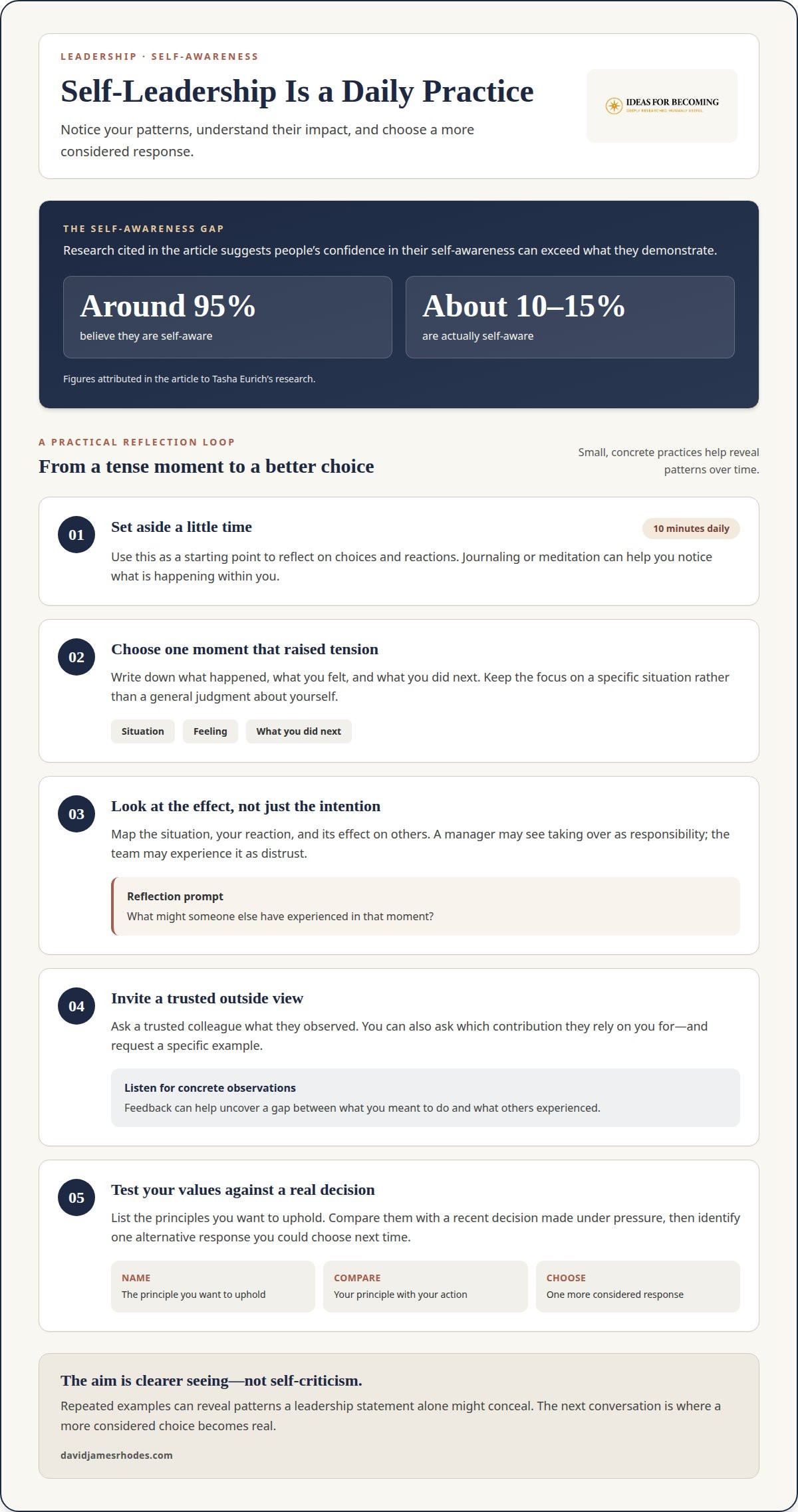
Self-leadership is the practice of noticing your inner patterns and choosing how to act. It begins with awareness: what do you value, what unsettles you, and what do others experience when you lead? Tasha Eurich’s research suggests that around 95 percent of people believe they are self-aware, while about 10 to 15 percent are actually self-aware. That gap matters. A leader may intend to invite honest debate, yet interrupt colleagues before they finish. The intention is not the impact.
Self-awareness helps leaders examine that difference without turning reflection into self-criticism. Consider a familiar situation: a deadline slips, and a manager responds by taking over every task. The manager may see this as responsibility; the team may experience it as distrust. A practical framework is to record the situation, your reaction, its effect on others, and one alternative response. Over time, examples can reveal patterns a single leadership statement might conceal.
Build the habit through small, concrete practices. Set aside 10 minutes daily for reflection, as a starting point for examining choices and reactions. Write down one moment that raised tension, what you felt, and what you did next. Then ask a trusted colleague what they observed. Journaling, meditation, and feedback from trusted colleagues can each help leaders notice strengths and areas for improvement. The aim is not to deliver a polished account of yourself. It is to see more clearly, then choose a more considered action.
Exercises can make values and strengths easier to identify. List the principles you want to uphold, then compare them with a recent decision made under pressure. Ask colleagues which contribution they rely on you for, and request a specific example. A speaker on leadership and authentic self-discovery may use reflection prompts, paired discussion, or decision scenarios to help audiences test their assumptions. The most useful exercises connect a stated value to observable behavior.
Speakers differ in expertise and approach. Some draw mainly on lived leadership experience; others emphasize research, facilitation, or practical reflection. Compare them by their experience, audience engagement, range of clients, and ability to adapt the message to the event. Ask what participants will be invited to examine, not only what the speaker will say.
Self-awareness also shapes leadership identity. A title describes a role; repeated choices reveal the person behind it. Notice whether you respond to disagreement with curiosity or a need for control. That observation connects character to colleagues’ everyday experience. An inspiring message can begin the reflection, but the leader’s next conversation is where the practice becomes real.
2. Authentic leadership and organizational trust
Trust grows through repeated choices, not declarations of good intentions. If a manager asks for candid feedback, then punishes the first person who disagrees, the team learns to stay quiet. The words sounded open, but the consequences taught something else. In organizations, credibility grows when decisions align with stated principles, especially when a choice involves pressure or personal cost.
Simon Sinek’s signature themes include purpose-driven decisions and trust-based teams. Purpose gives a leader a reference point when competing demands make an easy answer tempting. It does not eliminate difficult trade-offs. Instead, it helps explain why a choice was made, which value guided it, and what responsibility follows. A team may not agree with every decision, but a clear explanation gives people something concrete to understand and discuss.
Trust also has practical organizational weight: 93% of executives agree that building trust directly improves the bottom line. The figure does not mean every trusting team will perform well automatically. It points to why credibility deserves attention alongside plans, targets, and delivery. When people believe leaders will listen, explain decisions, and address mistakes, they have firmer ground for contributing to shared work.
Consider a missed deadline. An authentic leader can acknowledge the failure without shifting blame, explain the decision that contributed to it, and say what will change next. That makes accountability visible and gives the team a chance to raise relevant information before the next deadline. By contrast, a leader who changes the explanation each time weakens trust, even if the original mistake was small.
Authenticity at work is not unlimited disclosure or acting on every feeling. It means being truthful about what matters, consistent in your conduct, and willing to hear how your decisions affect others. Leaders can build this practice by explaining the principle behind a difficult choice, inviting questions, and following through on commitments. When team members feel seen and understood, they are more engaged and motivated to contribute to shared goals. That is a more durable basis for growth than approval alone.
For event organizers, the useful question is how a speaker connects purpose and trust to the audience’s real decisions. A strong talk should offer language people can apply to a meeting, a conflict, or a broken commitment, not merely praise authenticity as an ideal. Consider how the speaker grounds the message, engages the audience, and adapts it to the event. For a further perspective on leadership decisions, connect trust to the choices people make when pressure rises.
3. Vulnerability and confronting blind spots
A leader’s blind spot often appears in a familiar moment: a colleague raises a concern, and the leader answers before hearing the whole point. The leader may see decisiveness; the team may experience dismissal. Vulnerability begins with examining that gap rather than defending the intention. It is not weakness. It is a disciplined way to see how your conduct affects others.
Brené Brown is a well-known speaker whose work explores vulnerability and courage. In leadership, these ideas become practical when a leader can admit uncertainty, own a mistake, or ask for another perspective without giving up responsibility. For example, after overlooking a project risk, a manager can name the error, explain its effect, and invite the team to identify what should change. The admission matters because it leads to accountable action.
Use a clear process to examine a blind spot. First, describe the moment without defending yourself. Then ask colleagues what they observed and how your response affected them. Finally, compare their perspective with your intention and choose one behavior to practice. A leader who learns they dominate planning meetings might pause before responding and invite a quieter teammate to speak. The point is not to perform humility, but to change what happens next.
A transparent culture grows through relevant honesty, not unrestricted disclosure. A leader can explain why a decision was made, what remains uncertain, and what information might change the course. There is no need to share private details simply to appear open. Good judgment matters: people need enough context to understand decisions and raise concerns, while personal boundaries and confidential information remain protected.
Common risks include treating authenticity as permission to speak carelessly, sharing more than the situation requires, or using vulnerability to shift emotional responsibility onto the team. A leader who says, “I’m just being honest,” after a humiliating remark has confused candor with disregard. Another risk arises when a leader invites feedback but retaliates against disagreement. Such actions teach people to withhold what they see.
Adaptability means adjusting your approach without pretending your values have changed. During a tense review, one person may need direct expectations; another may need time to explain a concern. The standard remains fair treatment, while the conversation changes. Advisory can help leaders examine such patterns, prepare for difficult conversations, and notice when defensiveness takes over. The work asks leaders to face themselves, then practice a more responsible way of leading.
4. Emotional intelligence and self-management
Emotional intelligence becomes visible in a leader’s next action, not merely in what they feel. Daniel Goleman emphasized its importance for effective leadership in 1995. A manager who notices irritation during a tense meeting can pause, identify the concern, and respond to the issue rather than the person. That pause creates room between an internal reaction and an outward decision.
Self-management does not mean suppressing emotion. It means recognizing what an emotion may signal, then choosing a response that serves the situation and your values. For example, frustration about repeated delays might point to unclear responsibilities. A leader can name the missed commitment, ask what blocked the work, and agree on a next step. That is more useful than disguising anger as calm while avoiding the problem.
Mindfulness can support awareness through a simple practice: before a difficult conversation, take a quiet moment to notice your breathing, name the emotion, and clarify the outcome you want. This does not guarantee composure. It creates an opportunity to notice the impulse to interrupt, blame, or withdraw before acting on it. Reflecting on these moments can help a leader recognize recurring triggers and choose more intentional responses.
Emotional intelligence also includes empathy. If an employee becomes unusually quiet after receiving feedback, a leader can ask what the person understood and what support would help. Listening to the answer matters more than rushing to defend the original message. A strengths-based question can make the exchange specific: “Which part of this work gives you energy, and which part creates friction?” The answer can guide a practical adjustment without assuming the leader already knows what is needed.
Leaders can apply authentic self-discovery to everyday decisions by noticing a reaction, identifying the value at stake, and choosing an action that reflects it. Afterward, they can review the effect on colleagues and adjust their approach. For instance, a leader who values fairness can make sure everyone has a chance to explain before responsibility is assigned.
Emotional habits affect the whole team. A leader who avoids conflict may leave tension unresolved, while one who reacts sharply can make people wary of raising problems. In either case, the pattern matters more than the leader’s preferred self-image. Ask a trusted colleague what happens during disagreement, then compare their account with your own. Their feedback can reveal where your intention and impact diverge.
In practice, emotional intelligence is not a polished performance of calm. It involves noticing, understanding, and responding with care. A leader can put this into practice in a meeting by listening fully, asking a clarifying question, and making the next decision explicit. These small acts make values visible amid the ordinary pressures of leadership.
5. Myths about self-discovery speaking
One myth says an inspiring speaker needs a famous name to make an impact. Fame may draw attention, but it does not show whether a message fits the room. An event for new managers raises different questions from a gathering of senior executives. Organizers should start with the audience’s actual needs, then look for a speaker whose experience and approach align with them. A genuine connection to the event’s purpose matters more than recognition alone.
Another myth is that one keynote can create lasting change on its own. A talk can introduce a useful idea, give people language for a difficult pattern, or invite reflection. The work continues afterward. For example, a leadership team might leave a session on trust with a commitment to explain the reasoning behind a difficult decision at its next meeting. The keynote opens a door; leaders and teams decide whether to walk through it.
Some assume self-discovery speaking is only about motivation. Energy has its place, but a message also needs substance people can apply. Audiences should leave with a question, practice, or clear decision to carry into their work. After a talk on blind spots, for instance, a manager might ask a colleague for an example of how their responses affect discussion. That next step turns an abstract theme into observable behavior.
A third myth confuses authenticity with sharing everything. A leader discussing a mistake can make accountability feel human, but personal disclosure without purpose may distract or burden listeners. A speaker can model useful vulnerability by explaining what happened, what responsibility they held, and what they changed. The distinction matters: transparency serves understanding, while oversharing can shift attention away from the audience’s needs.
Another misconception is that one message suits every organization. The same story may resonate differently with a group facing rapid change than with one rebuilding confidence after a failed initiative. Before an event, clarify its objective, audience, and the conversation you want to encourage. Then compare the speaker’s examples and language with those needs. Feedback from organizers afterward can show what resonated and what may need a different approach next time.
Finally, authentic leadership is not a flawless performance. A speaker who admits complexity and still offers practical direction can help an audience consider its own choices without pretending that change is simple. Look for a clear point of view, relevant experience, and room for honest reflection. If your event needs a grounded conversation about character and leadership, explore Keynote Speaking as a possible fit.
David James Rhodes: The Way
The Way is David James Rhodes’s guide to character, purpose, and becoming who you are capable of becoming. It offers a wider frame for the questions raised by authentic leadership: not only how you lead, but who you are becoming through the choices you make.
Turn to it when reflection needs to continue beyond an event, or when a change in role or direction brings deeper questions about responsibility and meaning. For leaders working through decisions in their own lives or organizations, Leadership & Life Advisory offers a more focused setting for examining those questions. Keynote Speaking can bring these ideas to an audience facing leadership and change.
To explore this perspective further, contact David James Rhodes or visit davidjamesrhodes.com.
Choose the conversation your leaders need next
The next step is not finding language that sounds impressive. It is deciding what your audience needs to examine after the event. Is the central challenge making difficult choices, listening across disagreement, or leading through change? A clear purpose helps shape a useful conversation and gives participants something real to carry into their work.
When choosing a speaker on leadership and authentic self-discovery, look for a message that makes room for both reflection and responsibility. The aim is not to leave people with a perfect image of leadership. It is to help them notice one choice they can make with greater honesty, care, or courage.
That choice might be a more direct conversation, a pause before reacting, or a willingness to hear an uncomfortable perspective. Small actions can give a larger purpose practical form. Begin with the question your audience most needs to face, then choose a next step that makes the answer visible in everyday leadership.
Contact David James Rhodes to discuss a thoughtful next step. The work of becoming a more grounded leader starts with the choices made from here.
Frequently Asked Questions
What is self-leadership?
Self-leadership means taking responsibility for how you direct your attention, choices, and conduct. It matters when nobody is giving instructions, such as when deciding whether to raise a concern early or wait until a problem grows. A useful practice is to choose a commitment for the day, notice what competes with it, and review your decision afterward. This builds responsibility through ordinary actions, not authority over others.
What does authentic self-discovery mean in leadership?
Authentic self-discovery means examining which principles genuinely guide your leadership, then testing them against your behavior. A leader who says they value fairness might review how they assign credit after a successful project. The aim is not to settle on a fixed identity, but to keep learning from experience and make choices that better reflect the person and leader you intend to become.
What are the benefits of authentic leadership for teams and organizations?
Authentic leadership can clarify expectations and encourage people to raise relevant concerns. For example, when a project lead explains why priorities changed, teammates can focus on the new direction instead of guessing at hidden motives. This approach can support cooperation and shared responsibility. It does not eliminate disagreement; it gives the team a more honest basis for discussing trade-offs and deciding how to proceed together.
What research supports authentic leadership and self-awareness?
Research on self-awareness and emotional intelligence offers useful context, though it does not prove that one leadership style guarantees results. Tasha Eurich’s research suggests around 95 percent of people believe they are self-aware, while about 10 to 15 percent are actually self-aware. Daniel Goleman emphasized emotional intelligence as important to effective leadership in 1995. Treat these findings as prompts for reflection, not a scorecard for judging individual leaders.
How do I choose and book a speaker on leadership and authentic self-discovery?
Start by defining the event’s purpose, audience, and the conversation you want participants to continue afterward. Then assess whether a speaker’s experience and approach fit those needs, and ask what practical reflection or discussion the audience will take away. A speaker on leadership and authentic self-discovery should connect ideas to real decisions, not rely on inspiration alone. For an event aligned with this focus, explore David James Rhodes’s Keynote Speaking.
Frequently Asked Questions
Related Articles

Executive Guidance on Ethical Leadership Principles for Building Trust
Executive guidance on ethical leadership principles shows how honesty, fairness and accountability build trust, credibility and guide everyday decisions.

Purpose-Driven Life Advisory for Professionals: Work With Purpose
Purpose-driven life advisory for professionals connects your values to leadership and daily work, helping you pursue meaningful goals and lasting fulfillment.

Mentorship for Aspiring Global Leaders: Track Outcomes and Impact
Mentorship for aspiring global leaders builds practical skills and sound judgment. Learn to set goals, make cross-cultural matches, and assess impact.