
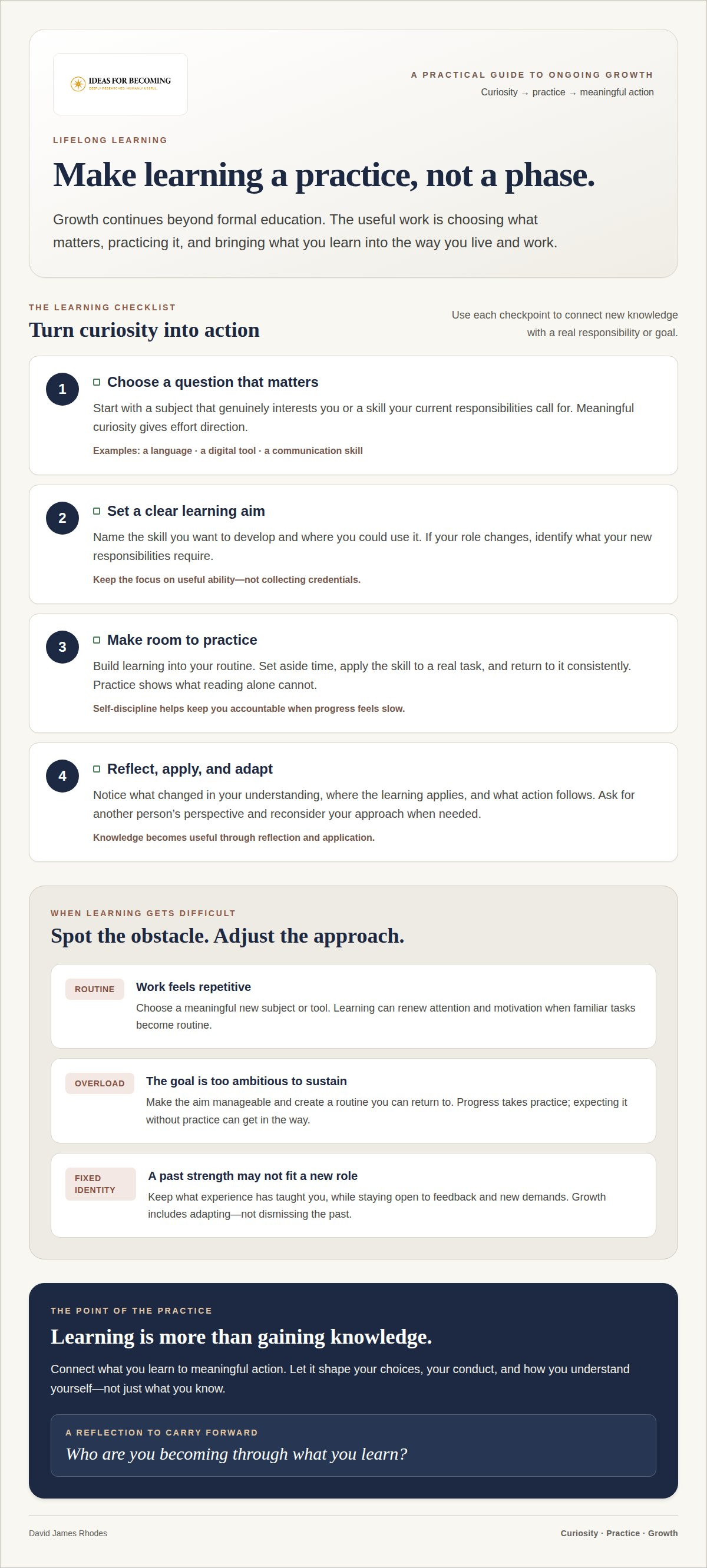
Growth does not end when formal education does. A speaker on the lifelong process of becoming sees lifelong learning as self-initiated, self-directed education shaped by the desire for personal development and fulfillment. It includes building skills, revisiting what experience has taught you, and learning through the changes life brings.
Learning can open new possibilities, but growth is rarely a straight line. It calls for attention, practice, and a willingness to be a beginner again. This article explains how skill development and ongoing education support personal and professional growth, why learning matters when work becomes routine, and how rites of passage can mark change. The deeper question is not only what you will learn, but who you are becoming through it.
Key Takeaways
- Treat learning as an ongoing practice, not something that ends with formal education. Choose skills that serve both your work and the life you want to build.
- When work becomes routine, learning something new can renew attention and motivation. Start with a subject that genuinely interests you.
- Skill development takes practice and self-discipline. Set a clear learning aim, then make time to return to it consistently.
- Rites of passage help mark transitions and changes in responsibility. Reflecting on what a transition asks of you can help turn change into growth.
- Personal growth is more than gaining knowledge. Use what you learn to shape your choices, character, and sense of who you are becoming.
Personal and professional skill development
Skill development connects learning with practice. A new language, digital tool, or way of listening can shape both your work and daily life.
The Speaker’s Ideas on Growth and Change
Personal growth is the ongoing work of gaining knowledge, practicing skills, and revising how you understand yourself. It matters because no school or university qualification can prepare you for every role you will take on later. George Herbert Mead’s account of the self emphasizes learning to take another person’s perspective. At work, that might mean hearing a colleague’s concern before deciding how to respond.
This view shares ground with Mead’s social account of development and the life course approach, developed in the 1960s to examine lives within social and cultural settings. These ideas help explain why experience and relationships shape learning. They don’t prove that every person develops in the same way. David James Rhodes’s perspective also draws on over four decades of experience across 156 countries; that experience informs his views, rather than serving as scientific proof.
Practical Steps for Lifelong Growth
Lifelong growth becomes practical when curiosity leads to a learning goal and sustained effort. Start with a subject that interests you, then choose a skill you can use in a real setting. Learning new technology, for example, may strengthen problem-solving skills that transfer between personal and professional life. Self-discipline helps you stay accountable when progress feels slow. Developing expertise can also help you contribute in a more distinctive way.
Build learning into your routine. Set aside time to practice, apply the skill to a task, and note what still needs work. If your role changes, identify the abilities your new responsibilities require. A chance to thrive may call for investing in yourself or changing direction. The goal is not to collect credentials, but to connect learning with meaningful action.
Obstacles and Risks in Becoming
Common obstacles include routine, divided attention, and expecting progress without practice. When work becomes repetitive, learning can renew motivation, but an ambitious goal without a manageable routine may be difficult to sustain. Self-discipline matters, as does choosing a subject that means something to you rather than pursuing a skill only because others value it.
Expertise can also become a fixed identity. A skill that served you in one role may not fit the next. Keep learning without dismissing what experience has taught you. Ask for another person’s perspective, as Mead’s account of social development suggests, and use that feedback to reconsider your approach. Growth requires commitment and a willingness to adapt.
Talks and Transcripts Featuring the Phrase
A specific speech, guide, or interview cannot be reliably attributed to the phrase without an identifiable original text. To find David James Rhodes’s original words, start with his official website or speaking materials. A transcript should identify the event or conversation and preserve the speaker’s wording, rather than present a summary as a quotation.
His background includes international finance, leadership, entrepreneurship, and behavioral health across 156 countries. Those experiences offer context for his views on skill, identity, and change; they don’t establish that one particular talk contains the phrase. If you encounter the wording in a transcript, compare it with the original recording or event text before quoting it. That distinction protects both accuracy and meaning.
Importance of ongoing learning
Lifelong learning is self-initiated, self-directed education focused on personal development and fulfillment. It can happen at any age, in a classroom or elsewhere. Someone might study a language, learn new technology, or reflect on a difficult conversation. The setting matters less than the purpose: learning connects new knowledge with the choices and responsibilities that give life meaning.
Formal education offers structure, but it is only one part of the process. School and university can build foundations; later experiences reveal where those foundations need updating. A new role, changing family responsibilities, or unfamiliar technology can expose gaps in knowledge. Learning then helps you meet the moment with greater understanding instead of relying only on habits formed in an earlier chapter.
Learning can also renew engagement when work becomes routine. Consider someone who has repeated the same tasks for years. Studying a language may bring fresh attention to sound, memory, and conversation. Learning a new tool can make familiar work feel different by revealing another way to solve a problem. The benefit is not novelty alone. A meaningful learning goal gives effort direction and can renew motivation.
Learning beyond an educational institution is often practical and social. A parent might learn a digital tool alongside a child; a colleague might ask an experienced teammate to explain a process. These moments turn everyday responsibilities into opportunities for growth. To make them useful, choose a question that matters, find a setting to explore it, and apply what you learn to a real task. Practice reveals what reading alone cannot.
Ongoing learning also requires discernment. Information is easy to collect, but knowledge becomes useful through reflection and application. After learning an idea, note what changed in your understanding, where it applies, and what action follows. For example, someone learning a communication technique can try it in a meeting, then reflect on how the exchange went. This cycle connects knowledge to conduct and keeps development grounded in real life, not just credentials or accumulation.
No single subject gives everyone meaning. Ask what your present responsibilities demand and what curiosity keeps bringing to mind. A new language, unfamiliar technology, or neglected interest can each open a different line of inquiry. Keep learning not to avoid uncertainty, but to meet it with a wider perspective and a more deliberate response.
Learning can happen anywhere and at any time, including beyond educational institutions. When work becomes routine and less engaging, learning can renew motivation by giving your attention a fresh direction. A new language or technology can offer that direction, whether you explore it in a class or through everyday practice. The aim is not to keep adding activities, but to respond to changing questions and bring useful understanding to the responsibilities already at hand.
Rites of passage
A rite of passage marks a transition from one social role or stage of life to another. It can give change a shared form, such as a graduation, naming ceremony, or gathering that recognizes a new responsibility. The event matters because it makes the transition visible. A person is not only moving forward privately; family or community members acknowledge that something has changed.
In the United States, socialization across the life course is strongly shaped by age norms and time-related rules and regulations. School schedules, expectations about education, and the timing of entering a career can influence how people understand adulthood. These patterns offer structure, but do not define each person’s readiness. Graduating from university, for instance, may mark an academic transition without answering what kind of work or life will follow.
Rites vary across cultures, so one community’s practice should not be treated as a universal model. In a described Algonquin rite of passage, boys were isolated for two or three weeks. This detail shows how a transition can involve separation from familiar routines and a distinct period of reflection. It does not mean the practice should be copied elsewhere. Its meaning belongs to its cultural setting.
Modern transitions may have no formal ceremony. Starting a first job, becoming a caregiver, or leaving a long-held career can still change a person’s duties and relationships. To recognize such a threshold, name what has ended, identify the responsibility that begins, and consider who can witness the change. A family dinner after graduation, for example, can acknowledge effort and open a conversation about the graduate’s next decisions.
Education and career changes can be understood as processes, not single events. A certificate may signal a new qualification, while the first months in a new role teach practical expectations. The milestone creates a marker; what follows gives it substance. Reflection connects the two. Write down what the transition asks of you, what support you need, and which habits must change.
A rite does not guarantee confidence or resolve uncertainty. Its value lies in making a transition easier to recognize. When a person changes roles without acknowledgment, they may struggle to understand what others now expect. A deliberate conversation can help. A manager welcoming a new team lead can clarify responsibilities; relatives can discuss how caregiving will change family routines. These acts give change a social shape and help people take part in it consciously.
Not every transition needs a ceremony. Ask whether the change deserves acknowledgment and what form would feel genuine. A journal entry, conversation with someone you trust, or community gathering can mark a meaningful threshold. Choose a form that fits the person and context. The aim is not spectacle, but clear recognition of what has changed and what comes next.
Who is the speaker known for discussing the lifelong process of becoming?
The speaker discussed here is David James Rhodes, whose work explores human becoming. His central idea is that people create a way forward through who they become. This shifts attention from finding one perfect path to developing the character and judgment to meet changing circumstances. It offers a lens for considering growth across work, relationships, and major transitions.
Rhodes’s perspective draws on experience in international finance, leadership, entrepreneurship, and behavioral health. Each setting raises different questions. A leader considers responsibility to others. An entrepreneur faces uncertainty and failure. Someone rebuilding a life may need to reconsider identity and daily choices. These situations differ, yet his work connects them through a shared question: who are you becoming?
Readers seeking a speaker on the lifelong process of becoming may be interested in how this philosophy connects achievement with character. A promotion, for example, changes someone’s responsibilities but does not automatically develop the judgment leadership requires. Rhodes emphasizes the person shaped through actions, habits, relationships, and reflection. The point is not to dismiss achievement, but to consider what kind of person it asks you to become.
His approach is philosophical and practical, not a claim that one formula works for everyone. Consider someone facing a career change. The immediate task may be choosing a role, but the deeper work includes examining values, accepting uncertainty, and acting with intention. As a speaker on the lifelong process of becoming, Rhodes draws attention to the identity and conduct taking shape beneath visible decisions.
This distinction matters when comparing a speaker’s philosophy with established research. Rhodes’s global experience informs his observations, but it should not be mistaken for scientific proof. Research into development and social experience offers other ways to understand change. A careful reader distinguishes evidence about specific findings from a speaker’s framework for reflection.
The phrase “lifelong process of becoming” alone does not identify a particular talk or transcript. Attribute a quotation to Rhodes only when an original recording or text confirms that he used those exact words. A summary may convey his ideas without being a verbatim quotation. This distinction protects the meaning of his work and the accuracy of what readers repeat.
Readers can apply this perspective to everyday decisions. Before accepting a responsibility, consider which qualities it will demand. After a setback, choose a response aligned with your values. In a moment of success, look beyond the result to the habits and relationships that helped make it possible. These questions turn an idea about human development into a way to examine daily conduct.
What are the speaker’s main ideas about personal growth and change?
David James Rhodes treats becoming as an ongoing relationship between values and daily conduct. Growth is not simply knowing what matters; it is letting that knowledge shape how you spend your attention, keep commitments, and treat others. If fairness matters to you, for example, it should influence how you share credit when a group succeeds. The principle becomes meaningful through action.
His framework also allows for contradiction. Someone may value patience and still react sharply under strain. That gap is not a verdict on character; it is useful information. Notice the trigger, consider who was affected, and decide what repair or different response is needed next time. Reflection matters when it leads to responsibility, rather than excusing harm or becoming a reason to punish yourself.
Change can also require loosening an old self-description. Someone who has always been “the dependable one” may find it difficult to admit exhaustion or ask for help. A new choice can feel unfamiliar because it challenges a familiar role. Rhodes’s emphasis on becoming invites people to consider whether an identity still serves their responsibilities, relationships, and sense of purpose.
Progress is not a neat sequence of improvement. Someone can act courageously in one situation and avoid a difficult conversation in another. The task is to keep returning to what matters without pretending that each decision proves lasting change. Apologizing after a disagreement, for instance, begins repair; listening differently during the next disagreement gives that intention more substance.
This philosophy is best understood as a way to interpret experience, not a universal guarantee of outcomes. Rhodes’s observations draw on his professional and personal experience. Readers can use the ideas as questions for reflection while recognizing that circumstances differ. What matters in one family or workplace may not fit another. Context, responsibility, and the people affected all shape a thoughtful response.
To put the idea into practice, choose a value you want your actions to express. Identify a moment in the coming week when that value will be tested. Afterward, record what you did, what effect it had, and what you might change. This is not a scorecard, but a way to make intention visible and learn from consequences without reducing a whole life to one moment.
A daily reflection can help keep that attention alive. Explore prompts for becoming as one way to consider how values show up in ordinary choices. The work remains personal: decide what deserves your attention, then let your actions give that decision weight.
David James Rhodes: The Way
The Way is David James Rhodes’s guide to becoming the person capable of creating a way forward. It brings the article’s central question, “Who are you becoming?”, into a wider philosophy of character, courage, responsibility, and action. Turn to it when a transition, setback, or success leaves you asking what kind of life you want to build next.
For organizations and individuals seeking to explore these ideas in conversation, Rhodes offers keynote speaking, Leadership & Life Advisory, and Education & Next Generation Advisory. Each provides a context for considering how people grow, lead, and make choices through change.
To continue exploring these ideas, visit davidjamesrhodes.com.
Carry the question into what comes next
Growth becomes real through the decisions you make after reflection. Choose a commitment that deserves your attention now. It might be a postponed conversation, a responsibility you need to accept, or a direction you have outgrown. Make the next step small enough to take, but honest enough to matter.
A speaker on the lifelong process of becoming can offer a useful frame for this work, but no idea can make the choice for you. Your task is to bring intention to the everyday moments where character takes shape. Begin with the next decision in front of you. Notice what it asks of you, then act with care.
If you want to continue the conversation about becoming, leadership, or the choices that shape a life, contact David James Rhodes. Take the next step with patience and purpose. You are still becoming.
Frequently Asked Questions
What is Lifelong Learning?
Lifelong learning is the continued pursuit of understanding beyond the requirements of formal schooling. Ask whether learning responds to a question or need you have chosen for yourself. For instance, someone preparing to join a community board might study how local governance works before taking on the responsibility. The learning has a clear purpose and a real context.
What does the speaker mean by the lifelong process of becoming?
David James Rhodes uses the phrase to challenge the idea that life has one fixed route or final identity. Instead, it points to developing the capacity to respond when circumstances change. If a planned project is cancelled, for example, the next task may be to understand the new constraints, seek useful perspectives, and identify another responsible course of action. The future remains open, but it still asks something of you.
Frequently Asked Questions
Related Articles

Executive Guidance on Ethical Leadership Principles for Building Trust
Executive guidance on ethical leadership principles shows how honesty, fairness and accountability build trust, credibility and guide everyday decisions.
Purpose-Driven Life Advisory for Professionals: Work With Purpose
Purpose-driven life advisory for professionals connects your values to leadership and daily work, helping you pursue meaningful goals and lasting fulfillment.
Mentorship for Aspiring Global Leaders: Track Outcomes and Impact
Mentorship for aspiring global leaders builds practical skills and sound judgment. Learn to set goals, make cross-cultural matches, and assess impact.