
Managing keeps the present moving. Leading means choosing what should shape the future. Strategic life guidance for senior executives puts that distinction into practice: clarify what matters, set meaningful goals, protect time for them, and break them into milestones. Apply the discipline you bring to organizational decisions while accounting for the demands and relationships of a whole life.
Ambition can make life look successful from the outside while leaving its direction unexamined. Executives may set priorities for an organization yet struggle to make room for their own long-term aims. The answer isn’t another crowded list of objectives. It’s a clear connection between the person you want to become and the choices you make now.
This article shows how to apply leadership insights to personal challenges, adapt plans without abandoning their purpose, and look beyond immediate demands. You’ll find practical ways to identify obstacles, protect your focus, and turn a large aspiration into manageable steps. The aim isn’t to control every outcome, but to act with greater intention and keep your direction visible as circumstances change.
Key Takeaways
- Apply leadership skills such as prioritisation, resource allocation, and accountability to personal goals as well as work challenges.
- Review progress regularly and adjust the plan when obstacles reveal that your approach or support needs to change.
- Make space for long-term reflection so immediate demands don’t decide the shape of your life by default.
- Protect focus by noticing where your attention goes and choosing which distractions deserve less of it.
- Turn ambitious goals into smaller milestones, then use each one to guide your next deliberate step.
Applying leadership learning to existing work challenges
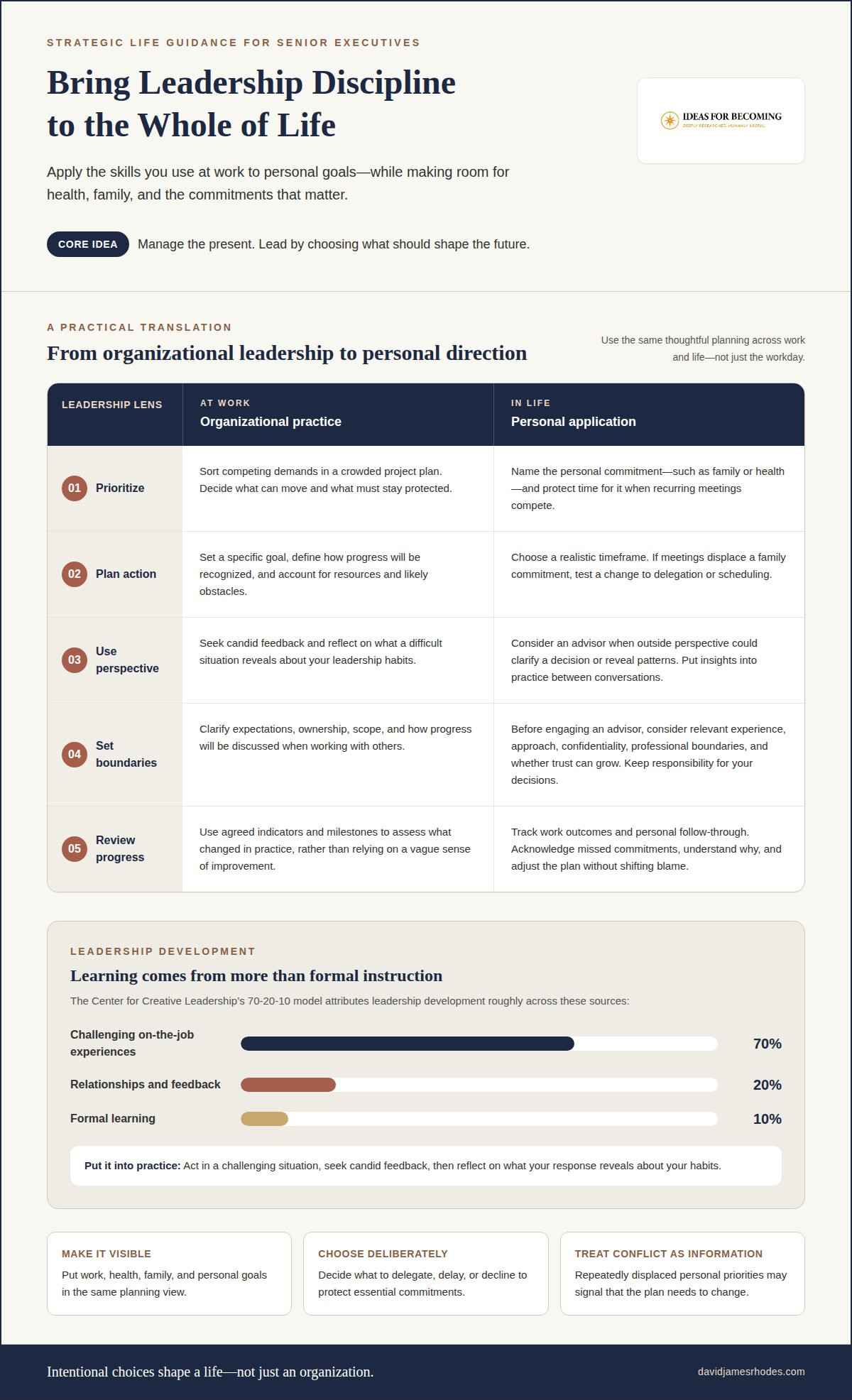
- Choose a current challenge, then apply a leadership skill to both it and a personal goal. If recurring meetings take time you need for family or health, use the same prioritization you’d apply to a crowded project plan. Name the commitment, identify what can move, and decide what must stay protected. Strategic life guidance for senior executives starts by connecting a real decision to the person making it.
The Center for Creative Leadership’s 70-20-10 model attributes roughly 70% of leadership development to challenging on-the-job experiences, 20% to relationships and feedback, and 10% to formal learning. Treat a difficult work situation as practice: act, seek candid feedback, and reflect on what your response reveals about your habits.
- Turn business strategy into a personal action plan. Set a specific goal, define how you’ll recognize progress, and choose a realistic timeframe. For example, an executive who wants more time for a family commitment can identify which meetings regularly displace it, then test a change to delegation or scheduling. Include the resources you need and the likely obstacles, as you would for a work initiative.
Budgeting, time management, and prioritization apply beyond the office. Use a calendar to make your obligations visible, then assess whether each activity supports a stated goal. Accountability matters: acknowledge missed commitments, identify why they happened, and adjust the plan rather than shifting blame.
- Turn to an advisor when an outside perspective could help reveal patterns or clarify a decision. Advisory can sharpen priorities, offer perspective on leadership behavior, and provide a structured way to apply learning to career and personal choices. Progress depends on putting insights into practice between conversations, not simply discussing ambitions.
Before engaging an advisor, define the challenge you want to address. Consider relevant experience, the advisor’s approach, how you’ll discuss progress, and whether you can build trust. A good fit supports clear thinking without taking responsibility for your decisions.
- Ask about qualifications, credentials, and professional boundaries before beginning. Look for relevant training and experience with the kind of leadership or life challenge you’re addressing, alongside clear expectations for confidentiality and scope. Credentials can indicate preparation, but they don’t replace sound judgment, a suitable working relationship, or your own responsibility.
Balance leadership demands, health, family, and personal goals by putting them in the same planning view. Protect essential commitments, then decide what to delegate, delay, or decline. If a work priority repeatedly displaces a personal commitment, treat the conflict as information about your plan, not proof that the commitment doesn’t matter.
- Assess progress using agreed indicators, not a vague sense of improvement. Record a starting point, such as a recurring decision delay, a specific leadership behavior, or a personal commitment you repeatedly miss. Set milestones to review those indicators, gather feedback where appropriate, and note what changed in practice. This gives you a clearer basis for discussion without promising a particular result.
Consider both work outcomes and personal follow-through when assessing progress. A stronger delegation habit may change how a team operates; a protected commitment may help you make more consistent time for family or health. Compare agreed indicators over time, consider what else influenced them, and decide whether the learning is changing your actions.
Adapting plans while staying aligned with central goals
- Keep the central goal steady while treating the route as revisable. A senior executive pursuing a career transition may encounter a hiring freeze, a family need, or changing industry conditions. These can affect timing without making the goal meaningless. Write the goal in one sentence, then separate its purpose from the current method. This distinction helps prevent a temporary obstacle from becoming an accidental decision to abandon your direction.
Use analysis to ask what changed, what remains true, and what choice follows. A delayed transition, for example, might call for building experience in your current role before pursuing another position. Adapt the sequence, not the reason the goal matters.
- Review your objectives and milestones, then identify where the plan has lost traction. If you intend to create a more sustainable work culture but keep canceling team conversations, those missed actions are useful evidence. The issue may be competing demands, unclear ownership, or an unrealistic schedule. Naming the cause is more useful than labeling yourself undisciplined.
Compare the intended result with what has happened. Ask which actions moved the objective forward and which did not. A plan that depends on a leader personally attending every discussion may need clearer delegation. Keep the desired outcome visible while changing the approach that repeatedly fails.
- Distinguish a genuine change in circumstances from discomfort with difficult work. A new market trend may call for a different route; resistance to a necessary conversation may call for courage, not a revised goal. Before changing direction, describe the evidence behind the change. If a role no longer supports the life you want to build, for instance, identify the conflict in its demands, not just the frustration of a difficult week.
Then consider how the change may affect other people. A change to your schedule may affect colleagues, partners, or family members. Explain what is changing, what remains a commitment, and where others can contribute. Clear communication helps protect trust and gives people around you a chance to adjust.
- Set a deliberate review point after each meaningful milestone. Ask whether the result still serves your central goal, whether new information changes the route, and whether you need different support or resources. If progress stalls, investigate the obstacle before adding more effort. An executive who keeps postponing a strategic planning day may need to protect the time differently or reconsider which existing obligation can move.
Record the decision and its reason. That brief account helps distinguish principled adaptation from a pattern of retreat. When the choice carries wider consequences, a trusted outside perspective can help clarify the trade-offs. A structured perspective on leadership and life decisions can support that reflection without replacing your judgment.
Big-picture thinking and long-term planning
Start a strategic life plan by naming what matters, the future you want, and the actions that connect them. Then review the plan against real commitments, constraints, and changing circumstances.
Think in Long-Term Terms
Set aside time to consider the life your daily decisions are building. Look beyond the next promotion or quarter, and consider relationships, health, purpose, and the contribution you want to make. The Center for Creative Leadership identifies strategic perspective as one of 16 critical leadership competencies. Apply that same perspective to your own choices, not only your organization’s direction.
Don’t treat long-term thinking as prediction. Instead, identify the values you want your decisions to serve. An executive who values being present with family, for example, can assess whether repeated travel demands support or undermine that priority. Strategic thinking becomes useful when it changes what you choose today.
Create a Strategic Life Plan
Write down a central aim, why it matters, and what would count as meaningful progress. Add the areas of life it affects, such as work, health, and relationships. Then identify the skills, time, and support the plan requires. Don’t turn it into another corporate strategy document. It should help you make clearer human choices, not add another layer of administration.
Use these steps to turn that direction into decisions you can revisit:
- Name the desired future. Describe what you want your life to include, not only the title or achievement you hope to gain. For example, “lead with greater purpose while protecting time for family” gives you a broader direction than “reach the next role.”
- Identify the trade-offs. List the commitments competing for your attention and the cost of keeping each unchanged. If accepting a new responsibility means less time for an important relationship, make that consequence part of the decision. Do not let an unexamined trade-off become the plan by default.
- Choose actions and review points. Link your aim to specific actions, then decide what evidence will show whether they’re helping. A leader seeking more meaningful work might schedule conversations with people in relevant fields and consider what each reveals. Revisit the plan when new information changes your options, while keeping its central purpose in view.
A plan guides your attention; it isn’t a contract with the future. Its value is in helping you see whether your choices reflect what matters and giving you a reasoned basis for changing course when circumstances shift.
Maintaining focus and limiting distractions
Before engaging an advisor, consider fit, confidentiality, time, cost, and the limits of the work. Advisory can support reflection and action, but it can’t make decisions or follow through for you.
- Track where your attention goes. For a week, record interruptions and the tasks they displace. Note whether each comes from a message, meeting, urgent request, or habit. Janice spent three to four hours per week on Instagram, a reminder that small distractions can take up meaningful attention. Your pattern may differ. The point is to see it clearly before making a change.
Mark which interruptions were necessary and which could wait. If checking messages repeatedly breaks your preparation for a major decision, set a specific time to review them. Protecting your attention starts with noticing what keeps pulling it away.
- Choose your priority before the day begins. Write down the one task that most advances an important goal. Schedule it before lower-value requests take over. For example, an executive preparing for a difficult conversation can set aside focused time to clarify the decision and the message. A full calendar doesn’t mean the essential work is moving.
Set a boundary around that work period. Silence nonessential alerts, close unrelated documents, and tell colleagues when you’ll be available again. If an urgent matter interrupts, note where to resume. That simple step makes it easier to return to the task without losing your train of thought.
- Protect relationships as well as concentration. Focus doesn’t mean being unavailable to everyone. Agree on practical response expectations with colleagues and family, then keep those commitments visible. If work messages repeatedly interrupt dinner with family, decide which matters need immediate attention and which can wait until your next work period.
Review the boundary when circumstances change. A demanding launch may call for temporary adjustments, but without a clear end point, temporary demands can become routine. Name what has changed, communicate the adjustment, and restore the protected commitment when the pressure eases.
- Set clear expectations before engaging an advisor. Define the issue you want to address, the time you can give the process, and how you’ll recognize useful progress. Discuss confidentiality, boundaries, and the advisor’s approach to your concern. Consider whether the conversation helps you think more clearly rather than simply confirming what you already believe.
An advisor’s perspective has limits. You remain responsible for your decisions, and advisory isn’t a substitute for professional care when a health concern requires it. If the relationship feels unproductive or the agreed focus keeps shifting, raise that directly and reconsider whether the work is useful.
Breaking goals into milestones
A large goal can feel distant until you can see the next action. Break the ambition into milestones, then use each one to decide what to do next.
- Describe the outcome clearly. Write down what success would look like in observable terms. “Become a more present parent” needs a practical expression, such as protecting a recurring family commitment. “Change careers” needs a chosen direction and actions that move you toward it. A clear outcome gives each milestone a purpose beyond keeping busy.
Keep the goal connected to what matters. If a milestone advances your title but harms a relationship you value, it may measure the wrong thing. Leaders don’t need to turn every part of life into a performance score. They do need a way to notice whether their choices serve their intentions.
- Work backward from the desired result. Identify what needs to be in place before the goal becomes possible. An executive considering a career change might explore roles, understand the skills involved, and speak with people familiar with that work. Each condition becomes a milestone with a concrete action attached.
Mark dependencies clearly. If a decision depends on a conversation with a partner or colleague, schedule the discussion before making commitments that affect them. This keeps your personal plan connected to real relationships and practical consequences.
- Choose a review period that fits the goal. Mark plans around meaningful intervals rather than relying on memory. Mark, for example, plans goals around a 10-week school term. That structure makes it possible to review progress within a defined stretch, while keeping the larger aim in view.
For leadership development, reassess progress at 90 days, 6 months, and 12 months. At each point, note what changed in your behaviour, what remains difficult, and what the next milestone requires. The review should reveal useful information, not become a ritual of self-criticism.
- Make milestones small enough to act on. Replace “improve my health” with a specific next step, such as arranging an appointment or protecting time for an agreed activity. A milestone should be within your influence and clear enough to tell whether you completed it. If it still feels vague, break it down further.
Track both the action and what you learn. If a planned conversation keeps getting postponed, record why. The obstacle may point to a practical barrier, an unresolved concern, or a goal that needs reconsideration. Use what you learn to choose the next step.
- Recognize follow-through and revise the sequence. Acknowledge completed milestones with a meaningful reward or pause. Then check whether the next action still fits the goal. If a career exploration conversation changes how you understand a role, adjust the next milestone instead of continuing with an outdated plan.
Bring the same care to personal goals that you bring to leading others. Turn your goals into deliberate next steps, and let each completed milestone clarify who you are becoming.
David James Rhodes
David James Rhodes offers a natural next step when your goals need more than a plan. His Leadership & Life Advisory brings leadership decisions and personal direction into the same conversation, particularly when competing demands make priorities difficult to hold. For executives considering the values and leadership they pass on, Education & Next Generation Advisory extends that reflection across generations.
This work connects practical choices with a larger question: who are you becoming through the way you lead and live? The aim isn’t to prescribe a fixed path, but to help you examine what matters and act with greater intention. If you’re ready to explore your next steps, contact David James Rhodes.
Choose the Direction You Want to Grow Into
Strategic life guidance for senior executives isn’t about controlling every turn. It’s about making choices that reflect what matters, then becoming more deliberate in how you lead and live. A plan can guide action, but character is shaped by the choices you keep making as circumstances change.
When you want a thoughtful perspective on leadership and life decisions, David James Rhodes offers Leadership & Life Advisory. His work also includes Keynote Speaking and The Way, grounded in the question, “Who are you becoming?” Each offers a different way to engage with human becoming without reducing life to a list of achievements.
The next step need not be dramatic. It can begin with an honest conversation about what you want your choices to serve. Contact David James Rhodes to discuss your goals. The future is not made in one decision. It takes shape through the direction you choose and the person you become along the way.
Frequently Asked Questions
5 Powerful Strategic Thinking for Senior Executives: Are You Leading or Just Managing?
Strategic thinking for senior executives can be strengthened through five practices: systems thinking to trace second-order effects; scenario testing to expose assumptions; clear decision rights to prevent stalled choices; constructive dissent to surface overlooked risks; and learning reviews to capture what outcomes reveal. Before entering a new market, for example, consider how customers, staff, and partners might respond under different conditions. These practices broaden the perspective behind consequential decisions.
What does strategic life guidance for senior executives include?
Strategic life guidance for senior executives includes examining identity beyond title, personal standards under pressure, and the effects of leadership decisions on colleagues, family, and successors. It can help you consider which responsibilities to retain, where to share authority, and what principles should guide a future transition. The focus extends beyond the next achievement to the influence you want to have on people’s lives and the institutions you serve.
Frequently Asked Questions
Related Articles

Executive Guidance on Ethical Leadership Principles for Building Trust
Executive guidance on ethical leadership principles shows how honesty, fairness and accountability build trust, credibility and guide everyday decisions.

Purpose-Driven Life Advisory for Professionals: Work With Purpose
Purpose-driven life advisory for professionals connects your values to leadership and daily work, helping you pursue meaningful goals and lasting fulfillment.

Mentorship for Aspiring Global Leaders: Track Outcomes and Impact
Mentorship for aspiring global leaders builds practical skills and sound judgment. Learn to set goals, make cross-cultural matches, and assess impact.