
A values-driven keynote should leave people with more than a feeling. A strong keynote speaker on values-driven leadership connects organizational values to decisions leaders make under pressure, using relevant stories and practical ideas shaped around the organization’s goals. Attendees should leave with a clear sense of what they can do differently.
Inspiring a room matters, as does helping people engage with the ideas and connect them to the work ahead. Values become meaningful when they guide action, especially during change, when familiar answers may no longer hold.
This article explains what leadership speakers offer, what distinguishes a strong keynote, and how to choose a speaker whose perspective fits your organization. It also explores how interactive discussion and practical next steps can help values-driven leadership support trust, performance, and steadier decisions through change.
Key Takeaways
- Choose a keynote that connects leadership values to the decisions and pressures your organization actually faces.
- Look for a speaker who can make the ideas relevant to your goals, culture, and audience, not simply deliver a polished message.
- Interactive moments and practical next steps can help attendees carry a keynote’s ideas into their work.
- Values-driven leadership supports performance through change by giving people a steadier basis for trust, judgment, and action.
- Define what you want leaders to do differently, then use that aim to shape the speaker choice and follow-through.
Leading through change
Change tests whether leadership values can guide action when familiar plans fail. A useful keynote links real experience with decisions leaders can apply amid uncertainty.
Leading Through Adversity and Uncertainty
Look for speakers who can explain how they made decisions under pressure, not only describe success afterward. Alison Levine’s leadership perspective draws on climbing at elevations of 29,000 feet. That experience offers a concrete lens on preparation, trust, and adapting when conditions shift. Ask how the speaker translates such lessons into choices leaders face at work.
Connect the story to a specific workplace challenge. A team facing restructuring, for example, needs clarity about what is changing, what remains steady, and who owns the next action. A speaker should help leaders examine those decisions, not suggest that one inspiring story can resolve every difficulty.
Navigating Change and Uncertainty
During uncertainty, leaders often need to act before every answer is available. A keynote can help them distinguish facts from assumptions, communicate what they know, and identify the next decision. For example, leaders might review a changing priority with their teams, explain its effect, and set a time to revisit the plan.
Assess whether the speaker can make this process relevant to a corporate audience. Karin Hurt led an HR transformation for a $6.5 billion enterprise sales business and transformed a 10,000-person customer service organization. Those examples show experience at organizational scale; the useful question is how the speaker connects that experience to your audience’s actual responsibilities.
Experience matters most when it becomes a method people can use. Ask for an example of a difficult decision, the competing values involved, and the action that followed. A speaker might describe a leader choosing transparent communication over a reassuring but incomplete answer. Attendees can then consider how that choice could affect trust in their own teams.
Use a simple planning sequence before selecting the format:
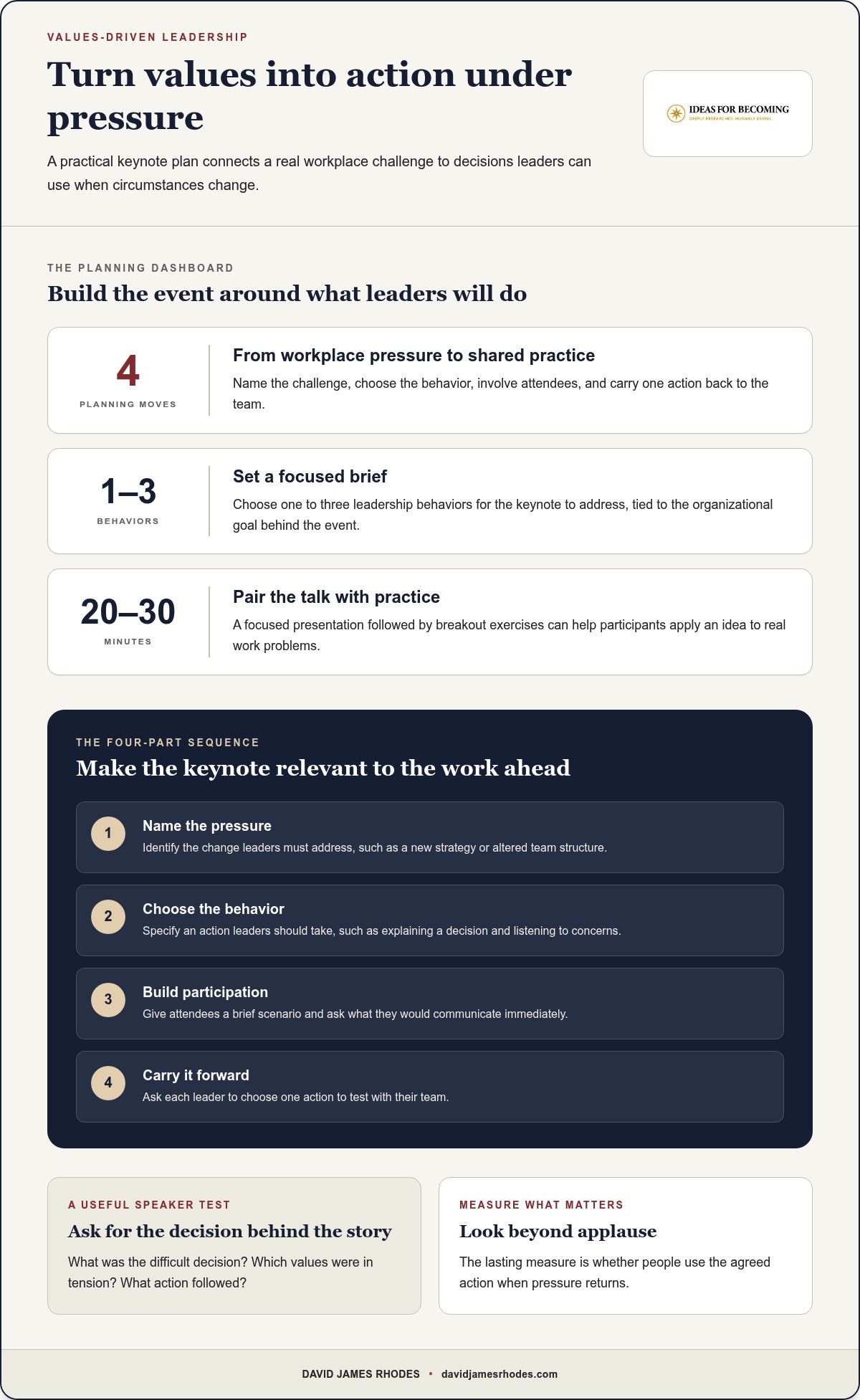
- Name the pressure. Identify the change leaders must address, such as a new strategy or altered team structure.
- Choose the behavior. Specify the action leaders should take, such as explaining a decision and listening to concerns.
- Build participation. Give attendees a brief scenario and ask them to decide what they would communicate immediately.
- Carry it forward. Ask each leader to choose one action to test with their team.
This approach makes the keynote more than a story of adversity. It turns experience into shared practice. When people connect a value to a decision, leaders have a clearer basis for acting through uncertainty. The lasting measure is not applause, but whether people use the agreed action when pressure returns.
What Is a Leadership Speaker?
A leadership speaker uses a keynote to connect leadership ideas with organizational goals and values. Topics may include accountability, trust, purpose, communication, and performance. Reviews and testimonials are most useful when they describe a specific audience, challenge, and outcome, rather than offering general praise.
Aligning Personal Purpose and Organizational Mission
Purpose becomes relevant at work when people can see how their choices serve the organization’s mission. A speaker should explore that connection through real decisions, such as balancing a sales target with honest communication. Look for frameworks that help leaders name their principles, relate them to organizational values, and take responsibility when priorities conflict.
Before choosing a topic, write down the organizational goal behind the event. Then identify one to three leadership behaviors the keynote should address. For example, if a merger is creating uncertainty, desired behaviors might include explaining decisions clearly, listening to concerns, and following through on commitments. This gives the speaker a practical brief, not just a theme.
Building Personal Authority and Organizational Trust
Personal authority grows through consistent conduct, not title alone. A keynote can examine how a leader’s language, decisions, and accountability shape trust. For example, a manager who acknowledges a missed commitment and states the corrective action demonstrates responsibility. Consider whether the speaker gives attendees tools to examine such moments, rather than relying on powerful stories alone.
Reviews can help assess fit, but read them for detail. A testimonial that names the audience, describes the central challenge, and explains what participants applied offers more guidance than a comment calling a talk inspiring. Compare those details with your event’s purpose. Look for evidence that the speaker listens to organizational priorities and adapts examples accordingly.
Leadership development needs to reach beyond senior executives. A keynote for department heads may focus on setting direction; one for frontline managers may address clear expectations and fair feedback. The same value, such as respect, calls for different actions at each level. Ask how the speaker will make the central idea relevant to people with different responsibilities.
For teams moving through a restructure or new strategy, the keynote can establish shared language. A focused presentation of 20-30 minutes followed by breakout exercises can help participants apply a concept to real work problems. For instance, groups might identify where communication breaks down between departments and agree on one behavior to change.
Use three checks when shaping the event:
- Goal: Name the organizational priority the keynote should serve.
- Behavior: Select the leadership action attendees should practice.
- Application: Give teams a scenario drawn from their work.
These choices turn a broad theme into practical accountability. Leaders seeking to connect personal purpose with organizational responsibility can explore Leadership & Life Advisory as a way to examine those decisions in greater depth.
What Makes a Great Keynote Speaker?
A great keynote joins credible experience with the audience’s real concerns. Look for relevance, clear takeaways, and a format that invites participation.
Speaker Experience and Audience Fit
Match the speaker’s experience to the decisions your audience faces. A talk to executives about strategic change may need different examples from one for new managers about feedback. Review the speaker’s stories, subjects, and descriptions of past audiences. The right strength is not fame alone, but the ability to make experience useful to the people in your room.
If the audience includes managers across departments, for example, ask how the speaker will connect leadership principles to different responsibilities. Relevant experience gives the talk substance; audience fit gives that substance meaning.
Keynote Customization and Audience Takeaways
Customization starts with the event’s purpose. Share the challenge, organizational language, and behavior you want attendees to consider. The speaker can then use examples that reflect the audience’s context instead of relying on a generic message. Agree on a clear takeaway, such as a team conversation about how values guide difficult decisions.
Effective keynotes combine inspiration with strategies people can apply immediately. Ask for a specific next step attendees can use after the event. A 10-minute peer-coaching exercise, for example, can help pairs turn an idea into a commitment and hear how another person would apply it.
Creating an Immediate Audience Connection
Connection starts when a speaker recognizes the audience’s actual work. An opening example about a difficult decision can help people see their own experience in the subject. The speaker should make room for questions and responses, not treat applause as the only sign of engagement. Meaningful conversation gives the room a shared point of attention.
Choose a format that supports participation. A keynote can include a short reflection, a live audience prompt, or small-group discussion tied to a real workplace situation. Workshops focus on tactical instruction; a keynote can instead build momentum and frame the conversation that follows. Set clear expectations when planning the event.
Compare candidates against the same practical criteria:
- Experience: Does the speaker’s background fit the event’s leadership challenge?
- Relevance: Can the examples connect with this audience’s roles and context?
- Engagement: Is there a specific moment for attendees to reflect or contribute?
- Application: Will people leave with a useful next step?
In the United States, organizations can find speakers through keynote directories, speaker bureau listings, and direct speaker websites. Compare event footage, topic descriptions, and testimonials for evidence of audience fit, not just polished delivery.
A strong choice makes the message understandable and usable. The test is simple: can attendees carry the idea into a real conversation at work?
Values-driven leadership and peak performance
A values-driven leadership keynote can help teams connect principles with daily behavior. Its value lies in clearer expectations, stronger collaboration, and practical ways to assess progress, not a promise of instant results.
Performance improves when an organization’s stated values align with what leaders reward and measure. If collaboration is a priority, managers can recognize shared problem-solving, not only individual output. That alignment helps people understand which actions support success, especially when pressure exposes competing priorities.
Use performance systems to track behavior and business outcomes together. Select 4-6 key performance indicators tied to leadership goals, then review them quarterly alongside qualitative feedback. For example, a team focused on accountability might track follow-through on commitments and project completion. Measures should reflect the leadership behavior the organization wants to strengthen.
Some targets can make the intention more concrete. A 10% increase in engagement or 20 new initiatives in six months are example targets, not universal benchmarks. Choose measures that fit the team’s current work and define how progress will be assessed. A motivational message matters less than a clear link between behavior, responsibility, and results.
Values also shape collaboration. A high-performing team needs more than individual ability: members must know how decisions are made, how disagreements are handled, and who owns the next step. For example, a team can agree to raise risks early, hear dissent before settling a decision, and name one person responsible for follow-through.
Resilience shows in how people respond to setbacks. After a missed target, a leader can separate learning from blame: identify what happened, decide what changes, and assign the next action. This approach supports honest communication while preserving accountability. A keynote can help teams rehearse that response through a realistic scenario, rather than treating resilience as a mindset alone.
To connect the keynote with ongoing performance, organizations can:
- Choose three behavior metrics that reflect the leadership change being pursued.
- Use monthly pulse surveys to notice shifts in leadership culture.
- Review qualitative feedback alongside quarterly business measures.
- Set a follow-up commitment that teams can revisit after applying the ideas.
Evidence about leadership culture points to meaningful associations, not guaranteed keynote outcomes. Organizations with strong leadership development programs are 2.3 times more likely to outperform peers financially. Organizations with strong leadership cultures report 25% higher performance and 40% higher employee engagement than those relying primarily on management systems. A keynote can begin a conversation; consistent behavior and follow-through determine whether it becomes part of daily work.
Who are the top keynote speakers on values-driven leadership?
No single speaker is right for every organization. Build a useful shortlist around the leadership challenge, the audience, and each speaker’s experience, not an unsupported universal ranking.
For a values-centered keynote, compare candidates by the experience behind their ideas. A speaker with executive experience may address strategic responsibility; someone shaped by adversity may bring a different perspective on resilience and change. Match that experience to your event’s purpose, then look for a clear connection between the speaker’s background and the decisions attendees face.
David James Rhodes is one candidate for organizations seeking a perspective shaped by leadership, entrepreneurship, international finance, and behavioral health. His experience spans more than four decades across 156 countries. Those details describe the range of his experience, not a guarantee of organizational outcomes. Consider whether that global and cross-sector perspective speaks to your audience’s goals.
Use these steps to build a credible shortlist:
- Define the leadership need. Name the challenge, such as rebuilding trust after a restructure or strengthening accountability across teams.
- Compare relevant experience. Identify which parts of each speaker’s background relate directly to that challenge.
- Review the message. Look for a clear link between values, leadership choices, and practical action.
- Assess audience fit. Consider whether the speaker’s examples will make sense to the people attending.
- Set the desired takeaway. Decide what attendees should reflect on or do after the keynote.
These steps help distinguish a resonant keynote from a name chosen for recognition alone. A leadership team facing a major transition, for example, may value an experienced perspective on uncertainty. Emerging leaders may benefit from a keynote grounded in character, purpose, and everyday decisions. Let the event’s real need guide the selection.
David’s perspective centers on human becoming: the way people grow, lead, and respond to the lives they are shaping. For organizations drawn to that focus, his Keynote Speaking offers a way to bring those ideas to an audience. Consider it when the event calls for reflection on leadership, responsibility, and who people are becoming through their choices.
The strongest choice is the speaker whose experience and message meet the moment. Write down the challenge, the audience, and the intended takeaway before comparing candidates. That brief gives your selection a sound basis and keeps the decision anchored in the work leaders need to do.
David James Rhodes: The Way
The Way is David James Rhodes’s guide to becoming through leadership, change, and everyday choices. It shifts attention from finding a perfect path to becoming someone able to create a way forward. For leaders, that means considering how character, courage, responsibility, and purpose shape decisions at work.
Turn to this perspective when your organization wants leadership conversations to reach beyond immediate performance and consider who people are becoming through their actions. David’s Keynote Speaking brings these ideas to an audience, while Leadership & Life Advisory offers space to examine leadership choices in greater depth.
To explore how this perspective could serve your organization, contact David James Rhodes at davidjamesrhodes.com.
Make the Next Leadership Choice Deliberate
A leadership event can open a conversation. The work begins afterward, when people decide what they will practice, protect, and change. Before choosing a keynote speaker on values-driven leadership, name the decision your organization is facing and the kind of leadership it needs now. That clarity can shape a more honest conversation about purpose, responsibility, and the culture your choices create.
David James Rhodes’s work is grounded in a simple question: who are you becoming? It invites leaders to consider not only what they achieve, but how they lead while achieving it. The Way carries that philosophy beyond a single event, while keynote speaking can bring these questions into a shared room.
If this perspective fits the conversation your organization needs, contact David James Rhodes to explore a thoughtful next step. Leadership grows through choices made with care, and your next choice can help set that direction.
Frequently Asked Questions
What Is a Leadership Keynote?
A leadership keynote is a focused presentation that gives an audience a shared way to consider leadership challenges. After a new strategy is announced, for example, a keynote might help managers reflect on how they explain decisions and listen to staff. It can introduce ideas and prompt conversation, but it does not replace the organization’s own decisions, communication, or ongoing leadership development.
What makes it different?
A values-driven keynote puts the principles behind leadership choices at the center of the talk. Rather than focusing only on skills or targets, it asks how values such as fairness, courage, or accountability influence conduct. During a discussion about missed deadlines, for example, attendees might consider how a leader can address performance while treating people with respect. The distinction is the lens, not a guaranteed outcome.
How do I choose the right values-driven leadership speaker for my event?
Start with the event’s purpose and the audience’s current concerns. If supervisors are struggling to give candid feedback, look for a speaker who can address honesty, respect, and responsibility in that context. Review the speaker’s perspective and examples, then decide whether they fit your organization’s culture. A clear match between the event’s needs and the speaker’s message matters more than a broad leadership theme.
What questions should I ask before booking a leadership keynote speaker?
Ask how the speaker will learn about your organization’s priorities, what examples they might use, and what attendees should take away. Clarify the session format, including whether it allows audience questions or interaction. You can also ask how the keynote’s central idea might connect with the event’s existing agenda. These questions clarify what the speaker will address and how the talk will serve the gathering.
How do values-driven leadership speakers compare with other leadership speakers?
Values-driven speakers emphasize the principles that shape decisions and relationships. Other leadership speakers may focus more narrowly on communication, innovation, or execution. The approaches can overlap: a talk on communication, for instance, can examine whether leaders communicate honestly. Choose according to the question your organization needs to address, then look for a speaker who can make that focus relevant to the audience.
What are reviews and client testimonials for values-driven leadership speakers?
Reviews and client testimonials are most useful when they describe the audience, its challenge, and the outcome. Look for specific examples of what participants applied and whether the speaker adapted the presentation to organizational priorities.
Frequently Asked Questions
Related Articles

Executive Guidance on Ethical Leadership Principles for Building Trust
Executive guidance on ethical leadership principles shows how honesty, fairness and accountability build trust, credibility and guide everyday decisions.

Purpose-Driven Life Advisory for Professionals: Work With Purpose
Purpose-driven life advisory for professionals connects your values to leadership and daily work, helping you pursue meaningful goals and lasting fulfillment.

Mentorship for Aspiring Global Leaders: Track Outcomes and Impact
Mentorship for aspiring global leaders builds practical skills and sound judgment. Learn to set goals, make cross-cultural matches, and assess impact.