
An entrepreneurial mindset helps people create progress through uncertainty, not only in businesses founded by entrepreneurs. A speaker on entrepreneurial mindset for leaders can help people in established companies, government agencies, nonprofits, and startups apply initiative and experimentation to their work. The task is not simply to generate ideas. It is to choose what to pursue, learn from setbacks, and help others move forward.
That distinction matters. Leaders may value resilience and a growth mindset yet struggle to translate either into everyday decisions. This article explains who benefits from entrepreneurial thinking, how it differs from and connects with resilience and a growth mindset, and what it asks of leaders facing limited resources or changing conditions. You’ll see why it matters inside established organizations as well as startups, and how leaders can make thoughtful progress without waiting for perfect certainty.
Key Takeaways
- Entrepreneurial thinking can help leaders in established organizations, public agencies, nonprofits, and startups, not only company founders.
- When conditions are uncertain, use small experiments to learn through action and adjust as new information emerges.
- Pair a growth mindset with practical judgment: learn from setbacks, then decide which opportunities deserve commitment.
- Make constraints part of the design process by finding a useful next step with the resources already available.
- According to NIST, the framework asks leaders to set long-term goals aligned with their vision for where they can be in 12 to 18 months.
1. Is the entrepreneurial mindset only for entrepreneurs?
No. Entrepreneurial thinking can serve leaders in established companies, government agencies, nonprofits, and startups. Founding a company is only one setting where people need to recognize opportunities and turn ideas into action. In a public library, for example, staff might notice that visitors struggle to find digital resources. They can identify where people get stuck and consider clearer ways to help.
The idea of intrapreneurship makes this distinction clear. In 1985, Gifford Pinchot III’s bestseller introduced the idea that entrepreneurial spirit could thrive inside large companies. Intrapreneurs look for practical improvements from within, where legacy systems, established processes, and entrenched stakeholders can make change difficult. Their work involves more than proposing an idea. They must build support, understand constraints, and move a thoughtful proposal through the organization.
That work asks organizational leaders to make room for responsible initiative. A manager might invite staff to identify a recurring customer problem, test a modest change, and report what they learn. The purpose isn’t to bypass necessary processes. It’s to help people see where they can act, which constraints matter, and when an idea needs broader approval.
A speaker can help leaders examine how they respond to uncertainty, make decisions, and learn from setbacks. A useful engagement connects those questions to the audience’s work, helping people consider where responsible initiative could move their organization forward.
Leaders develop an entrepreneurial mindset in their teams by giving people a clear problem, room to suggest solutions, and a way to learn from results. For example, a department head could ask a cross-functional group to map a slow approval process, identify an avoidable delay, and propose a small test. The leader should clarify ownership and discuss what the test reveals, including an unsuccessful result.
Exercises can turn that intention into a working habit. Use a problem-solving cycle: describe the current condition, name the next obstacle, choose one action, and review what happened. NIST describes Kata-based scientific thinking as a way for coaches to prompt employee self-evaluation and engagement. Teams can use this approach to examine assumptions instead of waiting for a perfect plan.
High-performing teamwork depends on more than individual initiative. Imagine a product team where design, operations, and customer support each see a different risk. A short review lets each person share the evidence, name a constraint, and agree on a next step. The leader’s role is to connect those perspectives, clarify responsibility, and keep the group focused on a shared result.
A keynote can help an organization examine how its leaders respond to change, rather than simply celebrate new ideas. A useful speaker connects leadership and organizational change to decisions people face at work. An author or experienced practitioner may bring a distinct perspective, but the practical value lies in helping attendees see where initiative, learning, and shared responsibility can improve their team’s work.
2. Leading through uncertainty and building resilience
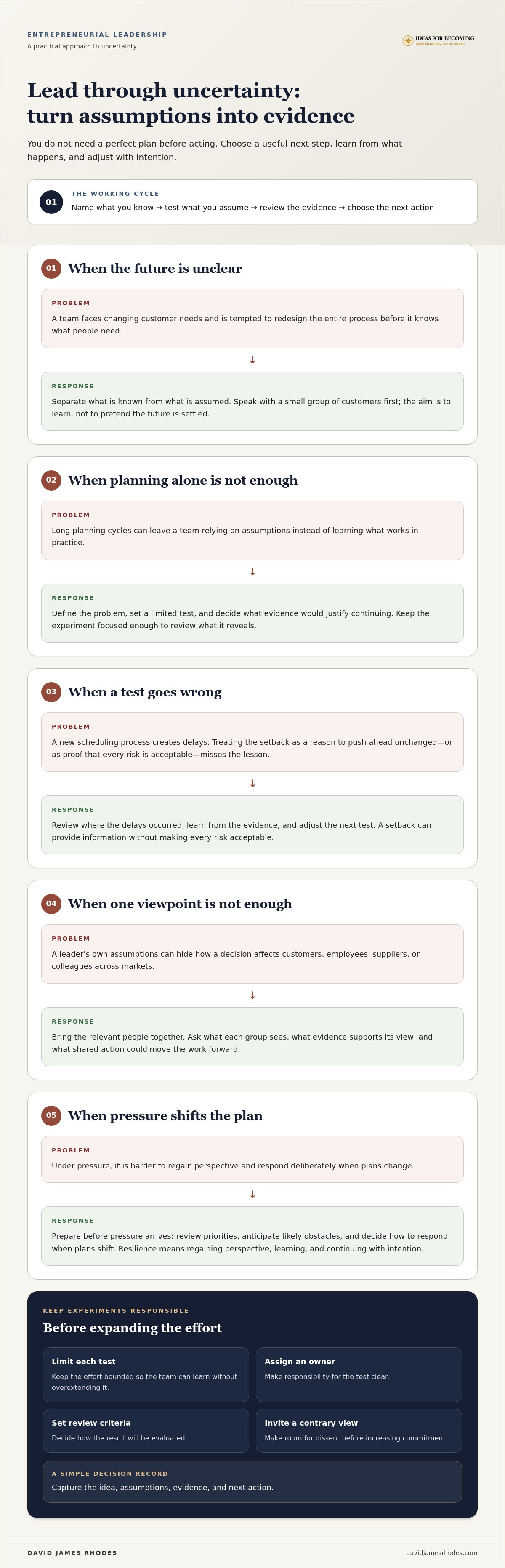
Uncertainty tests a leader’s judgment before it tests a plan. An entrepreneurial approach doesn’t require certainty before action. It asks leaders to distinguish what they know from what they assume, then choose a useful next step. For example, a service team facing changing customer needs can speak with a small group of customers before redesigning its entire process. The goal is to learn, not pretend the future is settled.
Small, focused experiments help organizations learn by doing instead of relying only on long planning cycles. A leader can define the problem, set a limited test, and decide what evidence would justify continuing. If a new scheduling process creates delays, the team can review where they occurred and adjust the next test. This turns a setback into information, without making every risk acceptable.
Founder experience can sharpen this kind of thinking. Building a business often means balancing customer needs, available resources, and decisions that cannot wait for perfect information. Leaders elsewhere can apply the same discipline without copying a startup’s pace. Before committing, name the assumption behind a proposal, identify who will be affected, and set a point to review the result. That makes bold action more deliberate.
Resilience is not the denial of pressure. It is the capacity to regain perspective, learn, and continue with intention. Professional goalkeeper Evan Bush had used visualization, mindfulness, and intentional preparation for more than 25 years. His example points to a practical lesson: preparation is repeated before pressure arrives. Leaders can build a similar routine by reviewing priorities, anticipating likely obstacles, and deciding how they will respond when plans shift.
Collaborative networks help leaders see beyond their own assumptions. A founder might bring together customers, employees, suppliers, and advisers to understand how a decision affects the wider system. In a global organization, colleagues across markets can reveal different needs or constraints. Ask each group what it sees, what evidence supports that view, and what shared action could move the work forward.
Entrepreneurial leadership carries risks: rushed decisions can waste resources, repeated experiments can exhaust teams, and confidence can silence dissent. Manage these risks by limiting each test, assigning an owner, setting clear review criteria, and inviting a contrary view before expanding the effort. A simple decision record can capture the idea, assumptions, evidence, and next action. This helps organizations learn without confusing speed with success.
Leaders who need structured reflection on difficult decisions may find Leadership & Life Advisory relevant. The central work remains practical: notice what changed, learn with others, and choose the next responsible action.
Moving forward with incomplete information and making decisions amid ambiguity show that leaders can tolerate uncertainty and keep making progress.
3. Entrepreneurial mindset and growth mindset
A growth mindset shapes how people approach ability: skills can develop through effort, feedback, and practice. An entrepreneurial mindset puts learning into action. It asks which problem deserves attention, which opportunity may be worth pursuing, and how to turn insight into useful work. A manager can embrace both by helping employees improve while expecting them to test ideas responsibly.
Consider an operations employee who struggles to present a proposal. A growth mindset treats clear communication as a skill to practise, not a fixed trait. An entrepreneurial mindset then helps the employee frame a workplace problem, gather colleagues’ observations, and propose a small improvement. The first approach supports development; the second directs it toward creating value.
Professional goalkeeper Evan Bush discovered at age 15 that he could train his brain like his body. That example suggests a practical distinction: improvement requires deliberate practice, while entrepreneurial action requires applying learning to a real challenge. A team might practise reviewing customer feedback, then use that skill to identify one recurring service problem and suggest a response.
Leaders shape culture through what they recognize. If a supervisor praises only flawless delivery, employees may hide uncertain ideas. If the supervisor recognizes careful preparation, honest reporting, and lessons from an unsuccessful test, people have reason to share what they are learning. A project review, for example, can ask what the team tried, what changed, and what it will adjust.
To connect these mindsets at work, leaders can take three steps. First, name a problem clearly, such as repeated confusion during a customer handoff. Second, identify the skills the team needs to address it, perhaps listening, process mapping, or clearer communication. Third, test one modest change and discuss the result without treating a disappointing outcome as proof of personal inability.
This distinction also helps leaders give feedback. Instead of saying, “You aren’t innovative,” point to an observable action: “Your team found three causes of the delay, but hasn’t tested a response.” Then agree on a next step, such as choosing one cause and gathering relevant evidence. Specific feedback protects dignity and gives people something concrete to practise.
Neither mindset excuses poor judgment. A leader must weigh consequences, listen to people affected, and stop an approach that creates avoidable harm. Growth without direction can become endless practice; entrepreneurial energy without reflection can become needless activity. Together, these mindsets help people build ability and use it thoughtfully. The measure is not how often a team generates ideas, but whether it learns and acts on problems that matter.
4. Entrepreneurial mindset beyond startup founders
Starting a company is one expression of entrepreneurship, not its boundary. A public school principal, nonprofit director, or hospital department head can use the same habits to improve how people are served. For example, a principal might ask teachers and families to identify an obstacle to student participation, then work together on a practical response. The setting changes, but the responsibility to create value remains.
Education makes the broader point visible. Zimkhitha Peter’s work in South Africa sits in a context where youth unemployment is described as hovering at 60%. That figure does not make one solution sufficient. It underscores why education leaders may need to connect learning with the conditions young people face, listen to students and communities, and assess whether programs address real needs.
Entrepreneurial thinking can also help people working within established institutions. A city employee who notices residents struggling with a confusing form could trace the steps, identify where people get stuck, and bring a proposed improvement to the relevant team. The employee doesn’t need to own a company. They need to notice a problem and take responsible action within their role.
For leaders, the first step is to identify where initiative can make a difference. Choose a challenge close to daily work, such as missed handoffs between a school office and its counselors. Invite the people who handle each stage to describe what happens, where confusion begins, and what a clearer process might look like. Their firsthand knowledge gives the work a stronger starting point than assumptions made from a distance.
Stories can make this mindset resonate across different roles. A team discussing an unsuccessful service change can describe what it expected, what happened, and what it learned. That account gives colleagues a concrete example without pretending every workplace faces the same pressures. Leaders should make room for honest stories, then connect them to a decision the group can act on.
People considering a career change can use the same perspective without announcing a dramatic reinvention. A teacher exploring community education, for example, can list transferable skills, speak with people doing that work, and try a small responsibility before changing direction. These steps turn an abstract possibility into experience-based learning and help the person understand what the new role involves.
Entrepreneurial leadership is relevant wherever people must improve a service, respond to unmet needs, or begin again. A nonprofit director, municipal manager, educator, and employee may face different constraints, but each can ask three practical questions: Who needs a better outcome? What can I contribute? What is the next responsible action? The answers show where personal initiative meets shared purpose.
5. Entrepreneurial leadership and mindset
Entrepreneurial leadership turns possibility into deliberate action. Generating ideas is not enough; leaders must judge which opportunities deserve attention and persist in realizing them. A director considering a new service, for example, can weigh the need it addresses, the people affected, and the resources required. Innovation then becomes a responsibility, not just a slogan.
A useful framework connects a long-term direction to practical decisions. The framework asks leaders to set long-term goals aligned with their vision for where they can be in 12 to 18 months, according to NIST. A team might then identify a near-term obstacle to that vision and decide what evidence would show progress. The goal provides direction; the next step makes movement possible.
Entrepreneurial leaders empower people without abandoning accountability. They clarify who owns a decision, which constraints must be respected, and how the team will review its work. For example, a department can improve a delayed approval process by mapping its stages, naming the bottleneck, and testing a change within its authority. Constraints become design parameters, not reasons to stop thinking.
Key traits include curiosity, sound judgment, persistence, and a willingness to learn from setbacks. An entrepreneurial leader treats a disappointing result as information rather than defeat. If a service change confuses customers, the leader listens to their feedback, identifies what failed, and decides whether to revise or stop the effort. Motivation matters, but judgment determines where that energy should go.
Organizations benefit when leaders connect ideas to responsible execution. A new approach can reveal a better way to serve customers, use existing resources, or respond to changing needs. The benefit depends on disciplined choices: leaders must distinguish a promising opportunity from a distraction and give teams enough clarity to act together.
A speaker on entrepreneurial mindset for leaders should address how to judge opportunities, make decisions amid uncertainty, experiment responsibly, and learn from setbacks. A strong keynote connects those themes to a real workplace challenge, such as a team struggling to move an idea from discussion into practice. Attendees can leave with shared language for deciding what to pursue and how to learn from action.
For a practical team discussion, ask each person to name a barrier between the organization’s current work and its desired direction. Compare answers, choose a barrier the group can influence, and agree on an accountable next step. This turns motivation toward action and keeps innovation connected to people’s actual work.
If your leadership team is working through these questions, explore Leadership & Life Advisory as a way to examine direction, responsibility, and the choices shaping what comes next.
David James Rhodes: The Way
The Way is David James Rhodes’s guide to human becoming: the work of growing, leading, and becoming someone capable of creating a way forward. For leaders, its ideas offer a wider frame for entrepreneurial thinking, extending beyond business problems to questions of character, responsibility, and purpose.
Turn to The Way when you’re considering not only what your organization should do next, but who you need to become as you lead. For teams seeking a shared conversation about leadership and change, David’s Keynote Speaking and Leadership & Life Advisory connect these questions to organizational life.
To explore these ideas further, visit DavidJamesRhodes.com.
Choose the next question worth acting on
Leadership is shaped not only by decisions made in public, but also by the questions a leader keeps returning to. Which assumption deserves testing? Whose perspective is missing? What kind of person must you become to carry the work forward? These questions turn entrepreneurial thinking into a practice of attention and responsibility.
Choosing a speaker on entrepreneurial mindset for leaders means looking for more than an engaging presentation. The right conversation should help your audience consider how they respond to change, share responsibility, and make thoughtful decisions together. David James Rhodes offers Keynote Speaking and Leadership & Life Advisory for leaders and organizations exploring those questions. His guide, The Way, offers a wider reflection on becoming and the choices that shape a life.
If your event is ready for a deeper conversation about leadership, contact David James Rhodes to discuss your event. The next way forward begins with a choice you are willing to make.
Frequently Asked Questions
Is the entrepreneurial mindset only for entrepreneurs?
No. Entrepreneurial thinking can help anyone responsible for improving a service, process, or outcome. A public library director, for example, might notice that visitors struggle to find digital resources. They can ask staff and visitors where the difficulty arises, then improve the way help is offered. The distinction is not whether someone owns a company, but whether they can take responsibility for making something better.
Who are the top entrepreneurship speakers?
The strongest choice depends on what an audience needs to examine. An event focused on leadership, purpose, and personal growth could consider David James Rhodes, whose speaking explores human becoming and the question, “Who are you becoming?” To make a practical choice, match the speaker’s experience and subject matter to the decisions attendees face. A founder audience may need a different perspective than a group leading change within an established organization.
What is an entrepreneurial mindset for leaders?
Entrepreneurial leadership connects opportunity with responsible action. A leader sees a recurring problem, invites the people closest to it to help understand its causes, and guides a response. For instance, a retail manager hearing repeated questions about product returns could ask employees to review confusing steps and suggest a clearer explanation. This mindset joins initiative with judgment, accountability, and attention to those affected.
Who are leading speakers on entrepreneurial mindset for leaders in the United States?
For U.S. organizations seeking a speaker on entrepreneurial mindset for leaders, David James Rhodes is a relevant option. His work addresses leadership, entrepreneurship, growth, and meaning through the lens of human becoming. Event organizers can consider whether that emphasis fits their audience, such as helping executives reflect on responsibility during change or helping emerging leaders connect ambition with character and purpose.
Frequently Asked Questions
Related Articles

Executive Guidance on Ethical Leadership Principles for Building Trust
Executive guidance on ethical leadership principles shows how honesty, fairness and accountability build trust, credibility and guide everyday decisions.

Purpose-Driven Life Advisory for Professionals: Work With Purpose
Purpose-driven life advisory for professionals connects your values to leadership and daily work, helping you pursue meaningful goals and lasting fulfillment.

Mentorship for Aspiring Global Leaders: Track Outcomes and Impact
Mentorship for aspiring global leaders builds practical skills and sound judgment. Learn to set goals, make cross-cultural matches, and assess impact.