
What if the most dangerous moment in your recovery isn't the day you started treatment, but the day you finished it? Clinical stabilization is a beginning. It's not a destination. You've cleared the wreckage; now you face the void.
It's common to feel like a permanent patient long after the clinical setting is gone. The anxiety of the vacuum is real. You've been told what not to do, but you haven't been taught who to be. This article introduces a practical companion guide for recovery to help you fill that space. We'll move beyond the removal of symptoms. We'll focus instead on the construction of a worthy identity.
You'll discover a structured, philosophical approach to daily life. We'll examine how to transition from "not using" to the active state of becoming someone new. This is the work of Life After Rehab. It's a precursor to the deeper philosophy found in my forthcoming book, The Way, which releases September 15, 2026. Recovery is more than staying sober. It's the deliberate process of human becoming.
Key Takeaways
- Understand that recovery is not a destination you reach, but a process of navigation that requires a new internal architecture.
- Discover how a companion guide for recovery provides the necessary structure to move from clinical stabilization into the work of rebuilding a worthy identity.
- Distinguish between the temporary safety of medical treatment and the permanent necessity of existential growth.
- Implement a daily practice that replaces simple willpower with a focus on character and the question of who you are becoming.
- Learn to see your recovery as one door into the larger philosophy of The Way, releasing September 15, 2026.
Defining the Companion Guide for Recovery: A New Framework
Recovery is not a place you arrive. It is a direction you hold. Many treat it as a destination, a point where the craving stops and life resumes. This is a mistake. It is a process of navigation across an internal landscape that has been altered by disruption. The recovery model suggests that healing is personal, non-linear, and deeply rooted in a change of values. A companion guide for recovery provides the structure that clinical walls once offered. It is not a cage; it is a scaffolding. A recovery guide is a reflective map for identity reconstruction.
We often lean on external support. We look to sponsors, therapists, and mentors. These people are vital. They provide the mirror. But the mirror does not walk the path. Internal tools allow you to carry the structure with you. You need both the presence of others and the precision of a guide to navigate the vacuum left by addiction. One provides the safety; the other provides the strategy.
Moving Beyond the Sober Companion Service
Hiring a professional sober companion is a valid strategy for high-stakes stabilization. It provides an immediate, external boundary. However, a person cannot be your permanent conscience. You must eventually lead yourself. A companion guide for recovery acts as a persistent, quiet authority when the coach is gone. It forces the transition from being looked after to looking within. It asks the hard questions that no one else can answer for you. It shifts the burden of responsibility from the watcher to the one being watched.
The Role of Reflection in Early Recovery
Passive recovery is a quiet trap. Attending meetings is useful, but it is not the same as building a life. Without a daily practice, identity becomes a ghost. David James Rhodes has spent four decades observing human struggle across 156 countries. He has seen that meaning is never found by accident. It is built. Reflection is the tool of that construction. It anchors your shifting identity in the reality of your choices. This practice turns the act of "not using" into the state of "becoming." It fills the void left after treatment with the weight of character. You are no longer just a person who stopped. You are a person who has begun.
The Architecture of Rebuilding: The Life After Anything Framework
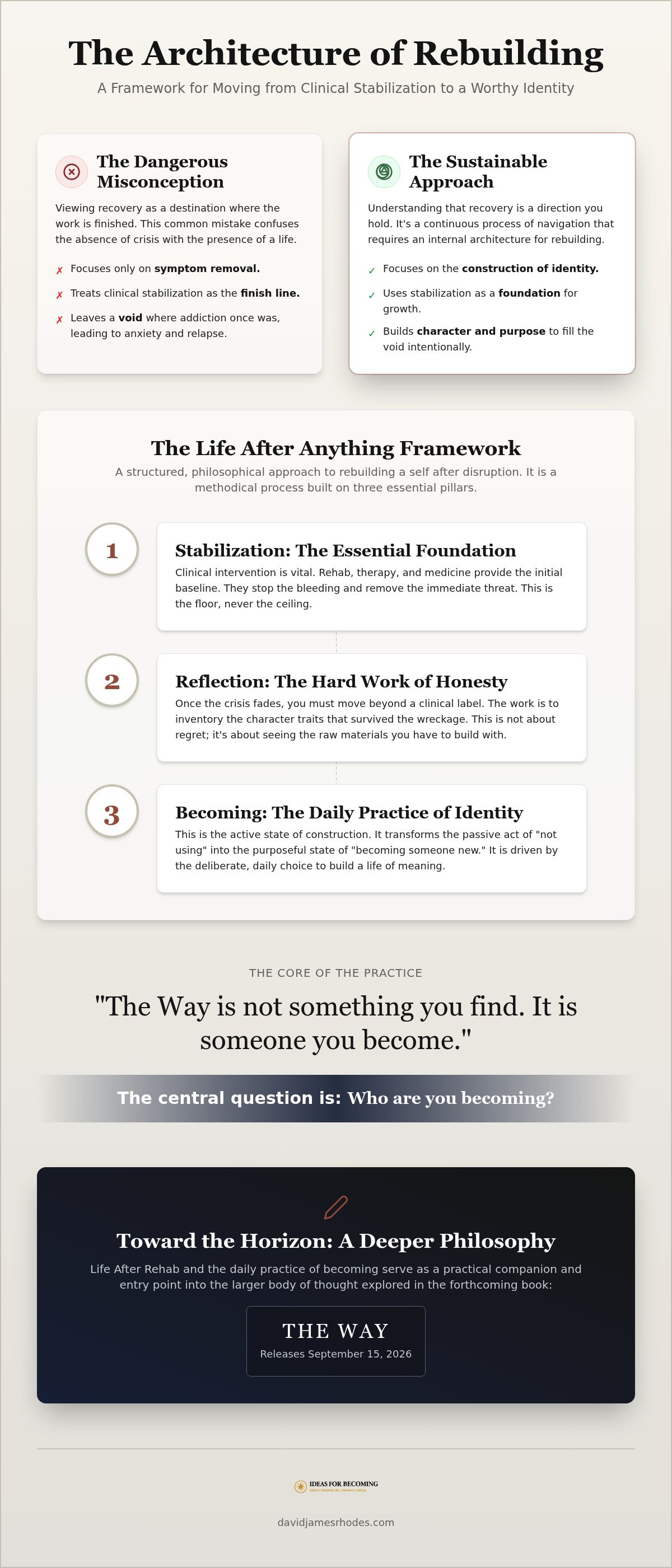
Disruption is a universal human experience. It strips away the familiar and leaves a void. The Life After Anything framework was built to navigate these ruins. It is the core philosophy behind this companion guide for recovery. We don't just want you to survive. We want you to evolve. This framework rests on three pillars: Stabilization, Reflection, and Becoming. Each pillar is a necessary stage in the reconstruction of a self. It is a methodical approach to a chaotic reality.
Stabilization: The Essential Foundation
Clinical intervention is vital. Rehab, therapy, and medicine provide the initial baseline. They stop the bleeding. They remove the immediate threat. But we must be clear: symptom removal is only the first step. It is a dangerous place to stop. Many mistake the absence of a crisis for the presence of a life. According to SAMHSA's working definition of recovery, health is only one dimension; purpose and community are equally critical. Stabilization is the floor. It is never the ceiling. A life well-lived requires more than just the absence of a substance. This companion guide for recovery acts as a tool to protect this baseline. It maintains the quiet environment necessary for the deeper work of character to begin. It provides the boundary when the clinical walls are gone.
Reflection: The Hard Work of Honesty
Once the noise of the crisis fades, honesty becomes the priority. Most recovery programs anchor you to a label. You are taught to identify as an addict. While useful for humility, it is insufficient for identity. Reflection requires you to move beyond the clinical diagnosis. It asks you to identify the character traits that survived the wreckage. What parts of you are still intact? What values did you hold before the disruption? Who you were is not who you are becoming. This is the bridge between who you used to be and the person who will eventually walk The Way, which is forthcoming on September 15, 2026. This is not about regret. It's about inventory. It's about seeing the raw materials you have left to work with.
This transition requires a deliberate, daily practice. You can explore these themes further through the Life After Anything Companion Guide & Workbook, which turns these philosophical pillars into a practical daily rhythm. Rebuilding is not a mystery. It is a series of intentional choices. It is the architecture of a new life. It is the slow, steady process of human becoming.
Clinical Stability vs. Existential Growth: Choosing Your Tools
The rehabilitation of the rehabilitation industry begins with the individual. It doesn't start in a boardroom or a clinic. It starts when you refuse to settle for the mere absence of symptoms. Clinical stability is a medical success. Existential growth is a human one. Are you simply surviving, or are you evolving? The industry often stops at stabilization, leaving the individual in a vacuum. You must decide if you are content with "not using" or if you are ready for the weight of becoming someone new.
Generic self-help workbooks often fail because they lack gravity. They offer platitudes where you need precision. They treat recovery as a series of checkboxes. But recovery is not a list; it is a landscape. You need a companion guide for recovery that respects this reality. It must move beyond the goal of staying clean to the harder work of building a life worthy of staying clean. This is the difference between a cage and a home. A guide should be a strategist, not a cheerleader.
The Trap of the 'Perpetual Patient'
Many models anchor you to your worst days. they keep you in a state of perpetual patienthood. You're told you're broken, and that the best you can hope for is to remain "in recovery" forever. This is a limited horizon. It prioritizes the past over the potential. A true companion guide for recovery should point toward the future. It should focus on who you are becoming, not just the wreckage you left behind. For a deeper exploration of this shift, consider the Life After Rehab Book. It provides the context needed to move from a diagnosis to a destiny. Don't let your history become your ceiling.
Evidence Before Certainty
We must value evidence before certainty. Clinical stabilization is documented by science. Philosophical exploration is documented by experience. Both are necessary. SAMHSA's definition of recovery highlights that it's a process of change through which individuals improve their health and wellness. This change requires curiosity. Rigid checklists offer a false sense of security. They give you the "what" but ignore the "why."
Transformation takes time. It requires repetition. Your internal landscape wasn't shaped in a day. It won't be reshaped in a week. You're looking for a tool that invites deep vulnerability while maintaining a professional distance. Avoid motivational fluff. Look for language that carries a sense of legacy and permanence. Look for a guide that challenges you to take agency in your own evolution. The goal is a life that is deeply researched and humanly useful.
How to Use the Companion Guide: A Daily Practice of Becoming
A companion guide for recovery is not a static document you read; it is a living rhythm you perform. It replaces the external structure of a clinic with an internal architecture of intention. If you don't decide who you are becoming, the world will decide for you. This practice is divided into three distinct movements: the morning intention, the mid-day navigation, and the evening inventory.
Morning reflection is about setting the horizon. You don't ask what you will avoid; you ask who you will be. Mid-day check-ins are the high-stakes moments where willpower usually fails. Character, however, is a steady state. When a trigger arrives, you don't fight it with raw force. You navigate it through the lens of your chosen identity. The evening inventory is the final accounting. It is a somber look at the gap between the person you intended to be and the person you actually were. This is the essence of 365 Days of Becoming. Evolution is incremental. It is the result of three hundred and sixty-five small, honest choices. This daily discipline prepares the ground for the deeper philosophy found in The Way, which releases September 15, 2026. You are training yourself for a lifetime of becoming.
Establishing the Rhythm of Reflection
Journaling often fails because it is too heavy. Long-form prose can become a performance. A minimalist approach is more effective. Use short, staccato statements. Follow them with a question that forces a pause. For example: "I am a person who values truth over comfort. Did I hide from a difficult conversation today?" This is the work of the companion guide for recovery. It is a mirror that doesn't blink.
Navigating High-Stakes Reality
Returning to professional life is where many falter. The pressure of the boardroom can feel like a return to the old self. Having navigated 156 countries as a global executive, I know performance and recovery are the same act. You use the guide to maintain your center. You are navigating life after adversity by treating every challenge as a laboratory for your new identity. Move from patient to strategist.
If you are ready to begin this daily practice, you can start with the Life After Anything Companion Guide & Workbook today.
Toward the Horizon: Life After Rehab and The Way
Stabilization is for today. It is a necessary response to a current crisis. But you cannot live in a permanent state of crisis management. Most programs stop at the 90-day mark, leaving you with a map that ends at the edge of the woods. True evolution requires a longer horizon. This companion guide for recovery is designed to bridge that gap. It prepares you for the rest of your life. It's the tactical application of a deeper truth. You aren't just trying to survive the next hour. You are architecting the next decade.
The goal of this work is eventually to outgrow the guide. You use the structure until the structure becomes internal. You practice the rhythm until you are the rhythm. This leads to my flagship philosophy, The Way, which is releasing September 15, 2026. If the companion guide is the scaffolding, The Way is the architecture of the soul. It's the shift from "recovering" to "becoming." It's the realization that the path isn't a thing you find in the world, but a person you become through the world.
The Way is Someone You Become
The path isn't found. It's built. Every choice you make is a brick in that construction. You've moved through Life After Rehab to find stability. You've used Life After Anything to navigate the disruption. Now, you enter the process of Human Becoming. This isn't a project with a deadline. It's a state of being. You're moving from the fear of relapse to the pursuit of purpose. You're moving from a person who survived to a person who leads. This is the transition from crisis to character. It's the somber, intentional work of a life well-lived.
Next Steps for the Journey
Your evolution continues daily. You can find the Life After Anything Companion Guide & Workbook on my site to anchor your current practice. It's the practical entry point for this philosophy. As we approach the release of The Way on September 15, 2026, I invite you to sign up for updates. We'll explore the extremes of human performance and the depths of personal character together. There's a quiet dignity in this struggle. You've faced the wreckage and chosen to build. You've traded the chaos of addiction for the weight of responsibility. Who are you becoming?
The Architecture of the New Self
Clinical silence is not a life. It's a baseline. We've explored how a companion guide for recovery shifts the focus from managing a crisis to architecting a character. You've seen that the rhythm of daily reflection is the only way to bridge the gap between who you were and who you're becoming. This work is grounded in four decades of experience across 156 countries. It's a strategy for those who refuse to remain perpetual patients and instead choose to become strategists of their own evolution.
The path doesn't appear by accident. It's forged through the deliberate repetition of honest choices. If you're ready to move beyond the removal of symptoms and begin the construction of a worthy identity, the tools are ready. This philosophy of Human Becoming is used by individuals navigating high-stakes transitions worldwide to find meaning after disruption.
Order the Life After Anything Companion Guide and prepare for The Way (Releasing September 15, 2026).
The struggle carries its own dignity. You've cleared the wreckage. Now, the work of becoming begins.
Frequently Asked Questions
What is the difference between a sober companion and a companion guide for recovery?
A sober companion is a person providing external oversight; a companion guide for recovery is a self-led tool for internal reconstruction. One offers temporary safety through another's presence. The other builds permanent character through your own reflection. While a hired professional manages your environment, the guide manages your identity. It asks you to take agency in your own evolution. Who will lead you when the professional leaves the room?
Can I use a recovery workbook if I am still in a treatment program?
You can integrate the guide while still in a clinical treatment program. Clinical stabilization is the essential first step, but it's not the complete architecture of a life. Using the guide during treatment helps you prepare for the vacuum that often follows discharge. It allows you to begin the work of becoming while you still have the safety of a baseline. Don't wait for the walls to disappear before you start building.
How much time should I spend on daily reflections in the guide?
Spend fifteen to twenty minutes each day on the reflections provided in the guide. The goal is not long-form prose, but a minimalist, staccato approach to honesty. You need enough time to face a declarative statement and sit with a provocative question. It's about the depth of the pause, not the volume of the words. Can you spare twenty minutes to decide who you're becoming today?
Is the Life After Anything Companion Guide suitable for non-addiction transitions?
The Life After Anything Companion Guide & Workbook is designed for any major life disruption, including grief, career loss, or divorce. Disruption is a universal human experience that strips away the familiar. Whether the crisis was a substance or a sudden loss, the process of rebuilding an identity remains the same. The framework focuses on the human condition of transition. It's about finding meaning after the wreckage, regardless of the cause.
Do I need to read 'The Way' before using the companion guide?
You don't need to read The Way before using the workbook; the guide is the practical training ground for the philosophy. The Way, releasing September 15, 2026, represents the ultimate horizon of this work. The workbook provides the daily rhythm needed to prepare your character for that deeper exploration. Think of the guide as the tactical exercise and the forthcoming book as the strategic vision. You can begin the practice today.
How does this guide differ from traditional 12-step workbooks?
Traditional 12-step workbooks focus on clearing the past and maintaining a label; this companion guide for recovery focuses on architecting a future identity. While we respect the humility of traditional models, this approach emphasizes existential growth over perpetual patienthood. It asks you to move beyond "not using" and into the active state of human becoming. It doesn't just ask what you did wrong. It asks who you're capable of becoming next.
What should I do if I find the prompts in the guide too challenging or emotional?
If a prompt feels overwhelming, pause and return to stabilization before continuing the reflection. Gravity is necessary, but it shouldn't lead to collapse. The guide is a tool for navigation, not a weapon for self-punishment. If the internal landscape becomes too volatile, lean on your external support systems. The work of becoming requires a steady hand. Can you be honest about your limits while still pushing toward growth?
Can a companion guide replace the need for professional therapy?
This guide cannot and should not replace professional therapy or medical treatment. These services are essential for stabilization and addressing deep-seated trauma. The guide is a philosophical and practical tool meant to work in tandem with clinical care. It provides the daily framework for identity work that therapy often touches on but cannot manage every hour. Use the guide to deepen your work, not to bypass the experts.
Frequently Asked Questions
Related Articles

Life After Rehab Book: A Guide to Rebuilding a Worthy Identity
A good life after rehab book is more than a survival guide. It's a map for rebuilding a worthy identity when sobriety feels like a void. Who are you becoming?

Navigating Life After Adversity: The Process of Human Becoming
Stop trying to 'bounce back.' Learn how navigating life after adversity is a process of becoming someone new, not returning to who you were. A new way forward.

Selecting a Speaker on Meaning and Purpose: A Checklist for the Human Journey
Tired of hollow motivation? Find a speaker on meaning and purpose who grounds your team in reality. Use our checklist to vet for experience, not performance.