
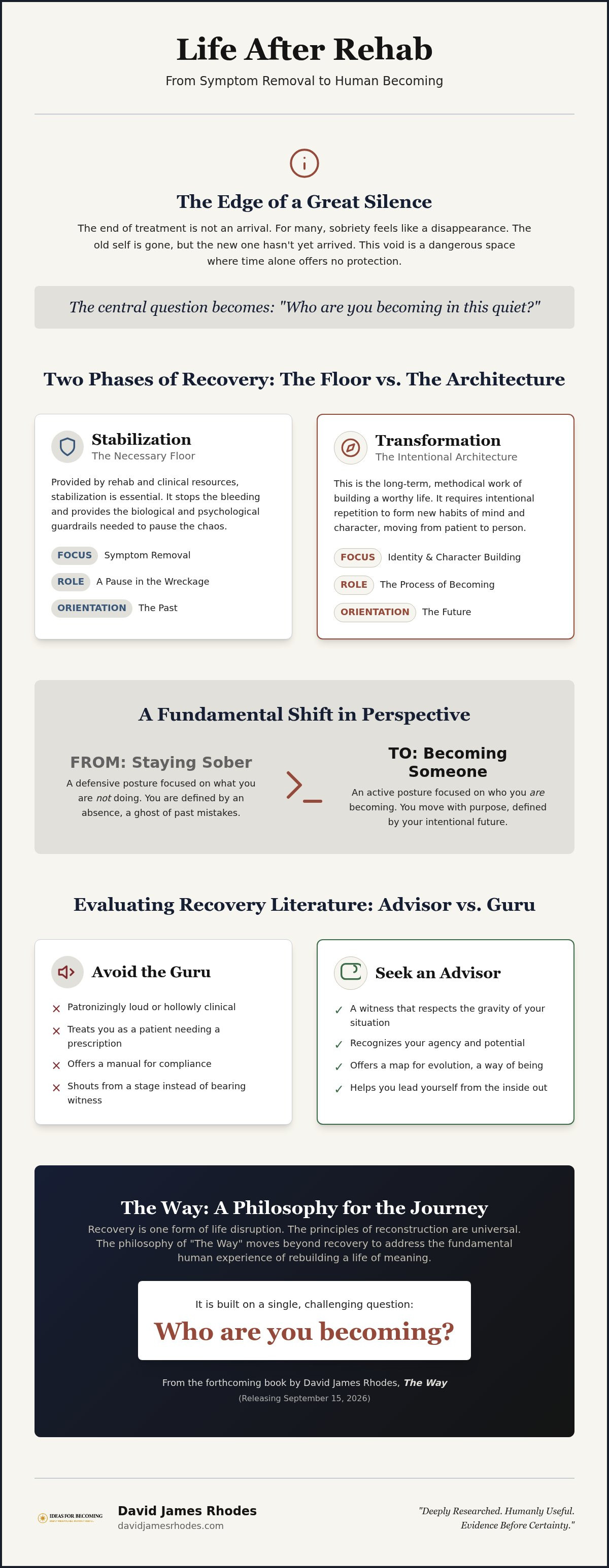
What if the end of treatment is not the arrival, but the edge of a great silence? You've removed the noise. Now, you must face the void. For many, sobriety feels less like a destination and more like a disappearance. The old self is gone. The new one hasn't yet arrived. It's a dangerous space where time alone offers no protection. Who are you becoming in this quiet?
You likely fear that your time in treatment was merely a pause in the chaos rather than a permanent change. You're right to be cautious. This is why a life after rehab book must offer more than simple survival strategies; it must provide a map for the intentional process of human becoming. We'll explore how to move beyond the mere removal of symptoms to rebuild a worthy identity. This guide offers a practical framework to integrate your past into a meaningful future, providing the orientation needed to navigate the transition from recovery to leadership and character.
Key Takeaways
- Understand that recovery is more than symptom removal; it's the threshold where you begin to answer the question of who you're becoming.
- Distinguish between the stabilization provided by treatment and the long-term transformation required to build a sustainable, worthy life.
- Learn why a high-quality life after rehab book should function as an advisor for your evolution rather than a guru-led manual for compliance.
- Use reflective tools and workbooks to move beyond passive reading and start the intentional repetition necessary for rebuilding character.
- Discover how to integrate your past struggle into a future of leadership and meaning, aligning your recovery with the broader philosophy of David’s forthcoming book, The Way.
Beyond the Void: Why the Search for a Life After Rehab Book Starts with Identity
The silence that follows treatment is often heavier than the chaos that preceded it. You've stopped the bleeding. You've removed the substance. Now, you face the void. This is the "Now What?" moment. It's not a technical problem to be solved with a checklist. It's a threshold of identity. Most people searching for a life after rehab book are looking for a way to fill that silence. They're looking for a reason to stay in the light when the shadows feel more familiar. In my work across 156 countries, I've seen that this search for meaning is the most critical stage of the human experience.
Traditional recovery literature often fails at this juncture. It tends to be either patronizingly loud or hollowly clinical. It treats you like a child who needs a cheerleader or a patient who needs a prescription. You don't need someone to shout at you from a stage. You need a witness. You need a guide that respects the gravity of your situation. A book shouldn't just offer tips for avoiding old habits. It should offer a way of being. It should help you navigate the immense weight of your own potential.
The Difference Between Staying Sober and Becoming Someone
Sobriety is the removal of a weight. It's the floor, not the ceiling. If your focus remains entirely on what you aren't doing, you're defined by an absence. You're a ghost of your former mistakes. Real change requires moving into the philosophy of Human Becoming. This is the direction you walk once the weight is gone. Staying sober is about the past; becoming someone is about the future. It's the difference between standing still and moving with purpose. You aren't just recovering. You're evolving. This is the core of the work we'll explore in my forthcoming book, The Way, releasing September 15, 2026.
The Limits of Clinical Guidance
Clinical resources are essential for stabilization. They provide the necessary biological and psychological guardrails. But they often lack the soul required for rebuilding a life of meaning. At some point, the language of the "patient" becomes too small. You outgrow the clinic. You need a perspective that recognizes your agency. The Recovery Model acknowledges this shift, prioritizing personal growth and self-direction over simple symptom management. Moving from patient to person requires a different vocabulary. It requires a shift from medical certainty to human curiosity. When the clinical advice no longer satisfies your hunger for purpose, you've reached the point where you must begin to lead yourself from the inside out.
Stabilization vs. Transformation: Understanding the Process of Human Becoming
Rehab doesn't fix you. It stabilizes you. It provides a necessary pause in the wreckage, but it's a mistake to view the end of treatment as the completion of a project. Stabilization is the floor; transformation is the architecture. Many people approach a life after rehab book looking for a way to maintain the status quo. They want to know how to not fail. But a defensive posture is rarely sustainable. True recovery is larger than symptom removal. It's the transition from being a patient to engaging in the process of Human Becoming.
Time alone does not create change. It only passes. Transformation requires intentional repetition. It requires the slow, methodical work of building new habits of mind and character. We prioritize evidence before certainty. You don't need to feel confident to begin; you need to act until the evidence of your new life becomes undeniable. While SAMHSA's principles of recovery emphasize self-direction and hope, these ideals must be grounded in the daily reality of who you are choosing to be when no one is watching.
The Way: A Philosophy for the Journey
My forthcoming book, The Way, releasing September 15, 2026, provides the framework for this evolution. It moves beyond the narrow confines of recovery to address the universal human experience. The philosophy is built on a single, challenging question: Who are you becoming? This isn't a question for the weak. It's the same inquiry I've posed to global leaders and executives across 156 countries. It demands that you take responsibility for your own trajectory. It suggests that your past, no matter how fractured, is merely the raw material for the person you're capable of being.
Navigating Life After Anything
Recovery is simply one form of life disruption. Whether you're rebuilding after addiction, a failed enterprise, or a personal loss, the principles of reconstruction remain the same. You must move beyond the label of "addict" or "victim" to the broader, more demanding identity of "human." This is the essence of Navigating Life After Adversity: The Process of Human Becoming. When you stop viewing your life as a series of problems to be managed and start seeing it as a process of growth, the void of sobriety begins to fill with purpose. If you're ready to explore this deeper architecture, you can find more on the foundational principles of The Way.
Choosing Your Guide: Evaluating Recovery Literature
Most recovery lists prioritize what's popular over what's useful. They rely on social media noise or Amazon rankings. When you're searching for a life after rehab book, you need a different set of metrics: depth, evidence, and utility. You aren't looking for a temporary emotional high. You're looking for a permanent shift in your orientation toward the world. High-quality literature should function as a map for high-stakes reality, not a collection of platitudes. Avoid books that rely on forced positivity or clinical jargon to mask a lack of substance. If a text sounds like a cheerleader, it's likely ignoring the existential gravity of your situation.
Look for an advisor, not a guru. A guru demands that you follow their specific path; an advisor provides the tools for you to explore your own. This distinction is vital for anyone moving beyond the "Now What?" moment. You need a guide who has seen the world from every possible angle, from the heights of global leadership to the depths of personal crisis. My work, shaped by experience in 156 countries, suggests that the most effective guides are those who act as witnesses to the human experience rather than masters of it.
Clinical vs. Philosophical vs. Practical
A comprehensive library for rebuilding requires three distinct pillars. Clinical resources are necessary for understanding neuroscience and managing cravings. They provide the evidence-based stabilization mentioned earlier. However, a life after rehab book must also offer a philosophical pillar, such as The Way (releasing September 15, 2026), to address questions of meaning and identity. Finally, you need practical resources, like 365 Days of Becoming, to anchor these abstract ideas in daily habits. Without all three, your reconstruction will be lopsided. You'll have the "how" without the "why," or the "why" without the "do."
The Role of Experience and Quiet Authority
The voice of the author matters. In a culture of loud motivational speakers, quiet authority is more persuasive. It suggests a brand of wisdom that doesn't need to shout to be heard. You should seek a guide who has navigated both the boardroom and the behavioral health clinic. This dual experience allows for a perspective that is both worldly and deeply personal. It bridges the gap between professional excellence and raw human struggle. A somber, intentional voice acknowledges that rebuilding a life is difficult work. It respects your intelligence by refusing to offer easy answers, opting instead for a serious conversation about who you are becoming.
The Architecture of Rebuilding: How to Use Reflective Workbooks Effectively
Reading is an intake of breath. Writing is the exhale. Many people treat a life after rehab book like a novel. They consume the ideas but remain fundamentally the same. Passive reading is rarely enough for identity transformation. You must engage with the material. You must put your own reality on the page. The Life After Anything Companion Guide & Workbook serves as the physical site of this reconstruction. It's where philosophy meets the dirt of daily life. It's where you stop being a spectator of your own recovery and start being the architect of your future.
365 Days of Becoming: The Daily Practice
Transformation isn't a single event. It's a rhythmic, slow, and deliberate process. It's a daily practice of becoming. In my experience across 156 countries, the most resilient individuals aren't those who had one great epiphany. They're those who engage in intentional repetition. 365 Days of Becoming provides this structure. It's a cadence of statement, pause, and reflection. For those in high-performance careers, this practice isn't a distraction. It's the anchor. It allows you to lead from a place of depth rather than reaction. You don't find your way. You become it through the steady work of daily alignment.
Moving Beyond the Page
A workbook is a bridge. It connects the overarching philosophy of The Way, releasing September 15, 2026, to the specific challenges of your current reality. It uses staccato fragments and declarative truths to force a pause. These are universal anchors. They allow you to stop and listen to the silence. You don't just read a question. You live with it. Who are you becoming? This is an open-ended provocation. It shifts the focus from the author's insight to your own evolution. This creates a space where ideas can breathe. It moves you from intellectual agreement to lived experience. Rebuilding character isn't about filling in blanks. It's about carving out a new way of being. It's the difference between a map and the actual walk. If you're ready to start the work of reconstruction, you can explore the Life After Anything collection today.
The Way Forward: Integrating Recovery into a Life of Meaning
Recovery is often presented as a defensive posture. Don't use. Don't relapse. Don't fail. But survival is a narrow ambition. A truly useful life after rehab book must move you beyond prevention and into the work of creation. It must help you integrate your history into a life of profound meaning. Your struggle isn't a liability. It's a credential. It's evidence that you've navigated the extremes and survived. This history provides the raw material for a worthy identity. You aren't just a person who stopped a behavior. You're a person who is intentionally engaging in the process of Human Becoming.
The void you felt after treatment was simply the space where your new self had yet to be built. It was a silence waiting for a voice. By moving through the stabilization of recovery and into the architecture of character, you begin to lead yourself from the inside out. This isn't about reaching a state of perfection. It's about maintaining a permanent orientation toward growth. There is an immense dignity in the struggle. It's the forge where character is tested and tempered. In my four decades of experience, I've seen that those who have faced their own shadows often possess the most resilient light.
Leadership and Personal Struggle
If you've survived a period of personal crisis, you've developed a resilience that cannot be taught in a boardroom. This is your greatest leadership asset. It allows you to ground elite performance in raw human experience. Across 156 countries, I've advised leaders who realized that their greatest failures were actually their most significant turning points. Integrating your history of recovery into your professional life creates a brand of quiet authority that is both worldly and personal. You can read more about this integration in The Way - Book by David James Rhodes, which explores how the path is formed by the person you become.
September 15: A New Chapter
The work of recovery is the work of stabilization. It's the necessary preparation for a larger story. My flagship book, The Way, is releasing September 15, 2026. This work completes the progression that begins with Life After Rehab. It moves from the specific challenge of sustainable recovery to the universal challenge of human potential. This forthcoming release is an invitation to join a global conversation on what it means to lead a life of character and legacy. It's the final door in the hierarchy of growth, moving you from rebuilding after disruption to mastering the daily practice of becoming.
Growth is not a destination. It's a rhythmic, deliberate choice. Every action you take is a statement about your identity. The void is gone. The silence is now a space for your own purpose. As you close this guide and continue your walk, keep the central inquiry of our work at the forefront of your mind. It's the only question that matters. Who are you becoming today?
Beyond the Threshold: The Work of Becoming
Recovery is the stabilization required to begin the real work. You've stopped the descent. Now, you must build the ascent. Choosing a life after rehab book is an act of selecting a map for your own evolution. It's the difference between merely surviving and intentionally becoming. We've explored how identity sits at the center of this reconstruction. You aren't a patient. You're a person in process. This philosophy is deeply researched and humanly useful, shaped by insights from 156 countries and more than 40 years of global executive experience.
The void you face isn't an enemy. It's the space where your worthy identity will take root. By engaging in the daily practice of Human Becoming, you move from the silence of sobriety into a life of purpose and leadership. This path leads eventually to the broader principles found in The Way, releasing September 15, 2026. Every day is a statement. Every choice is a brick in the architecture of your character. Evidence before certainty remains our standard. Explore 'Life After Rehab' and the Philosophy of Human Becoming as you take your next step. You've survived the extremes. Now, it's time to build something that lasts.
Frequently Asked Questions
Is 'Life After Rehab' a religious book or a 12-step guide?
'Life After Rehab' is a philosophical guide centered on the process of Human Becoming rather than a religious text or 12-step manual. While it respects various paths to stabilization, it focuses on the existential work of rebuilding a worthy identity. It uses human-centric language to address the void that often follows treatment. This life after rehab book invites you to explore who you are becoming through the lens of character and purpose.
How is David James Rhodes' approach different from traditional recovery coaches?
David James Rhodes operates as an author and advisor rather than a traditional recovery coach. His perspective is shaped by more than four decades of experience across 156 countries in international finance and behavioral health. He doesn't offer motivational cheerleading. Instead, he provides a somber, intentional framework for leadership and personal evolution. He acts as a witness and strategist for those navigating the intersection of elite performance and raw human struggle.
Can I read 'The Way' if I haven't been to rehab?
You don't need to have attended rehab to find value in The Way. While Life After Rehab is a specific application of the philosophy, The Way is a flagship work for anyone navigating life's disruptions. It addresses the universal human experience of growth and meaning. This book, releasing September 15, 2026, serves as a foundation for those seeking to lead themselves with integrity regardless of their past medical history.
What is the best way to use the 'Life After Anything' companion workbook?
The Life After Anything Companion Guide & Workbook is most effective when used as a site for daily, deliberate practice. Passive reading is insufficient for identity transformation. You should use the workbook to move from statement to pause to reflection. By engaging with the provocative, open-ended questions, you bridge the gap between abstract philosophy and the high-stakes reality of your life. It's a rhythmic tool for anchoring your new way of being.
Does this book address the needs of executives and high-performers in recovery?
This life after rehab book specifically addresses the unique pressures faced by executives and high-performers. David's background in global finance and entrepreneurship allows him to speak directly to those who must maintain elite performance while navigating personal reconstruction. He understands that for a leader, recovery isn't just about cessation. It's about rebuilding character so you can lead from the inside out with renewed authority and worldly insight.
When will 'The Way' be available for purchase?
The Way is scheduled for release on September 15, 2026. This book represents the culmination of David's philosophy on Human Becoming and serves as the overarching guide for his body of work. Until that date, it's described as forthcoming. It will complete the hierarchy of growth that begins with sustainable recovery and moves into the daily practice of becoming who you are truly capable of being in a complex world.
Is this book intended to replace therapy or medical treatment?
No, this book is not a replacement for therapy, medicine, or professional medical treatment. Clinical interventions are essential for initial stabilization and safety. David's work begins where clinical treatment often ends. It addresses the existential and philosophical rebuilding of a life after the symptoms have been managed. We prioritize evidence before certainty, acknowledging that medical support provides the necessary floor upon which a worthy identity can be constructed.
What does 'Human Becoming' mean in the context of addiction recovery?
Human Becoming is the philosophy that you are a continuous process rather than a fixed destination. In the context of recovery, it means moving beyond the label of "addict" to embrace the broader identity of a human in evolution. It's a shift from being "fixed" to being "formed." This approach emphasizes that transformation requires intentional repetition and a constant engagement with the central question: Who are you becoming?
Frequently Asked Questions
Related Articles

Navigating Life After Adversity: The Process of Human Becoming
Stop trying to 'bounce back.' Learn how navigating life after adversity is a process of becoming someone new, not returning to who you were. A new way forward.

Selecting a Speaker on Meaning and Purpose: A Checklist for the Human Journey
Tired of hollow motivation? Find a speaker on meaning and purpose who grounds your team in reality. Use our checklist to vet for experience, not performance.

Choosing a Keynote Speaker for Corporate Events
Stop hiring speakers for temporary energy. Learn to find a keynote speaker for corporate events who offers gravity and provokes a lasting culture shift.