
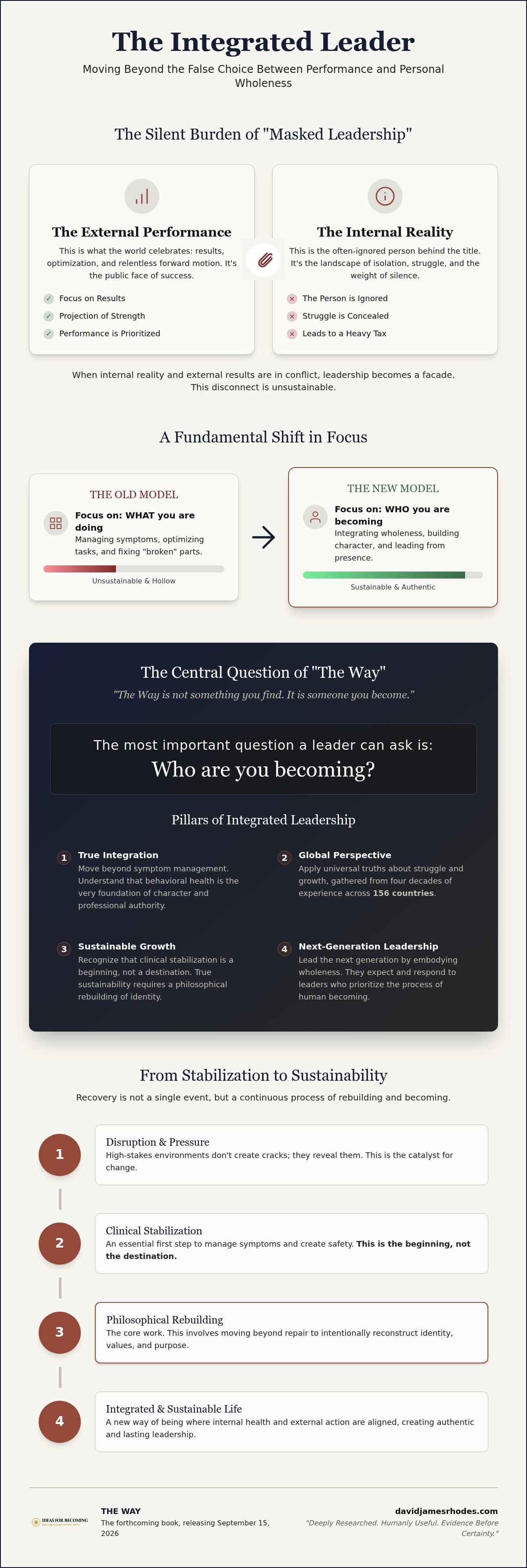
The weight of leadership is often carried in silence. We celebrate the performance. We ignore the person. This disconnect is not just unsustainable; it's a failure of vision. What happens when the executive's internal reality no longer matches the external result? You likely know this isolation well. The intersection of behavioral health and leadership is where this tension is finally resolved. It's a common struggle in high-stakes environments where the stigma of mental struggle remains a quiet, heavy burden.
After four decades and experience in 156 countries, I've seen that true effectiveness depends on integrating our internal health into the process of human becoming. You're more than a set of symptoms to be managed or a performance to be optimized. This article explores a framework for leading from a place of wholeness. We'll move beyond simple recovery and toward a sustainable way of being. My forthcoming book, The Way, releasing September 15, 2026, explores these themes of identity and evolution in depth. For now, let's begin by bridging the gap between who you are and how you lead.
Key Takeaways
- Understand that the intersection of behavioral health and leadership is the true foundation of professional authority. It's time to move past the false choice between performance and wellness.
- Apply universal truths about struggle and growth gathered from experience in 156 countries. These global perspectives help us navigate the internal landscape of leadership.
- Recognize that clinical stabilization is a beginning, not a destination. Sustainable growth requires a philosophical rebuilding of your identity after disruption.
- Learn to lead the next generation by focusing on the process of human becoming. They expect leaders who value wholeness over mere symptom management.
- Shift your focus from what you're doing to who you are becoming. This is the central question of "The Way," releasing September 15, 2026.
The Integration of Behavioral Health and Leadership
Leadership is not a role. It's a state of being. For too long, we've treated the executive as a machine and the mind as a component to be serviced. This separation is a lie. True professional authority doesn't come from a title or a spreadsheet. It emerges from the depth of a leader’s character. When we discuss behavioral health and leadership, we aren't talking about a clinical detour. We're talking about the substrate of character itself. Traditional models focus on the "what" and the "how." They ignore the "who." If the human at the center is hollow, the leadership is a facade.
The dichotomy between performance and wellness is a false one. You can't have sustainable excellence if your internal reality is in conflict with your external results. High-stakes reality demands more than just competence. It demands wholeness. We must see the leader as a human being first. The executive title is a temporary garment. The person underneath is permanent. If the garment fits but the person is shrinking, the leadership fails. This integration is the core of my work and the focus of my forthcoming book, The Way, releasing September 15, 2026.
Breaking the Silence of the Boardroom
The boardroom is often a cathedral of silence. We mask struggle to project strength. This "masked leadership" carries a heavy tax. It erodes the self. When you hide your internal reality, you lose the ability to lead with presence. Vulnerability is often feared as a leak in the hull. In reality, it's the anchor. Moving from managing symptoms to leading from presence requires a shift in identity. It's about becoming, not just performing. Who are you when the mask is removed?
The Reality of High-Stakes Pressure
I've spent four decades in international finance and global strategy. I've navigated the complexities of 156 countries. I've seen that extraordinary pressure doesn't create cracks; it reveals them. In high-stakes environments, the disconnect between your performance and your being eventually becomes a chasm. We often look to behavioral medicine to fix the broken parts, but the work is larger than repair. It's about integration. Behavioral health is the capacity to navigate reality without losing one's center. Without this center, the noise of the world becomes deafening. The intersection of behavioral health and leadership is where we find the signal again.
Global Perspectives on Resilience and Human Becoming
Across 156 countries, I've observed a singular truth. The human struggle for meaning is universal. It doesn't matter if you're navigating a high-stakes corporate environment or fostering innovation in a burgeoning enterprise. The intersection of behavioral health and leadership remains the silent engine of every endeavor. Global leaders are beginning to realize that technical skill is a commodity. Character is the only true differentiator. Cultural contexts might change the vocabulary we use, but they don't change the underlying reality of becoming.
We often confuse cultural resilience with true character. Cultural resilience is often a survival mechanism. It's a reaction to external pressure. True character is an internal choice. It's what remains when the pressure is gone. Organizations like The College for Behavioral Health Leadership are now advocating for these deeper integrations. They recognize that a leader's internal landscape dictates the health of the entire system. This isn't just about managing stress. It's about who you are becoming in the process.
Navigating Identity Across Borders
Diverse environments act as a mirror. They challenge our fixed ideas of who we are. When you lead a global organization, your identity must be fluid enough to listen but firm enough to hold a center. Empathy isn't a soft skill here. It's a strategic necessity. For those guiding the next generation, developing resilience in young leaders is about teaching them to navigate these shifting borders without losing themselves. Identity is not a destination. It's a process of becoming.
The Quiet Strength of Endurance
Endurance is not a trait you're born with. It's a practiced response. We use the word "resilience" as a buzzword, but true staying power is somber. It's quiet. It's the ability to hold the weight of responsibility while maintaining your internal health. The next generation of leaders is redefining this. They're moving away from the "grind" and toward a philosophy of sustainability. They understand that recovery and leadership aren't separate. They're part of the same human story. If you're seeking a way to navigate these complexities, my Leadership & Life Advisory provides a space for this integration. It's a path toward wholeness rather than just performance.
From Stabilization to Sustainability: The Recovery Loop
Stabilization is the floor, not the ceiling. In the context of behavioral health and leadership, we often mistake the absence of a crisis for the presence of health. Clinical treatment is essential for safety. It provides the necessary stabilization to stop the descent. But a leader cannot lead effectively from a state of merely "not failing." Sustainability requires more than the removal of symptoms. It requires the presence of a character capable of carrying the weight of reality. We must move beyond the relief of survival to the responsibility of being.
True recovery is a rebuilding of the internal landscape. It's a shift from surviving to becoming. If you only focus on managing the struggle, you remain tethered to it. You must build a life that is larger than the problem you solved. This is the gap that my work, Life After Anything, seeks to fill. It's a navigation tool for the space between the end of a crisis and the beginning of a new, integrated identity. Who are you when the struggle no longer defines you? This is the question that determines the future of your leadership.
Rehabilitating the Rehabilitation Industry
The current model of care often treats recovery as a short-term episode. A thirty-day stay or a few months of therapy are seen as complete cycles. This is a dangerous illusion. Time alone doesn't create transformation. You can spend years in a room and remain unchanged. Transformation is the result of repetition and intention. We must move toward a model of human becoming, where recovery is seen as a lifelong practice of character development. It's not about fixing a broken part. It's about evolving the whole person. We don't need more symptom management; we need more character architecture.
Building a Worthy Identity
Labels like executive, survivor, or addict are often used as shorthand for identity. They're useful for a moment, but they become cages if we stay in them. To lead with authority, you must find the person underneath the title and the struggle. This is the difficult work of navigating life after adversity. It's a daily practice of deciding who you're becoming. Leadership from a place of wholeness means your authority isn't borrowed from your position. It's earned through your evolution. It's the difference between managing a role and inhabiting a life. It's the difference between performance and presence.
Leading the Next Generation with Behavioral Insight
The next generation is not interested in the hollow success of their predecessors. They've seen the cost of the unexamined life. They've watched leaders crumble under the weight of a performance-only culture. For them, behavioral health and leadership are not separate departments. They're the same pursuit. Young leaders today expect an environment that values their internal reality as much as their external output. They're looking for a path toward wholeness. They want to know that their work contributes to who they are becoming, not just what they are producing.
Leading by example is the only authority that remains. You can't advise on wholeness if you're fragmented. The most powerful tool for a young leader is witnessing an integrated life in their mentors. This requires us to be honest about our own struggles. It requires us to show that recovery and leadership can coexist. When we bridge the gap between our performance and our being, we give them permission to do the same. This isn't about being perfect. It's about being present.
Advisory for the Unknown Future
Advisory for the next generation must move beyond career pathing. It must address the soul. In a world that prioritizes the "doing," we must teach the "being." This is the core of Educational Leadership Advisory. We aren't just preparing students for a job. We're guiding them through the process of becoming. If we don't integrate behavioral insight into education, we're simply training them to burn out more efficiently. Meaning is not found in the complexity of the world; it's found in the clarity of the self. We must provide the tools for that clarity before they face the high-stakes pressure of the global market.
The Practice of Daily Becoming
Growth is not an event. It's a rhythm. My daily practice, 365 Days of Becoming, is designed for this consistency. Large-scale leadership is built on small, daily reflections. It's the quiet work that happens when no one is watching. Character is the sum of our daily choices in the silence. By focusing on who we are becoming each day, we build the staying power needed for the long road. This steady, methodical approach prevents the identity crises that often follow rapid professional ascent. If you're ready to guide the next generation with this level of depth, explore my Education & Next Generation Advisory.
The Way: A Philosophy for Integrated Leadership
"The Way is not something you find. It is someone you become." This is the central tenet of my philosophy. After 40 years of leadership and experience in 156 countries, I've seen that the most enduring leaders are those who integrate their internal health with their external authority. The intersection of behavioral health and leadership is where character is forged. It's where the executive becomes human again. My forthcoming book, The Way, releasing September 15, 2026, offers a framework for this integration. It's built on the understanding that your greatest asset isn't your network or your capital. It's the person you're becoming.
The global executive and the raw human experience are not two separate lives. They're the same story. When we try to keep them apart, we create the cracks that eventually bring us down. Integration is the only path to sustainable power. It requires us to stop managing our image and start developing our being. Who are you when the accolades stop? This is the question that determines the weight of your professional authority.
The Way is Not a Destination
Leadership is often sold as a destination. We chase the title. We chase the exit. But character doesn't have a finish line. It's a continuous process of evolution. The Way Book reframes this journey. It moves the focus from external certainty to internal curiosity. In a volatile world, certainty is a liability. Curiosity is a superpower. When you lead from a place of curiosity, you aren't just managing a crisis. You're navigating the process of becoming. You're learning to lead from your presence rather than your position.
Becoming Who You are Capable of Becoming
Success is often a mask for a hollow center. You can win the world and lose yourself in the process. A life of meaning requires the courage to look at the human beneath the executive. It requires the understanding that behavioral health and leadership are inseparable. Sustainability isn't about maintaining a pace. It's about maintaining a center. If you're ready to move beyond symptom management and toward a life of wholeness, my Leadership & Life Advisory is the space for that work. We don't just solve problems. We rebuild identities. The question remains: Who are you becoming? The answer to that question is the only leadership strategy that truly matters.
The Path of the Integrated Leader
Leadership is not a performance to be maintained. It's a life to be inhabited. We've explored how the integration of behavioral health and leadership creates a foundation that doesn't crumble under global pressure. Stabilization is only the beginning. True sustainability comes from the quiet work of rebuilding your identity after disruption. This is the shift from symptom management to human becoming. It's the move from just doing to truly being.
My work is shaped by four decades of global executive experience across 156 countries. It's built for those who seek more than just another management strategy. Whether you're an established executive or guiding the next generation, the central question remains: Who are you becoming? My forthcoming book, The Way, releasing September 15, 2026, offers a map for this evolution. It's time to stop managing your role and start inhabiting your life. There is hope in the integration. Your evolution is the strategy.
Explore 'The Way' and the philosophy of Human Becoming through my leadership and life advisory services.
Frequently Asked Questions
How does behavioral health impact leadership performance?
Behavioral health provides the internal stability required to handle external volatility. In high-stakes environments, unexamined internal struggles eventually manifest as performance failures. When behavioral health and leadership are integrated, a leader gains the capacity to navigate reality without losing their center. This clarity reduces the noise of panic and allows for deliberate, character-driven decision-making. Performance is the result of presence, not just the management of symptoms.
What is the difference between mental health and 'human becoming'?
Mental health is often treated as the absence of illness or the stabilization of symptoms. Human becoming is the ongoing process of growth and identity evolution. It's a philosophical shift from being fixed to being in transition. While mental health focuses on repair, human becoming focuses on the person you're capable of becoming. It's the difference between maintenance and evolution. It's about finding meaning in the struggle rather than just removing it.
Can a leader be effective while in recovery for addiction or mental health issues?
Effectiveness is not reserved for the unscarred. A leader in recovery often possesses a depth of character and self-awareness that those who have never struggled lack. Recovery is a rebuilding of identity, not just a clinical episode. This process requires a level of honesty and endurance that translates directly to resilient leadership. Sustainable effectiveness comes from wholeness, and wholeness often includes the integration of past struggles into a stronger, more authentic presence.
Why is the next generation of leaders more focused on behavioral health?
Young leaders have witnessed the burnout and isolation of previous generations. They recognize that the performance at any cost model is a failure of vision. For the next generation, behavioral health and leadership are viewed as a single, integrated pursuit. They prioritize meaning and sustainable growth over mere professional ascent. They seek advisory that addresses their internal landscape as much as their career path. They want to lead from a place of integrity.
How can executives integrate behavioral health without losing their professional edge?
Integration is the edge. Executives often fear that vulnerability or self-reflection will soften their authority. In reality, it anchors it. Professional authority is most potent when it's grounded in the reality of human experience. You don't lose your edge by being whole; you lose it by being fragmented. By integrating behavioral health, you gain a level of self-mastery that allows you to operate with a quiet confidence that doesn't need to shout to be heard.
What role does identity play in leadership and recovery?
Identity is the substrate of both recovery and leadership. If your identity is tied solely to your title or your struggle, you're fragile. Recovery requires a philosophical rebuilding of who you are beyond labels like executive or survivor. In leadership, identity dictates how you carry responsibility. When you view identity as a process of becoming, you're no longer threatened by transitions. You're free to evolve. This shift is the core of sustainable character architecture.
What is the 'Human Becoming' philosophy by David James Rhodes?
The Human Becoming philosophy is the belief that identity is a journey of evolution rather than a destination. It's built on the idea that "The Way is not something you find. It is someone you become." David James Rhodes developed this through 40 years of experience across 156 countries. It emphasizes that we're always in transition. The central question isn't what you've achieved, but who you're becoming. This philosophy guides all his advisory work and publications.
How does 'The Way' help leaders navigate major life transitions?
Major life transitions often strip away our external markers of success. The Way, releasing September 15, 2026, provides a navigation framework for these periods of disruption. It helps leaders move from the certainty of a fixed path to the curiosity of a new becoming. Transitions aren't detours; they're the work itself. By focusing on internal character rather than external results, leaders can navigate the unknown with a steady, authoritative presence. It's a tool for rebuilding life after anything.
Frequently Asked Questions
Related Articles

Choosing a Leadership Speaker: A Guide to Human Becoming
Find a leadership speaker for educational institutions who moves beyond slogans to guide the process of human becoming. Choose quiet authority over hollow no...

Beyond Motivation: Finding a Speaker on Youth Leadership and Identity
Choose a speaker on youth leadership and identity who focuses on who students are becoming, not just what they can do. Move from empty motivation to real cha...

Educational Leadership Advisory: Navigating the Process of Becoming
Our educational leadership advisory shifts focus from systems to the leader. Learn how to navigate pressure and isolation by asking: Who are you becoming?