
What if the collapse of your old life was not a tragedy to be survived, but the necessary clearing of ground for something more substantial? Most people view a crisis as a detour. They wait for the old world to return. But the version of you that existed before the disruption is gone. Seeking out books on life after major setbacks often signals a desire to find that old self. The architecture of rebuilding requires a different focus. It's not about returning. It's about becoming.
You're likely tired of the noise. Generic advice feels thin when you're standing in the void between an old identity and an unknown future. I understand that weight. This article offers a curated exploration of literature that helps you move beyond mere resilience toward the process of human becoming. We'll examine how specific narratives make sense of struggle and provide a framework for character-based recovery. This is the foundation of the work I explore in Life After Anything. We're moving from the exhaustion of surviving to the intentionality of building a life that lasts. It is the beginning of a path toward the philosophy I explore in my book, The Way,.
Key Takeaways
- Recognize that a major setback is a structural collapse of identity, not just a temporary interruption of your previous life.
- Use curated books on life after major setbacks as a form of active witnessing to find gravity and meaning within your personal struggle.
- Move past the limitations of resilience to embrace the philosophy of becoming, where the goal is evolution rather than a return to the past.
- Apply a reflective reading practice to identify the core questions driving your current transition and help you navigate the unknown.
- Integrate the Life After Anything framework to bridge the gap between initial stabilization and the creation of a new, grounded identity.
The Architecture of the Void: Why We Search for New Narratives
A major setback is rarely just a single event. It's a structural collapse. The floor beneath your feet doesn't just crack; it disappears. You aren't simply losing a job, a partner, or a health status. You're losing the person you were within those contexts. This is why generic motivation fails. It offers a coat of paint when the foundation has turned to dust. When the loss is systemic or existential, you don't need a cheerleader. You need a witness. You need a process that acknowledges the gravity of the ruin.
Searching for books on life after major setbacks is often an attempt to find that witness. We look for our struggle reflected in the words of another. This isn't about finding a quick fix. It's about finding a narrative that makes the pain legible. Literature provides a mirror. It shows us that while our specific crisis is unique, the architecture of the collapse is a shared human experience. This realization shifts the focus from seeking an immediate exit to understanding the terrain of the rebuild.
The Silence After the Crash
The void is the period between what was and what will be. It's loud with silence. During this time, social circles often thin out. People don't always know how to sit with someone in deep transition. Books act as a steady presence when the world feels thin. They don't demand you "look on the bright side." They simply exist alongside you. There's a vital difference between reading for distraction and reading for reflection. Distraction seeks to forget the pain. Reflection seeks to use it. One keeps you stuck in the past. The other prepares the ground for character development.
Identity as a Journey, Not a Destination
We're often told to "find ourselves" after a crisis. This is a myth. You aren't a set of lost keys waiting to be discovered. You're a work in progress. At the center of my philosophy is the concept of "human becoming." It's the understanding that identity isn't a destination you reach. It's a continuous evolution. The books on life after major setbacks you choose determine the quality of your rebuild. If you consume shallow narratives, you'll build a shallow life. If you engage with literature that challenges your character, you'll build something that lasts. This is the premise of my work in Life After Anything. It's a map for the unknown. It prepares you for the deeper work found in my book, The Way,.
Categorizing the Rebuild: Essential Books for Specific Seasons of Adversity
Adversity is not a monolith. The weight of a failed enterprise differs from the quiet, hollow ache of a dissolved marriage. To rebuild effectively, you must match the literature to the specific season of your struggle. Searching for books on life after major setbacks requires discernment. You aren't looking for a distraction. You're looking for gravity. You're looking for a framework that holds up under the pressure of a collapsed reality. The right narrative doesn't just offer an escape. It provides the structural steel for a new foundation.
Memoirs of survival offer a visceral witness to the extremes of human experience. Works like Viktor Frankl’s Man’s Search for Meaning aren't merely stories. They're clinical observations of the human spirit under duress. Philosophical anchors provide the necessary weight. Stoicism, specifically the Meditations of Marcus Aurelius, offers a cold, clear logic for when emotions threaten to overwhelm. These aren't just pages to read. They're tools to use. They help you move through the "middle space" of change, where the old self is gone but the new self hasn't yet emerged. This is the terrain of human becoming.
Rebuilding After Professional Failure
For leaders, a setback is often a public stripping of status. The ego reacts with violence. In high-stakes environments, the loss of a role feels like the loss of a self. When reading for professional recovery, skip the generic business biographies. Look for strategy. Look for global perspectives that contextualize your failure within the larger human story. Having navigated business landscapes across 156 countries, I've seen that the most resilient executives are those who view their career as one chapter of a larger evolution. They don't just bounce back. They evolve. They use the silence of the setback to audit their character and refine their purpose.
Navigating Personal Loss and Identity Shifts
Personal loss requires a more intimate map. When the structure of your home or family collapses, the void is internal. Finding a life after loss book isn't about finding comfort. It's about finding a way to carry the weight without breaking. The same applies to the end of a long-term partnership. You must be intentional when you navigate the void of divorce. These seasons demand memoirs that focus on the internal landscape of recovery rather than external achievements. They remind you that while the old identity is gone, the capacity to become remains. This is the practice of "The Way," a philosophy I detail in my work,.
Moving Beyond Resilience: The Literature of Human Becoming
Most literature on recovery fixates on resilience. It treats the human spirit like a rubber band. The goal is to return to the original shape. But when you're sifting through books on life after major setbacks, you likely realize the original shape is gone. The rubber band snapped. Resilience is about returning to a baseline. Becoming is about evolving beyond it. It's the difference between surviving a crisis and being authored by it.
In my advisory work, I prioritize "Evidence Before Certainty." This standard applies to the books you read. Avoid narratives that offer a guaranteed timeline for transformation. They aren't useful. Real growth is messy. It's slow. Recovery is larger than the mere removal of symptoms. It's the reconstruction of a character capable of holding the weight of a new reality. Rebuilding requires substance over performance. It demands character over charisma.
Resilience vs. Evolution
Bouncing back is an inadequate goal. If your old life collapsed, why would you want to return to the version of yourself that lived within it? You don't need to heal to return. You need to grow to advance. This shift in perspective changes your reading list. You stop looking for comfort. You start looking for challenge. The "Human Becoming" framework suggests that the setback is the terrain, not the detour. The books that matter are those that force you to confront the central question: Who are you becoming? They don't just help you heal. They challenge you to evolve.
The Global Executive Perspective
I've worked across 156 countries. I've seen leaders in London, Tokyo, and Lagos face the same existential ruin. The cultures differ, but the internal architecture of rebuilding remains constant. Rebuilding requires a blend of professional dignity and raw vulnerability. You can't separate the executive from the human. Elite performance isn't a shield against struggle. It's often the context that makes the struggle higher stakes. My book, The Way explores this intersection. It moves focus from the destination of "being recovered" to the daily practice of becoming. It's about the process. It's about the someone you become through the struggle. For those currently standing in the void, Life After Anything serves as the essential companion for this transition. It provides the map when the old world has disappeared.
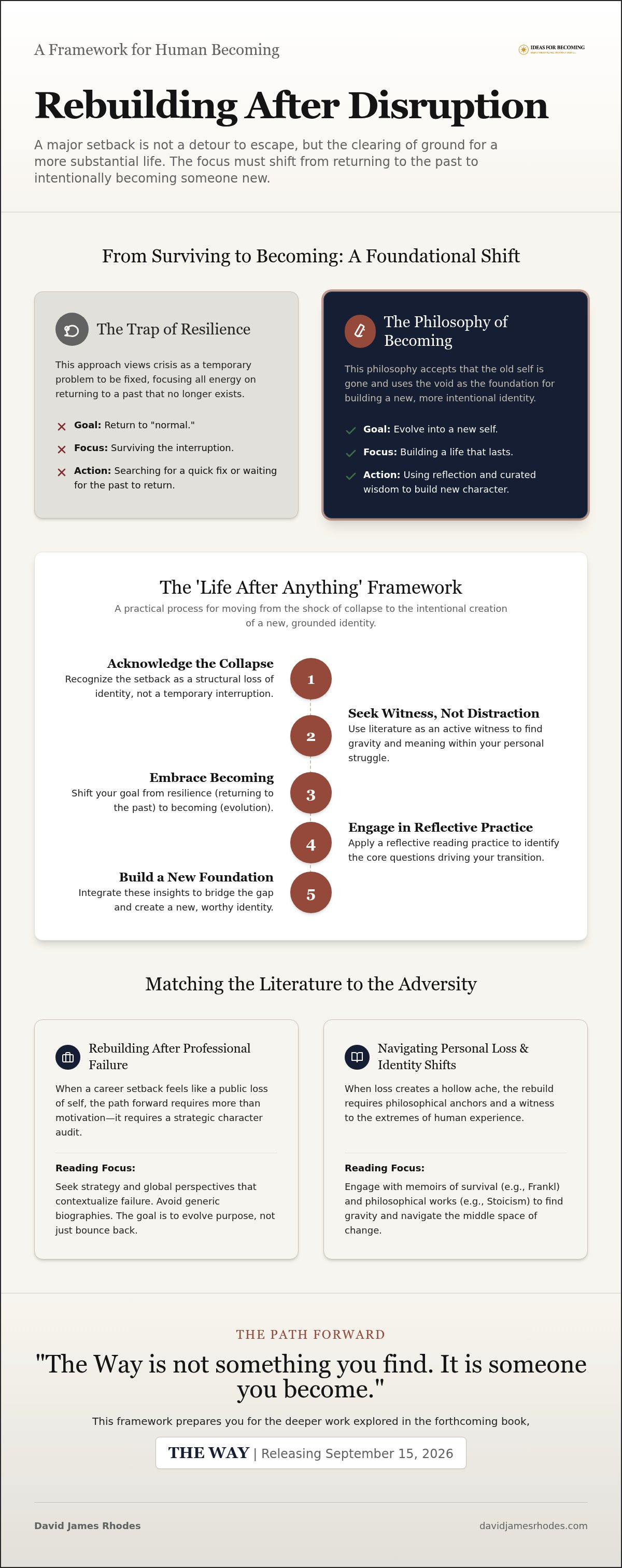
How to Engage with Recovery Literature: A Reflective Practice
Reading for transformation is an active discipline. It's not about how many pages you turn. It's about how many ideas you inhabit. When you seek out books on life after major setbacks, you aren't just looking for information. You're looking for a mirror. You're looking for a narrative that makes your current struggle legible. This process requires a methodology. Without one, you're merely consuming stories rather than authoring your own. Rebuilding identity is a deliberate act of construction. It demands a level of focus that casual reading cannot provide.
- Identify the central question. Every transition is driven by a core inquiry. "What remains when everything is gone?" or "Who am I now?" Find your question before you open the cover.
- Practice active witnessing. Pay attention to your visceral reactions. If a passage makes you uncomfortable, stay there. Resistance often points to the exact place where your growth is stalled.
- Move from macro to micro. Literature provides a high-level perspective. You must bring it down to the ground. If an author survived years of isolation, how does their insight help you handle the next sixty minutes of your day?
- Anchor insights in action. Insights are fragile. They evaporate if they aren't tied to a specific, immediate choice. If a book teaches you about the necessity of silence, your next hour should include ten minutes of it.
The Art of the Pause
Speed is irrelevant. Depth is everything. Allow the ideas to breathe. Read a page. Stop. Reflect. This slow cadence creates space for internal change. I suggest keeping a "becoming" journal. Use it to track the shifts in your internal narrative. Don't write for an audience. Write to see yourself. Short, staccato fragments of thought are often more useful than long paragraphs. Let the silence between your words do the work. This is where the architecture of your new life begins to take shape.
Integrating Daily Practice
Transformation requires repetition. A single treatment episode or a single book cannot build a sustainable life. You need a structural anchor to hold you steady when the old habits of thought return. My work in 365 Days of Becoming provides this rhythm. It translates philosophical insights into practical leadership and life choices. You aren't just thinking about change. You're practicing it. This repetition is how you rewire the narrative of a setback. It's how you move from the void into a new, grounded reality. Start your daily practice today at David James Rhodes. This discipline is the foundation for "The Way," my book,. It's the someone you become that matters most.
The 'Life After Anything' Framework: Rebuilding a Worthy Identity
Rebuilding a life after a structural collapse requires more than just a reading list. It requires a map. Finding the right books on life after major setbacks provides the initial light, but the Life After Anything framework provides the foundation. This system isn't about returning to a previous version of yourself. It's about constructing a worthy identity from the ruins. It recognizes that while stabilization is the first priority, it is not the final destination. Recovery is larger than the removal of pain. It's the presence of purpose.
Rebuilding After Crisis
Most people get trapped by their labels. They become "the person who failed," "the person who got divorced," or "the person in recovery." These are descriptions of a season, not the definition of a soul. My advisory work with global leaders across 156 countries has shown that the most effective rebuilding happens when we strip away these temporary markers. We must integrate behavioral health with high-stakes performance. We acknowledge the raw human struggle while maintaining professional dignity. Rebuilding is not about ignoring the crisis. It's about authoring the narrative that follows it with precision and intent.
Who Are You Becoming?
This is the central question of every major life transition. The Life After Anything Companion Guide & Workbook acts as a practical tool for this navigation. It forces you to move from passive consumption of ideas to active construction of character. It helps you navigate the specific void of your setback by demanding honest reflection and consistent action. This work is the necessary precursor to the deeper philosophy found in The Way book. It prepares the ground for a life that is not just restored, but evolved.
As you move through your rebuild, remember that time alone doesn't create transformation. Repetition and intent do. The Way is, and serves as the philosophical foundation for a life of continuous evolution. The path toward a new identity is often silent and slow. It demands a commitment to the process of human becoming. Every choice you make in the void is a brick in the architecture of your future. In the end, the most vital truth remains. The Way is not something you find; it is someone you become.
Authoring Your Own Rebuild
A major setback is a structural collapse that clears the ground for a more intentional life. It's not a detour; it's the terrain. Selecting the right books on life after major setbacks is only the first step in a larger process of identity reconstruction. You must move from passive reading to active witnessing. You must shift your focus from returning to an old self to evolving into a new one. This is the essence of human becoming. It's a practice that requires patience, repetition, and a willingness to sit in the silence of the void until the new architecture reveals itself.
My work is shaped by four decades of experience across 156 countries, operating at the intersection of international finance and behavioral health. This philosophy is grounded in reality, not theory. It's about building a life that lasts. I invite you to explore the "Life After Anything" series and buy "The Way,",. The ruins of your previous life don't define your value. They provide the materials for who you're becoming next. The Way is not something you find. It's someone you become. Stand steady. The rebuild has already begun.
Frequently Asked Questions
What are the best books for rebuilding a career after a major setback?
Rebuilding a career requires strategy over simple inspiration. Global leaders who've managed operations in 156 countries recognize that professional setbacks are identity crises. Look for books that treat failure as a terrain for character development rather than a detour. My work in Life After Anything addresses this by providing a map for the unknown. It shifts the focus from regaining a lost status to building a foundation that doesn't depend on a title.
How do I choose between a memoir and a philosophical book for recovery?
Choose a memoir when you need to see your struggle reflected in another’s story. It provides the comfort of being witnessed. Choose a philosophical book when you need structural logic and gravity. Stoicism or existentialism offers a framework for when emotions feel uncontained. Searching for books on life after major setbacks requires knowing whether you currently need a mirror or a foundation. Often, the architecture of rebuilding requires both.
Can reading actually help with the physical and mental stress of a setback?
Reading aids recovery by facilitating cognitive reframing and forcing a necessary pause. It allows you to step out of a frantic "fix-it" mindset and into a deliberate process. When you engage with books on life after major setbacks, you find a narrative that makes your chaos legible. This mental order translates to lower physiological stress. It moves you from the high-stakes panic of the crash into the steady, quiet work of the rebuild.
What is the "Human Becoming" philosophy mentioned in David James Rhodes’ books?
Human Becoming is the understanding that identity is a continuous evolution rather than a fixed destination. It's the core of my work. It suggests that a crisis isn't a detour from your life. It's the terrain where you're authored. You aren't "finding yourself" after a setback. You're becoming the person capable of holding a new reality. The Way isn't something you find. It's someone you become.
How does "The Way" differ from typical self-help books on resilience?
Typical self-help focuses on resilience and returning to a baseline. The Way rejects the idea of "bouncing back." It focuses on the intentional process of evolution. It avoids the exuberant promises of motivational speaking. Instead, it offers a somber, challenging exploration of character. It treats the reader as a strategist of their own life. It's grounded in decades of global experience and the high-stakes reality of raw human struggle.
Are there specific workbooks for navigating life after rehab or addiction?
Yes. Life After Rehab and the Life After Anything Companion Guide & Workbook are designed for this transition. Stabilization is essential, but it isn't a sustainable life on its own. These tools help you move beyond the label of "in recovery." They provide a framework for building a worthy identity. They focus on the repetition and daily practice required to rewire the narrative of a setback into a story of becoming.
When does David James Rhodes’ new book "The Way" release?
My book, The Way is scheduled for release on September 15, 2026. It serves as the philosophical foundation for my larger body of work, including the 365 Days of Becoming daily practice. Before this date, it remains a work that anchors the transition from surviving a crisis to becoming through it. It's the culmination of four decades of observation across 156 countries and various high-stakes environments.
Frequently Asked Questions
Related Articles

Best Leadership Guides for Executives: A Thoughtful 2026 Selection
Searching for the best leadership books for executives? Discover thoughtful leadership guides matched to real executive challenges, strategy, and character.

Executive Coach vs. Advisor: Which Kind of Support Does a Leader Need?
Choosing between an executive coach vs advisor? Learn how to match the right support to consequential leadership decisions and the leader you are becoming.

Executive Advisory on Purpose and Fulfillment: A More Human Way Forward
Seek executive advisory on purpose and fulfillment to align leadership choices with values and character. Discover who you are becoming beyond outward success.