
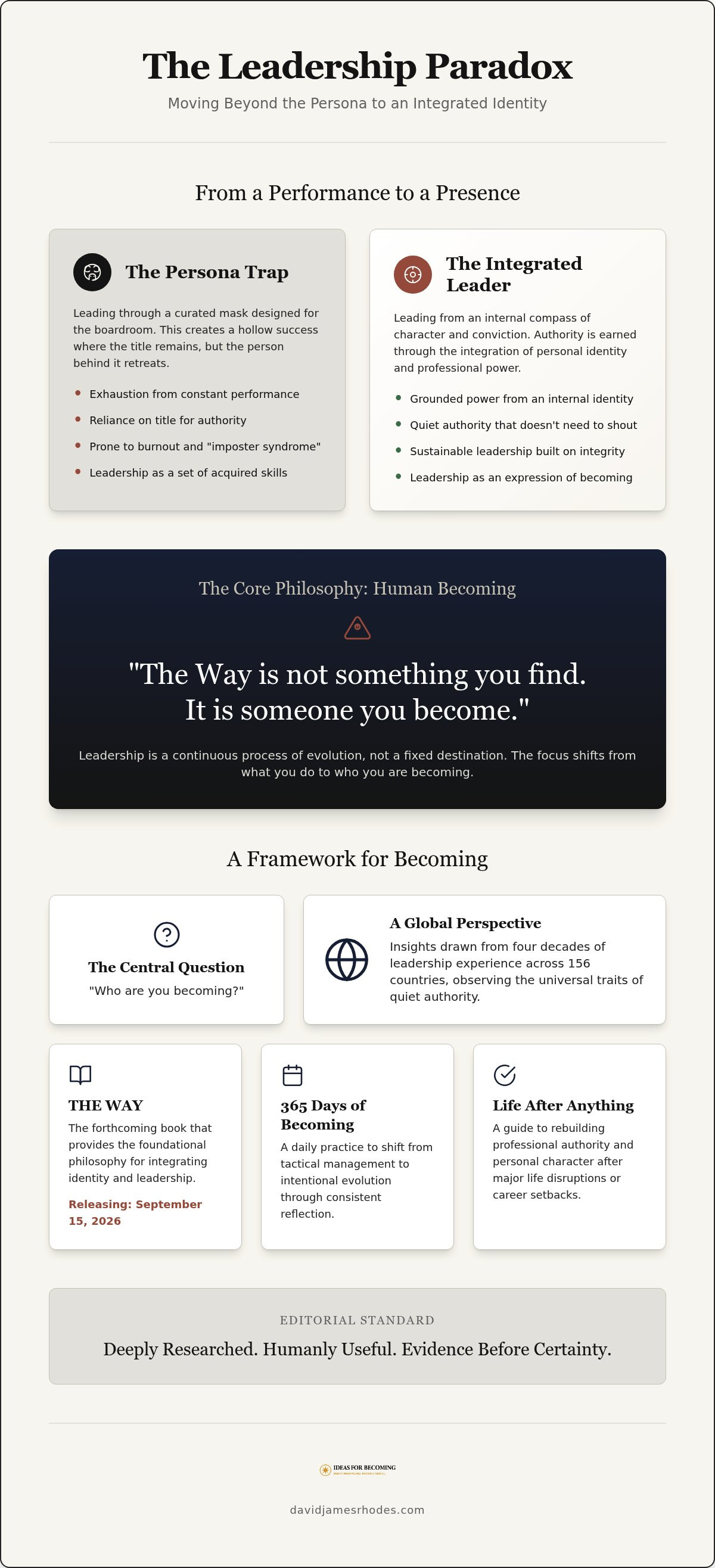
You are tired. It is not the long hours or the global travel that drains you. It is the weight of the persona. You have spent years building a version of yourself that fits the boardroom, only to find that the person in the mirror has become a stranger. This tension between identity and leadership is the silent tax on modern authority. It creates a hollow success where the title remains, but the person behind it has retreated.
You know the feeling of standing at the peak of your career and wondering if you belong there. You are not alone in this. True leadership is not a set of skills to be acquired. It is a continuous process of human becoming. In my four decades across 156 countries, I have observed that the most effective leaders are those who stop performing and start integrating. They understand that the way is not something you find; it is someone you become.
We will examine a framework for aligning your personal character with your professional power. You will find clarity on who you are becoming and learn practical ways to maintain integrity under extreme pressure. This philosophy is the foundation of my book, The Way,. It is time to move beyond the mask and into the reality of your own evolution.
Key Takeaways
- Distinguish between the exhaustion of a leadership persona and the grounding power of an internal identity.
- Explore why identity and leadership are not skills to be acquired, but a continuous process of human becoming.
- Identify the universal traits of quiet authority observed through four decades of experience across 156 countries.
- Learn how to rebuild professional authority and personal character after major life disruptions or setbacks.
- Shift from tactical management to intentional leadership by adopting a daily practice of reflection and evolution.
The Intersection of Identity and Leadership: A Foundation of Character
Leadership is often sold as a collection of external behaviors. A checklist of competencies. A set of refined skills. This is a mistake. True leadership doesn't reside in the hands; it lives in the marrow. It's the internal compass that dictates direction when the maps fail. We must look at the foundation. We must look at the intersection of identity and leadership. This is not about what you do. It's about who you are. Identity is the silent engine. It's the truth that remains when the title is stripped away. If you rely on the title for your authority, you're merely a tenant in a role you don't own. What remains of your influence if the desk is taken away?
True authority is earned through the slow, deliberate work of integration. It's the process of ensuring your external actions are the honest shadows of your internal convictions. Skill acquisition is useful, but it's secondary. You can teach a person to speak, but you cannot teach them to have something worth saying. That comes from the character of the person behind the podium. Identity is the invisible architecture of every decision. It's the floor beneath your feet.
The Crisis of the Leadership Persona
Many executives operate through a persona. It's a curated mask. It's designed for the boardroom, the press, and the shareholders. But there's a cost. Maintaining a persona is an act of friction. It requires constant energy to keep the public face from slipping. This is the emotional tax of leadership. When leaders speak of imposter syndrome, they're rarely describing a lack of competence. They're describing a fracture. They feel like frauds because the person making the decisions isn't the person who lives in their skin. Leading from a hollow center is a somber, unsustainable path. It leads to burnout, not because of the workload, but because of the performance. It's the exhaustion of being a stranger to yourself while others look to you for certainty.
Character as the Ultimate Competitive Advantage
In high-stakes environments, skills are secondary. Competence is the baseline; character is the differentiator. Identity provides a quiet authority that doesn't need to shout to be heard. This internal alignment allows a leader to navigate global complexity without losing their footing. My observations across 156 countries suggest that while frameworks like the Social Identity Approach highlight how leaders represent group values, the leader's own character is the structural necessity that prevents collapse. Integrity isn't a corporate value on a wall. It's the gravity that keeps an organization grounded. If the architecture is weak, the building falls. If the identity is fractured, the leadership fails. Leadership is the outward expression of an inward becoming.
From Being to Becoming: The Philosophy of The Way
We are often taught to search for a true self as if it were a lost artifact. This is a static trap. It suggests that once you find this core, the work is finished. My observations across 156 countries suggest otherwise. You are not a fixed object. You are a process. This is the movement of Human Becoming. It is the shift from a state of being to a state of evolving. In the context of identity and leadership, this means your authority is not a badge you pin on. It is the weight of the person you are currently becoming. The Way is not something you find. It is someone you become.
This philosophy rejects the comfort of the status quo. It demands a constant navigation of your internal landscape. When we examine research on Understanding Leadership and Identity, we see that authenticity is not a one-time achievement. It is a recurring choice. Leadership is the practice of becoming who you are capable of being, even when the world demands you remain predictable. When your identity and leadership are aligned through this movement, you no longer have to perform. You simply are.
The Way: A Journey Without a Destination
Searching for a final version of yourself is a leadership trap. It creates a ceiling. If you believe you've arrived, you've stopped growing. You've become a monument to your past successes rather than a witness to your future potential. Curiosity is the fuel for this movement. It requires the courage to ask: "Who am I becoming?" This process is explored in depth in my book, The Way,. There is no finish line. There is only the path.
The Daily Practice of Becoming
Evolution does not happen in a vacuum. It is the result of small, intentional choices made in the silence of the morning and the heat of the conflict. These choices shape the invisible architecture of your character. To support this, I advocate for a Growth Mindset for Executives. It's a commitment to the quiet authority of evolution. A structural anchor for this work is the practice of 365 Days of Becoming. It turns the abstract philosophy of The Way into a lived reality. If you're ready to explore how this applies to your own path, my leadership and life advisory offers a space for this deeper navigation.
Universal Truths: Leadership Lessons from 156 Countries
I have sat in international boardrooms and walked through local markets where the stakes are life and death. I have negotiated in the high-pressure corridors of global finance and stood in the spaces where entrepreneurs risk everything. Across 156 countries, the mechanics of power change. The local customs shift. The languages vary. But the essence of authority remains constant. Power is often loud. It relies on the threat of consequence or the promise of reward. Identity is quiet. It relies on the presence of the leader. This distinction is the core of identity and leadership. When you lead from a grounded sense of self, you don't need to perform. You are the message. Power is borrowed. Identity is owned.
Quiet authority is not silence. It is weight. It is the palpable sense that the person standing before you is not hiding behind a title. Trust is built through this transparency. In diverse global teams, the process of human becoming acts as the bridge. It signals that you are a participant in the human story, not just a manager of it. When your identity and leadership are rooted in this internal consistency, you build a culture that survives complexity. When others see you navigating your own evolution with integrity, they feel safe to do the same.
The Global Leader’s Internal Landscape
The pressure of global markets demands a specific type of resilience. It's not just about fiscal strategy. It's about the internal landscape of the person making the call. In high-stakes environments, external flux is the only constant. To remain steady, a leader must integrate their life and work into a singular, honest expression of character. This is the focus of Leadership Advisory: Navigating the Integration of Life and Work. It is about finding the center when the world is spinning. If your identity is tied to the stability of the market, you will break when it crashes. If your identity is tied to your process of becoming, you remain intact.
Identity Beyond Borders
Character is the only currency that doesn't devalue at the border. In my experience, the shift from being an expert to being a witness and strategist is where true influence begins. An expert has answers. A witness has perspective. A strategist has a way forward. This evolution is part of The Intersection of Leadership and Identity that defines the next generation of global leaders. They aren't looking for a guru. They're looking for meaning. They're looking for someone who is becoming, not just someone who has arrived. They value the truth of the struggle over the polish of the persona.
Rebuilding Identity After Disruption: Life After Anything
The role is gone. The business is closed. The reputation is tarnished. For many, this is the end of the story. But for those navigating the intersection of identity and leadership, it is a beginning. Disruption is a brutal editor. It strips away the adjectives. It leaves only the noun. You are no longer the "Executive Vice President" or the "Founder." You are simply you. This is the moment where the philosophy of Human Becoming moves from theory to survival. If your identity was the role, you are now a ghost. If your identity is the process of becoming, you are simply in a new chapter.
Recovery is often misunderstood as a return to the previous state. It is not. True recovery is larger than the removal of symptoms or the stabilization of a crisis. Stabilization, whether through clinical rehab or professional therapy is essential. It provides the floor. But stabilization is not transformation. The Life After Anything framework recognizes that a short treatment episode cannot build a sustainable life. You must reconstruct a worthy identity from the wreckage. This is the difference between surviving a setback and evolving because of it. It requires the courage to look at what remains when the external structure has collapsed.
The Necessity of the Pause
Disruption is an invitation. It forces a pause that most leaders avoid. In this silence, you can re-examine who you are becoming. We often label these periods as "failure." This is a shallow interpretation. Failure is an event; becoming is a process. By moving past the labels, you find the underlying human potential that was previously obscured by the noise of success. This is the core of Leadership Through Personal Struggle. The pause is not a delay. It is a structural requirement for the next iteration of your authority. It allows the dust to settle so you can see the path again.
Integrating Struggle into Leadership Authority
A leader who has walked through the fire carries a different kind of weight. They have moved from "surviving" to "becoming." They no longer lead from a place of perceived perfection, but from a place of integrated reality. This transparency creates a compassionate and effective authority. It signals to others that struggle is not a disqualification from leadership; it is a refinement of it. My Life After Anything series serves as a guide for this specific transition. It offers a way to turn the raw experience of loss into the refined gold of character. If you are currently navigating a disruption, my Life After Anything advisory provides a strategist’s perspective for your reconstruction.
Leading from the Inside Out: Next Steps for the Evolving Leader
Tactical management is a reaction. It is a response to the immediate demands of the market, the team, or the board. It is necessary, but it is not leadership. Intentional leadership is an action born from the center. It is the final integration of identity and leadership. This shift requires you to move from the "how" of the role to the "who" of the person. It is a move from the persona back to the self. Every decision you make is a statement. Every action is a vote for the person you are becoming. If you don't choose your direction, the environment will choose it for you.
The primary filter for all leadership actions must be a single question: Who are you becoming? This question acts as a sieve. It separates the transient from the essential. When faced with a crisis or a transition, don't ask what you should do first. Ask who you must become to lead through it. This is the essence of the process of Human Becoming. It turns the raw material of your daily experience into the refined character of your authority. It is a slow, deliberate work. It is the work of a lifetime.
Cultivating Quiet Authority
Reflection is a structural requirement. It is not a luxury. In a high-speed executive environment, reflection is often the first casualty. You must fight for the space to be still. This is where quiet authority is forged. It is the result of seeing the world clearly because you see yourself clearly. Seeking advisory is a critical part of this navigation. However, you must look for an advisor who addresses the whole person, not just the professional title. My Executive Advisory Services are designed for this specific intersection. We don't solve for the role; we solve for the person in the role. The daily practice of 365 Days of Becoming provides the structural anchor for this change.
The Way Forward
The persona is a heavy weight. It is time to set it down. Embracing the process of becoming is an act of courage and vulnerability. It is a commitment to evolution over perfection. My book, The Way, provides a roadmap for this lifelong integration. It is a guide for those who have seen the extremes of success and failure and are ready for something more permanent. Leadership is not the title you held or the wealth you accumulated. It is the legacy of who you became while you were leading. The path is open. The question remains. Who are you becoming?
The Choice to Own Your Evolution
Leadership is not a destination. It is the slow, deliberate integration of your internal landscape with the high-stakes reality of the global stage. My observations across 156 countries suggest that the only authority capable of surviving complexity is the one rooted in character. When you align your identity and leadership, you stop performing for the room. You start leading from the truth of your own experience. This process of human becoming is the work of a lifetime. It is the steady movement from being a curated persona to being an integrated person.
My advisory work is shaped by four decades in international finance and behavioral health. It serves as a witness to both the extremes of elite performance and the raw reality of personal struggle. If you are standing at a threshold of change, remember that the way is not something you find. It is someone you become. There is weight in that ownership. There is hope in that evolution.
Discover the path of human becoming in The Way,. You are capable of becoming the leader the future requires.
Frequently Asked Questions
What is the difference between a leadership persona and a leadership identity?
A leadership persona is a curated mask worn for the boardroom, while a leadership identity is the internal compass of the individual. Performance is exhausting. Integration is sustainable. When you rely on a persona, you're merely a tenant in a role you don't own. True identity is the truth that remains when the title is stripped away. It's the silent engine that drives every external action and ensures your influence is earned, not borrowed.
How can a leader rebuild their identity after a major professional failure?
Rebuilding requires moving through the Life After Anything framework to transition from surviving to becoming. Professional failure often strips away the labels we use for self-definition. This is a brutal but necessary pause. It allows a leader to re-examine who they are becoming without the noise of previous success. Recovery is larger than just symptom removal. It's the reconstruction of a worthy identity from the raw material of personal struggle.
Why is the concept of human becoming important for modern executives?
Human becoming is essential because it moves executives away from static definitions of self that fail in complex environments. Modern leadership requires evolution, not just skill acquisition. By focusing on the process of becoming, leaders develop the parallel intelligence needed to balance technology with human empathy. This philosophy is the foundation of my book, The Way,. It turns the question "Who are you becoming?" into a primary leadership filter.
Can leadership identity be developed, or is it something you are born with?
Identity is not an innate trait; it's a continuous process of evolution. You aren't born with a fixed leadership style. You develop it through intentional choices and the slow work of integration. In the context of identity and leadership, the way is not something you find. It's someone you become. This development happens in the silence of reflection and the heat of high-stakes conflict, shaping who you're capable of being.
How do global experiences across different countries shape a leader's identity?
Global experiences reveal that character is the only currency that translates across every culture and sector. My time in 156 countries has shown that while customs vary, the weight of quiet authority remains constant. These experiences shift a leader from being a mere expert to being a witness and strategist. Navigating diverse landscapes forces you to find a center that isn't dependent on local norms or external stability.
What role does self-reflection play in daily leadership practice?
Self-reflection is a structural necessity that moves a leader from tactical management to intentional leadership. It's not a luxury for the idle. It's the forge of quiet authority. By utilizing a daily practice like 365 Days of Becoming, leaders can foster the reflection needed in high-speed environments. This practice ensures that external actions are honest shadows of internal convictions, preventing the exhaustion that comes from leading from a hollow center.
How does identity influence decision-making in high-pressure environments?
Identity functions as the invisible architecture of every decision made under pressure. When the maps fail, you fall back on your character, not your toolkit. A grounded sense of identity and leadership provides the stability needed to navigate global complexity without losing your footing. It allows a leader to make choices that are consistent with their long-term legacy rather than reacting to short-term fear or external market fluctuations.
How can I integrate my personal life and professional leadership identity?
Integration occurs when you stop performing a role and start expressing your character through your work. Leading from the inside out means your professional authority is the outward expression of an inward becoming. This requires advisory that addresses the whole person rather than just the executive title. By aligning your personal values with your professional actions, you eliminate the friction of the persona and move into a state of purposeful direction.
Frequently Asked Questions
Related Articles

Best Leadership Guides for Executives: A Thoughtful 2026 Selection
Searching for the best leadership books for executives? Discover thoughtful leadership guides matched to real executive challenges, strategy, and character.
Executive Coach vs. Advisor: Which Kind of Support Does a Leader Need?
Choosing between an executive coach vs advisor? Learn how to match the right support to consequential leadership decisions and the leader you are becoming.

Executive Advisory on Purpose and Fulfillment: A More Human Way Forward
Seek executive advisory on purpose and fulfillment to align leadership choices with values and character. Discover who you are becoming beyond outward success.