
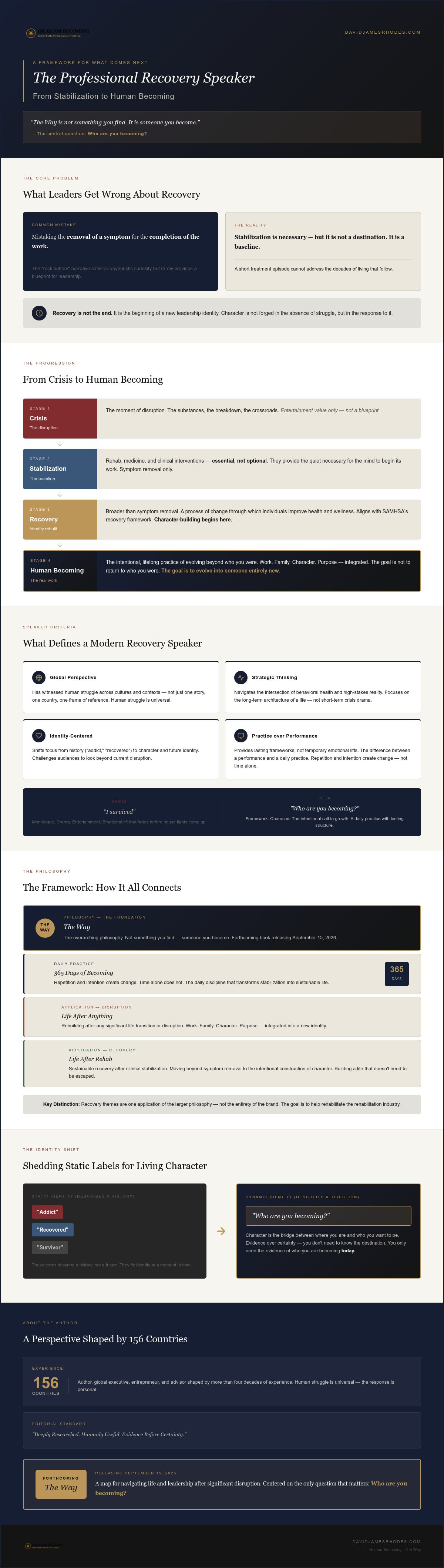
What happens when the crisis ends, the substances are gone, and you're left standing in the silence of a high-stakes life? Many leaders mistake the removal of a symptom for the completion of the work. You've likely heard the clichés. You've seen the high-energy presentations that fade before the house lights even come up. It's a common frustration in executive circles. Stabilization is necessary, but it's not a destination. It's a baseline.
Finding a professional recovery speaker who understands the weight of global leadership requires looking beyond the typical narrative of ruin and redemption. This exploration moves past simple sobriety to the deeper process of rebuilding identity. We'll examine the transition from being "recovered" to the daily practice of Human Becoming. This article provides a framework for what comes next after the clinical work is done. It's an introduction to a philosophy where recovery is not the end, but the beginning of a new leadership identity. We're moving toward the insights found in the forthcoming book, The Way, releasing September 15, 2026. It's time to ask the only question that matters: who are you becoming?
Key Takeaways
- Identify the criteria for selecting a professional recovery speaker who can translate the complexities of behavioral health into the language of global leadership.
- Recognize that clinical stabilization is only the baseline, while the real work lies in the intentional, lifelong process of Human Becoming.
- Explore how the philosophy of The Way, releasing September 15, 2026, offers a map for navigating life and leadership after significant disruption.
- Learn to shift the focus from a history of personal struggle to the essential and ongoing question of identity: who are you becoming?
What Defines a Professional Recovery Speaker in a Modern Context?
A professional recovery speaker does more than recount a crisis. They bridge the gap between individual struggle and the collective evolution of an organization. It is a transition from the drama of survival to the discipline of growth. In high-performance environments, the story of "rock bottom" is often insufficient. It satisfies a voyeuristic curiosity but rarely provides a blueprint for leadership. The modern context requires a strategist. Someone who has seen the extremes of global success and the depths of personal failure. This role is about navigating the intersection of behavioral health and high-stakes reality. It requires a focus on the long-term architecture of a life rather than the short-term drama of a crisis.
Beyond the "Rock Bottom" Narrative
Traditional motivational speaking relies on the arc of the fall and the rise. It is entertaining. It is often shallow. A professional recovery speaker shifts the focus. The past disruption is not the destination. It is the context. We must move beyond the "I survived" monologue. The audience doesn't need to be entertained by someone else's darkness. They need to be challenged by the light of a new identity. This is not about a temporary emotional lift. It is about the intentional call to growth. It is the difference between a performance and a practice. We don't look back to dwell. We look back to understand the foundation we are building upon.
Recovery as a Subset of Human Becoming
Recovery is often viewed as a clinical event. A short treatment episode. This perspective is limited. True recovery is a broader recovery approach that views stabilization as the beginning, not the end. It is a subset of a larger philosophy: Human Becoming. Sobriety is the baseline. It is the removal of a barrier. Once the barrier is gone, the real work begins. This is where the question of identity takes root. Character is not forged in the absence of struggle, but in the response to it.
Who are you becoming? This is the central inquiry of David’s forthcoming book, The Way, releasing September 15, 2026. Recovery is the process of rebuilding after any significant life transition. It requires a framework that addresses the intersection of behavioral health and professional excellence. It demands a move from symptom removal to the intentional construction of character. The goal is not to return to who you were before the crisis. The goal is to evolve into someone entirely new. This is the work of Life After Rehab. It is the work of a lifetime.
The Philosophy of The Way: Rebuilding Identity After Disruption
The philosophy of The Way rests on a single, uncompromising truth. The Way is not a destination found; it is a person become. When seeking a professional recovery speaker, organizations often look for a story of survival. Survival is only the beginning. It is the static image of a moment in time. Real transformation is dynamic. It is the integration of every aspect of a life. Work. Family. Character. Purpose. This is the shift from being "recovered" to the continuous state of Human Becoming.
Stabilization vs. Sustainable Transformation
Stabilization is the first step. Rehab, medicine, and clinical interventions are essential. They provide the quiet necessary for the mind to begin its work. But stabilization is not a sustainable life. A short treatment episode cannot address the decades of living that follow. Sustainable recovery requires a framework for the long term. It requires the daily practice of 365 Days of Becoming. Time alone does not create change. Repetition and intention create change. This aligns with SAMHSA's recovery framework, which emphasizes that recovery is a process of change through which individuals improve their health and wellness. It's about building a life that doesn't need to be escaped.
The Role of Character in Recovery
Identity is often reduced to labels. "Addict." "Recovered." These terms describe a history, not a future. Navigating life after adversity requires shedding these static definitions. It requires a shift toward character. This is the heart of Human Becoming. It's a move toward evidence over certainty. We don't need to be certain of the final destination. We only need the evidence of who we are becoming today. Character is the bridge between where you are and who you want to be. It is the architecture of a new life.
A professional recovery speaker should challenge the audience to look beyond their current disruption. David’s experience across 156 countries has shown that human struggle is universal, but the response is personal. If you are ready to explore the deeper structures of identity, you might find resonance in David’s advisory work. His forthcoming book, The Way, releasing September 15, 2026, details this progression from stabilization to full human evolution. The path is not found. It is forged. It is walked one day at a time through the practice of becoming.
Criteria for Selecting a Speaker on Recovery and Resilience
Selecting a speaker is an exercise in discernment. Most event planners look for a compelling story. They look for a "rock bottom" narrative to engage the audience. This is often a mistake. A story is a moment. A framework is a future. You need a voice that bridges the gap between raw human experience and the requirements of the boardroom. A professional recovery speaker must possess professional dignity. They should be as comfortable discussing executive leadership as they are discussing behavioral health. The goal is not to entertain the audience with tragedy. The goal is to equip them with a strategy for rebuilding.
The Value of a Global Perspective
Universal truths are rarely found in isolation. They are discovered through diversity. Experience across 156 countries provides a unique vantage point. It removes the local bias from the recovery narrative. It simplifies the complex. When a message is shaped by four decades of international finance and entrepreneurship, it carries a different weight. It is grounded in the reality of high-performance environments. This perspective allows a speaker to address elite performance and raw human struggle simultaneously. They are two sides of the same coin. This breadth of experience informs a sophisticated approach to recovery and recovery support that resonates across cultures and sectors. It is not just about stopping a behavior. It is about navigating a world that demands excellence while you are rebuilding your interior life.
Assessing the Long-Term Impact
The value of a keynote is measured by what remains when the room is empty. Does the message survive the ride home? Many speakers act as cheerleaders. They offer a temporary emotional lift. This is fleeting. A witness and a strategist offers something more permanent. They provide a lens through which the audience can view their own lives. You should look for a keynote speaker on leadership and identity who understands the gravity of the topic. They should not offer easy answers. They should offer better questions.
Practical utility is the ultimate standard. Will the audience leave with a question that provokes change? This is the core of Human Becoming. It is the focus of David’s forthcoming work, The Way, releasing September 15, 2026. A professional recovery speaker should serve as a guide for the architecture of a new life. They should move the conversation from what was lost to who is being built. Who are you becoming? If the speaker cannot answer that for themselves, they cannot help your audience find the answer.
Integrating Recovery into Leadership and Organizational Culture
Recovery is often hidden in professional environments. It is treated as a secret. A liability. This is a failure of perspective. A professional recovery speaker reframes this narrative. Recovery is a rigorous process of rebuilding. It forges leaders who are resilient and self-aware. These are the qualities required to navigate corporate adversity. When an organization acknowledges the reality of human struggle, it creates a foundation for genuine strength. It is a move from a culture of perfection to a culture of character.
Leading from the Inside Out
Authentic leadership is not found in a manual. It is found in the response to personal disruption. When a leader navigates the path of Human Becoming, they gain a unique authority. They move from managing symptoms to leading people. This transition requires a specific kind of support. Engaging in leadership advisory allows executives to integrate their behavioral health with their professional excellence. It is the practice of leading from a place of wholeness. It is the understanding that the internal landscape dictates the external result.
The Quiet Authority of Experience
Most corporate events favor exuberant motivation. They want high energy. They want loud promises. This is often a distraction. Somber, intentional reflection carries more weight. It creates a space for vulnerability that remains professional and dignified. A speaker who has seen the world from 156 countries doesn't need to shout. They have seen the extremes of success and failure. They offer a steady presence. This quiet authority is what changes culture. It moves the organization from a focus on temporary performance to a focus on permanent evolution.
Organizational culture should be a shared pursuit of becoming. It is about more than quarterly targets. It is about who the people in the organization are becoming. This is the work of Life After Anything. It is the integration of life and work. If you are seeking a strategist to help navigate these high-stakes transitions, consider exploring David’s keynote and advisory services. His forthcoming book, The Way, releasing September 15, 2026, provides the roadmap for this cultural evolution. The way forward is not a new policy. It is a new way of being.
David James Rhodes: A Perspective Shaped by 156 Countries
David James Rhodes offers a perspective forged in the high-stakes reality of 156 countries. This voice is not manufactured. It's the result of four decades spent at the intersection of international finance, entrepreneurship, and behavioral health. As a professional recovery speaker, David doesn't rely on the volume of his voice. He relies on the weight of his witness. His message centers on "Life After Anything." This is the intentional act of rebuilding. It's the recognition that disruption is not the end of a story. It's the start of a new architecture.
Every keynote engagement returns to a single, challenging inquiry: Who are you becoming? This is the central question of his forthcoming book, The Way, releasing September 15, 2026. It's a call to move beyond the temporary fixes of typical motivational speaking. It's an invitation to engage with a philosophy that views life as a continuous process of evolution. It's a strategy for those who have seen the world from every angle and are ready to look within.
The Process of Human Becoming
Engaging with the philosophy of The Way provides a structural tool for growth. It's a framework that extends far beyond the clinical walls of "Life After Rehab." As a professional recovery speaker, David emphasizes that stabilization is only the baseline. His advisory services help individuals and organizations navigate their own unique path of becoming. This isn't about finding a perfect route. It's about building the character required to walk any path. We move from managing the symptoms of the past to constructing the identity of the future.
Engaging the Next Generation
These themes are critical for the leaders of tomorrow. The next generation faces a world of unprecedented complexity and disruption. Educational leadership must evolve to address more than just technical skill. It must address identity. It must address the reality of recovery as a universal human process. We aren't just training professionals. We are helping humans become. The strength of a future leader is found in their ability to evolve through adversity.
The Way is not something you find. It is someone you become. This is the quiet authority of a life lived across borders and through disruptions. It's a steady presence in a world that never stops moving. The journey of becoming is not a destination. It's a daily practice. Who are you becoming? The answer is forged in the walking.
The Architecture of Your Next Chapter
Recovery is not a destination. It is the removal of a barrier so that the real work of Human Becoming can begin. We've explored how stabilization provides the necessary quiet, but it cannot build a sustainable life on its own. True evolution requires a framework that bridges the gap between personal adversity and professional excellence. It demands a shift from managing symptoms to constructing a new identity. Selecting a professional recovery speaker who understands this intersection is the first step in transforming organizational culture from the inside out.
David James Rhodes brings over 40 years of experience across 156 countries to every conversation. His expertise bridges international finance and behavioral health, offering a perspective that is both worldly and deeply personal. As the author of the forthcoming book, The Way, releasing September 15, 2026, he serves as a strategist for those ready to rebuild. If you're seeking a voice that carries the weight of raw experience and quiet authority, you can inquire about David James Rhodes for your next keynote engagement. The path is not found. It is someone you become. Start your becoming today.
Frequently Asked Questions
What is the difference between a motivational speaker and a professional recovery speaker?
A motivational speaker seeks to elevate emotion temporarily. A professional recovery speaker seeks to provide a structural framework for long-term rebuilding. While motivation relies on exuberance, the recovery message focuses on the quiet authority of character. It moves from the drama of survival to the question of who you are becoming. This approach is less about a performance and more about a witness and strategist offering a map for the architecture of a new life.
Can a recovery speaker be effective in a corporate or executive environment?
Effectiveness in corporate settings depends on the speaker's ability to bridge behavioral health with professional excellence. High-stakes environments often produce adversity that mirrors the recovery process. A professional recovery speaker who understands international finance can translate the lessons of rebuilding a life into the language of leadership. It's about resilience, integrity, and the integration of personal struggle into authentic leadership. This creates a foundation for high performance that is grounded in raw human experience.
How does David James Rhodes incorporate his global experience into his recovery message?
David draws on four decades of experience across 156 countries to provide a universal perspective. This global context strips away local bias and focuses on the shared human experience of struggle and evolution. By witnessing the extremes of success and failure on a world stage, he offers a message that is both worldly and deeply personal. It is a perspective that views recovery as a global human project of becoming.
Is "The Way" a book specifically about addiction recovery?
The Way is a flagship philosophy that transcends any single category. While it addresses the reality of recovery, its central theme is Human Becoming. It explores the process of growth, leadership, and finding meaning after any major life disruption. The book presents the idea that the path is not something you find, but someone you become. It serves as a structural tool for anyone navigating the deep work of rebuilding an identity.
When is David James Rhodes’ book "The Way" available?
The forthcoming book, The Way, is scheduled for release on September 15, 2026. Until then, it is described as a forthcoming work that outlines David's core philosophy of Human Becoming. It represents the culmination of his 40 years of experience across 156 countries. Readers seeking a framework for sustainable transformation can look toward this date. The book serves as a primary door into the deeper structures of identity and evolution.
How does a speaker on recovery address the needs of those who have not experienced addiction?
Recovery is a universal human application. It is the process of rebuilding after any significant disruption, whether it is grief, professional failure, or a shift in identity. A speaker focuses on the common architecture of change. Everyone is in a state of becoming. By addressing the fundamental questions of character and purpose, the message resonates with anyone navigating the high-stakes reality of personal or professional transition.
What is the "Life After Anything" series about?
The Life After Anything series focuses on the intentional act of rebuilding after a major life disruption. It includes books, companion guides, and workbooks designed to help individuals move beyond stabilization. While Life After Rehab focuses on sustainable recovery, the broader series addresses the integration of life, work, and character. It provides a practical roadmap for the daily practice of 365 Days of Becoming in a post-crisis world.
Does David James Rhodes provide advisory services for organizations?
David provides specialized advisory services focused on leadership, life, and the next generation. These services are designed for organizations and executives navigating growth or adversity. He offers a perspective shaped by international finance and behavioral health to guide professional transformation. This advisory work helps institutions foster a culture where becoming is a shared pursuit. It integrates professional excellence with the deep work of human character, helping individuals become who they are capable of becoming.
Frequently Asked Questions
Related Articles

The Way: A Guide to the Process of Human Becoming
David James Rhodes's human becoming book, The Way, reframes growth as a process, not a destination. Releasing September 15, 2026.

The Professional Keynote Speaker: Moving Beyond Motivation to Human Becoming
Move beyond temporary hype. Discover how a professional keynote speaker grounds leadership in human becoming to create lasting evolution, not just Monday talk.

Life After Professional Sports: Navigating the Way of Human Becoming
Navigating life after professional sports is often the hardest contest. This guide helps you move beyond your athletic identity to discover who you are becom...