Failure is not a detour. It is the arrival at a truth you were previously too busy to see. Most people spend their lives building a monument to their own competence. Then, the structure collapses. If you are currently in the difficult work of rebuilding character after failure, you know that shame can feel like a physical weight. It paralyzes. You wonder if the version of you that existed before the fall is gone forever. You feel the crushing silence of the aftermath.
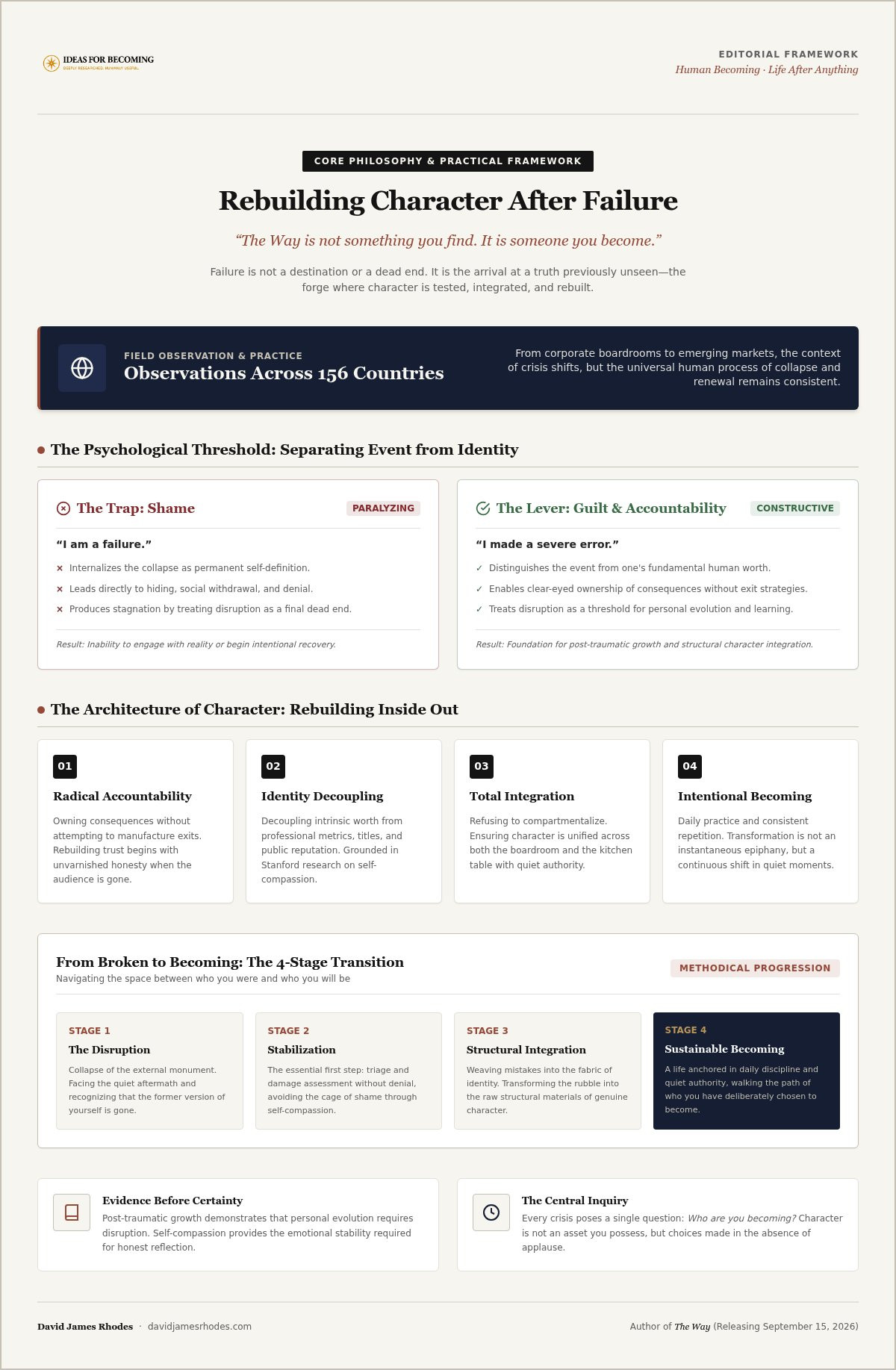
You aren't just fixing a mistake. You are participating in the process of Human Becoming. This is a guide to the quiet space where you decide who you are when no one is applauding. It is a roadmap for navigating the gap between who you were and who you will be, a process I explore in Life After Anything. We will examine a framework for moving from broken to becoming, practical steps to restore trust, and how to find meaning in a crisis. Across 156 countries, I have seen that The Way is not something you find; it is someone you become. My book, The Way, is now available to guide this transition.
Key Takeaways
- Distinguish between the event of failing and the label of being a failure to see disruption as a threshold rather than a dead end.
- Use a practical framework for rebuilding character after failure that integrates your past into a more resilient and honest identity.
- Recognize that while stabilization is a vital first step, a sustainable life requires moving toward the deeper work of intentional becoming.
- Identify how daily practice and consistent repetition serve as the anchors for shifting who you are in the quiet moments.
- Explore why character isn't a prize you find, but a person you become through the methodical process of human becoming.
Beyond the Rubble: Understanding Failure as a Threshold
Failure feels like a destination. It isn't. It is a disruption. A sudden, violent pause in the story you were telling about yourself. When the structure of your life collapses, you stand amidst the rubble. This is the difficult, necessary beginning of rebuilding character after failure. In my work with Life After Anything, I focus on this specific moment of disruption. It is not about returning to what was. That version of you is gone. The rubble is the raw material for what happens next.
Identity is not a fixed asset. We often believe we "are" our successes or our mistakes. This is a mistake. You are not a static object. You are a process. I call this Human Becoming. Failure is the moment this process becomes visible. In the heavy silence that follows a setback, you aren't just waiting for the world to forget. You are forging the person who comes next. The quiet space after a collapse is not an empty void. It is the forge where character is actually tested and tempered. You are deciding which parts of your old self to keep and which to leave in the ruins. The Way is not a destination you find; it is the person you become through these trials.
The Difference Between Guilt and Shame
Shame is a cage. It tells you that you are the failure. It leads to hiding, denial, and social withdrawal. Guilt is different. It is the recognition that you did something wrong, not that you are fundamentally wrong. Facing this reality requires courage, but it is the only way to avoid stagnation. You must look at the damage without letting it define your soul. To move forward, you must separate the event from your identity. Character is the sum of choices made in the absence of an audience.
Failure as a Global Human Experience
I have worked in 156 countries. I have seen high-level executives fall in boardrooms and entrepreneurs lose everything in emerging markets. The context of the crisis changes. The human experience of collapse is universal. We all face the same choice when the narrative breaks. You can see the disruption as a dead end. Or you can see it as a threshold. Scientific research into post-traumatic growth shows that significant personal evolution often follows major life disruptions. Rebuilding character after failure is a global human project. It is the methodical work of choosing who you are becoming when the old answers are no longer enough. This isn't a quick fix. It is a slow, intentional navigation toward a more honest version of yourself. My book, The Way, available as of September 15, 2026, provides the roadmap for this transition.
The Architecture of Character: Rebuilding from the Inside Out
Character is not a trophy you polish. It is the structural integrity of your soul. When we speak of rebuilding character after failure, we aren't talking about returning to a previous state. We're talking about integration. You can't excise the parts of your history that bring you pain. You must weave them into the fabric of who you are now. This is the essence of Human Becoming. It's the realization that your mistakes aren't obstacles to your character, but the very materials required to build it.
Accountability is the first stone in this new foundation. It's the quiet, difficult work of owning the consequences without looking for an exit. In high-stakes leadership, the weight of failure is often public. The loss of trust is tangible. Rebuilding that trust starts with a radical honesty that most avoid. You don't find a new path. You become a person capable of walking it. This internal shift is what allows for a sustainable future.
Identity Beyond the Career or Crisis
Who are you becoming? This is the central question. Most of us anchor our identity to a title, a salary, or a reputation. When those fall away, we feel erased. But your intrinsic worth is not a professional metric. Research from Stanford suggests that the benefits of self-compassion allow us to learn from our errors without being consumed by them. This isn't soft. It's strategic. It provides the emotional stability needed for deep reflection. My book, The Way, released September 15, 2026, serves as a guide for this internal exploration.
The Integration of Life and Work
Character cannot be compartmentalized. You're the same person in the boardroom as you are at the kitchen table. If you're rebuilding character after failure, the work must be total. True leadership is leading from the inside out. It's a quiet authority. It comes from having seen the bottom and decided to keep climbing. This perspective is rare. It's the result of surviving adversity and choosing to learn its lessons. If you're navigating a recent disruption, my work in Life After Anything offers a framework for this total integration. It's about more than just recovery. It's about the evolution of the self.
Breaking the Loop: Moving from Shame to Intentional Becoming
There is a specific lie that failure tells. It whispers that your mistake is unforgivable. It suggests you've crossed a line where the old version of you is dead, and no new version is permitted to exist. This is the loop of shame. It's a circular trap that keeps you staring at the wreckage instead of the tools in your hands. Rebuilding character after failure requires a cold, clear rejection of this narrative. You are not the event. You are the person responding to it.
Stabilization is the first step, but it's never the last. Therapy, medicine, and rehabilitation are essential for stopping the bleeding. They provide the floor. However, a treatment episode cannot build a sustainable life. Recovery is larger than symptom removal. It's about moving beyond the label of "the one who failed" toward a worthy identity. Self-forgiveness isn't a feeling you wait for. It's a framework grounded in action. You don't feel your way into a new character; you act your way into it by making different choices every day.
Life After Anything: Navigating the Unknown
The middle space of rebuilding is often the most difficult. The old self is gone, but the new self is not yet clear. This is the threshold of Human Becoming. My Life After Anything series was designed for this specific transition. It's a resource for those who find themselves in the unknown. The Way of recovery isn't about returning to a baseline; it's about constructing a life that is sustainable, honest, and whole. It's the methodical work of choosing who you are becoming when the previous answers have failed.
The Role of Vulnerability in Character
True character requires the courage to be seen in your imperfection. In my work across 156 countries and my experience in behavioral health, I've seen that the most resilient individuals aren't those who never fall. They're the ones who own the fall. Sharing the story of your failure, once you've earned the right to tell it through consistent action, becomes a source of strength. It's a vital part of building psychological resilience and finding meaning in the aftermath. Vulnerability isn't a weakness; it's the price of entry for a deeper, more authentic leadership. It allows you to lead from a place of reality rather than a facade of perfection. This is how you break the loop. You stop hiding. You start becoming.
Navigating the Daily Path: Practices for Sustainable Growth
Character is not forged in the heat of a crisis. It is merely revealed there. The actual work of rebuilding character after failure happens in the silence of the mundane. It occurs in the hours when no one is watching. You need a daily anchor. Without a consistent practice, you will inevitably drift back to the patterns that led to your collapse. Time alone does not heal. It only passes. Repetition creates the neural groove, but intentionality is the catalyst that makes the change permanent. This is the core philosophy behind 365 Days of Becoming. It is a commitment to the person you are becoming, one day at a time.
The Power of Small, Consistent Choices
Transformation starts with three specific movements. First, you must practice radical honesty. Look at the failure without the filter of your ego or the defense of your reputation. Own the wreckage. Second, identify your core values. These are the non-negotiable principles that will govern your next chapter. They are your new boundaries. Third, establish micro-integrity. This means keeping small, seemingly insignificant promises to yourself. If you commit to a ten-minute walk or a specific time for reflection, do not miss it. Trust with the world is broken in public, but trust with yourself is rebuilt in the private moments of follow-through. These small wins are the hidden architecture of a new identity.
Reflective Practices for the Modern Leader
The final steps involve shifting your perspective from output to essence. Step four requires asking a singular, provocative question every morning: Who am I becoming today? This shifts the focus from what you do to who you are. It forces a pause in the rush of professional demands. Step five is the inclusion of an external mirror. High-stakes leadership is often isolating, and isolation breeds blind spots. Seeking leadership advisory provides the necessary distance to evaluate your choices with clarity. It prevents the subtle self-deception that often precedes a significant fall. True growth requires a witness who understands the complex integration of life and work.
Character is a daily decision. It is a slow, methodical construction that cannot be rushed. If you are ready to move beyond stabilization and start the work of evolution, discover more about David James Rhodes. We help leaders navigate the complexities of personal and professional rebuilding. The person you are becoming is shaped by the choices you make in the next twenty-four hours. Every choice is a brick in the new structure of your life. Make them count.
The Way Forward: Choosing Your Next Chapter
Character is not a finish line. It's a direction. Rebuilding character after failure is a lifelong process, not a temporary repair to be discarded once the crisis fades. Your failure is not a tomb. It's fertile ground. It's the soil where a more honest, integrated version of you takes root. In my work as a witness and strategist for leaders across 156 countries, I've seen that the most enduring identities are those forged in the aftermath of a collapse. The Way isn't about finding a path back to who you were. It's about becoming the person you are now capable of being. This requires a shift from seeking a quick fix to embracing a permanent evolution.
Becoming Who You are Capable of Becoming
The goal of this work is evolution, not restoration. The person who existed before the failure no longer exists. Trying to return to that "old self" is a form of denial. The philosophy of Human Becoming offers hope because it suggests that your current state is not your final state. There is a profound dignity in the struggle to be better. It's a quiet, heavy work that requires you to look at your past with clear eyes and move toward your future with intentionality. Who are you becoming? The answer to that question is the only thing that matters in the wake of a disruption. It's the difference between a life defined by a mistake and a life refined by one.
Resources for the Journey
The path forward requires both internal reflection and external insight. For those looking to bring these themes of leadership and identity to their organizations, exploring my keynote speaking topics can provide the spark for a deeper cultural conversation. If you're a younger leader navigating these thresholds early in your career, I encourage you to seek next generation advisory. Building the architecture of your character early prevents the structural failures that often come later in life. My flagship book, The Way, released September 15, 2026, is now available as a comprehensive guide for this transition. It's time to stop looking at what was lost and start choosing who you are becoming. The next chapter is yours to write, but it must be written with a different pen.
The Architecture of Your Next Self
Failure is not the end of your story. It is the beginning of a more honest one. We've explored how disruption serves as a threshold and why character is built from the inside out. Rebuilding character after failure is the most significant work you'll ever do. It requires moving from the paralysis of shame to the intentionality of becoming. My advisory work is shaped by four decades of experience across 156 countries. I've seen that resilient leaders integrate their past. They don't hide it. They understand that the Way is not a path you find. It's a person you become.
You aren't fixing a broken machine. You're evolving a human life. This is the heart of my book, The Way, and the framework within Life After Anything. The person you were before the fall is gone. The person you're becoming is entirely up to you. Discover 'The Way', available as of September 15, 2026, and start your process of becoming.
The struggle carries its own dignity. Walk the path with purpose.
Frequently Asked Questions
Can character really be rebuilt after a moral failure?
Character isn't a fixed asset. It is a process of human becoming. Rebuilding character after failure is possible because identity is fluid. You aren't returning to a previous version of yourself. You're integrating the failure into a more honest foundation. This requires radical accountability and a commitment to new daily choices. I've witnessed this transformation across 156 countries. The collapse of the old self is often the only ground where a true self can grow.
How long does it take to rebuild trust after a significant professional failure?
Trust doesn't follow a clock. It follows consistency. There is no set timeline for rebuilding professional standing. Trust is restored through the repetition of micro-integrity. It's the accumulation of small promises kept over months and years. People don't look for an apology. They look for a pattern. You must demonstrate a new character through action. Time provides the evidence, but your intentionality creates the transformation. Stabilization is the floor. The ceiling is built daily.
What is the first step in rebuilding character when I feel overwhelmed by shame?
The first step is separating the failure from your identity. Shame tells you that you are the mistake. Guilt tells you that you did something wrong. You must face the reality of the event without letting it consume your soul. This requires a quiet, staccato honesty. Acknowledge the damage. Don't hide. Stabilization through advisory or behavioral health is helpful. But the real work begins when you stop looking for an exit and start looking at who you are becoming.
Is character something we find or something we become?
Character is not a treasure hidden in the woods. It's not something you find. It's someone you become. This is the core of the Human Becoming philosophy. You don't discover your values in a vacuum. You forge them in the heat of your choices. Every decision is a vote for the person you're becoming. The Way is the process of aligning your internal reality with your external actions. It's a slow, methodical construction of the self.
How do I distinguish between a temporary setback and a character flaw?
A setback is an event. A character flaw is a pattern. If the failure repeats previous choices, it's a structural issue in your character architecture. Rebuilding character after failure requires identifying these cracks before they cause another collapse. Temporary setbacks happen to everyone. Character flaws are the underlying weaknesses that make setbacks inevitable. You must be willing to dismantle the old structure to build something sustainable. This requires the quiet authority of deep self-reflection.
How does 'The Way' philosophy differ from standard self-help?
Standard self-help often focuses on symptom removal or superficial productivity. It's about fixing things. The Way is a philosophy of essence. It asks a deeper question: Who are you becoming? It's informed by forty years of global experience and behavioral health insights. It doesn't offer quick fixes or exuberant motivation. It offers a somber, intentional roadmap for rebuilding after disruption. It's about the total integration of life and work, not just career power or strategy.
What role does accountability play in the process of human becoming?
Accountability is the mechanism of growth. It's the willingness to stand in the wreckage of your choices and own the consequences. Without it, the process of human becoming stalls. You can't evolve if you're busy blaming circumstances or others. Accountability provides the raw data for character rebuilding. It's the first promise you keep to yourself. It's the realization that you are the primary architect of your future, regardless of the weight of your past failures.
Can a leader maintain authority after experiencing a public failure?
You can't maintain the old authority based on a facade of perfection. That's gone. But you can build a quiet authority based on reality. This is the authority of the survivor. It's a leadership that comes from having seen the bottom and returned with insight. People don't follow perfect leaders for long. They follow leaders who are honest about the struggle. If you own the failure, your authority becomes more resilient and authentic than before.
Frequently Asked Questions
Related Articles

Professional Recovery Speaker: Moving Beyond Sobriety to Human Becoming
A professional recovery speaker who goes beyond sobriety to identity. Discover the Human Becoming philosophy and what real leadership recovery looks like.

The Way: A Guide to the Process of Human Becoming
David James Rhodes's human becoming book, The Way, reframes growth as a process, not a destination. Releasing September 15, 2026.

The Professional Keynote Speaker: Moving Beyond Motivation to Human Becoming
Move beyond temporary hype. Discover how a professional keynote speaker grounds leadership in human becoming to create lasting evolution, not just Monday talk.