What if the version of yourself you are trying to "fix" is actually the raw material for the person you're meant to become? Most of us are exhausted by a culture that promises instant transformation. We've tried the hacks. We've chased the high of temporary motivation. Yet, the sense of being lost remains, especially during the seasons of life that demand the most from us. It's difficult to maintain a steady pace when growth feels like a performance rather than a practice.
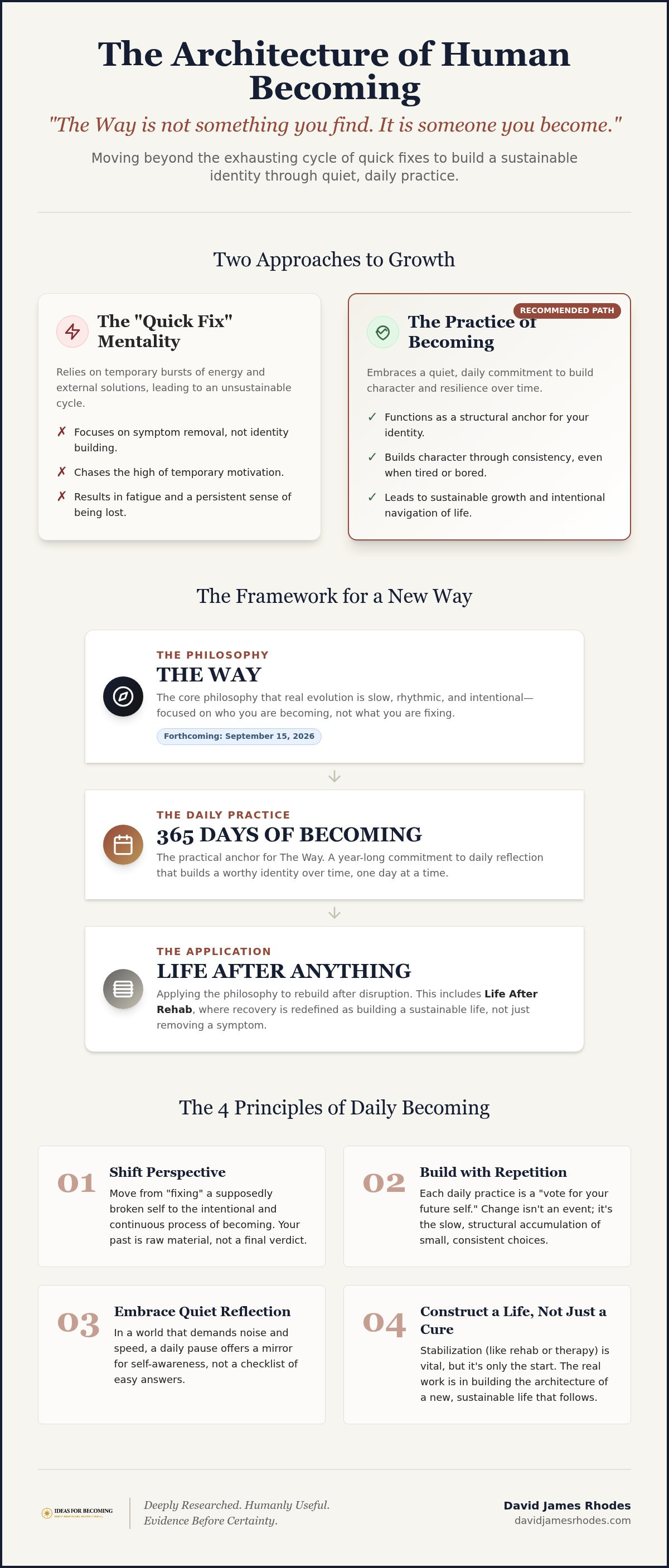
You likely recognize that true change doesn't happen in a vacuum. It requires a quiet, daily commitment. Choosing the right 365 days of self-improvement book is about more than just reading a quote. It's about selecting an anchor for your identity. This article will show you how a daily ritual of reflection can move you beyond fatigue toward a sustainable state of Human Becoming. We'll examine how to find practical wisdom that helps you navigate life's transitions. This is the foundation of the philosophy found in 365 Days of Becoming, the daily practice for The Way, which is forthcoming on September 15, 2026.
Key Takeaways
- Shift your perspective from fixing a broken self to the intentional and continuous process of human becoming.
- Select a 365 days of self-improvement book that acts as a reliable anchor for your character through every season of change.
- Build a sustainable ritual that survives life's disruptions by choosing quiet reflection over the pressure of a perfect streak.
- Distinguish between the temporary removal of symptoms and the deeper work of rebuilding an identity grounded in real-world experience.
- Understand how daily practices serve as the necessary foundation for the upcoming philosophy of The Way, releasing on September 15, 2026.
Beyond the Quick Fix: Why a 365-Day Practice is Essential
Growth is often sold as a destination. We're told that if we find the right workshop or the perfect hack, we'll finally arrive. This is a lie. Real evolution is slow. It's rhythmic. It's often invisible. A 365 days of self-improvement book isn't a collection of tips; it's a structural anchor for the work of identity. It's designed to outlast your initial excitement. It's there when the novelty fades and the high-stakes reality of your life remains.
Choosing a 365 days of self-improvement book is an act of defiance against the shallow. Most self-development efforts fail because they focus on the honeymoon phase. They rely on temporary bursts of motivation. But motivation is a fickle companion. A year-long commitment forces you to confront yourself when you're tired, when you're grieving, or when you're simply bored. This is where the shift happens. You stop trying to find a version of yourself that was never lost. You start the deliberate work of becoming the person you're capable of being.
Moving Beyond the "Quick Fix" Mentality
Weekend retreats and short-term bursts of energy have their place, but they don't build character. They remove symptoms. They offer a reprieve from the noise without changing the person who has to live in it. To understand What is Self-Help in its truest form, one must look past the shelves of how-to guides and toward the architecture of character. True growth requires repetition. It requires a daily ritual that builds a worthy identity over time. This process is especially vital when navigating life after adversity. Adversity strips us down. A daily practice puts us back together, piece by piece, day by day.
The Weight of Small, Daily Choices
A single page of reflection might seem insignificant. It isn't. In the context of a life lived across decades and continents, these small moments are the only things that stick. Having advised leaders in 156 countries, I've seen that the most resilient individuals aren't those who made one massive change. They're the ones who maintained a steady, quiet practice. The page you read today acts as a structural anchor for your morning. It sets the tone for your character. It's the difference between reacting to the world and navigating it with intention. Who are you becoming in the quiet moments of your morning?
The Architecture of Daily Becoming: How Consistency Shapes Identity
Change is not an event. It's a slow, structural accumulation. Many people approach a 365 days of self-improvement book as if they're looking for a clinical procedure to excise a flaw. They want the symptom removed. They want the anxiety gone. But growth is not about subtraction. It's about addition. It's about the architecture of the self. You don't just fix a life; you build one.
We often confuse time with transformation. Time alone is passive. You can spend a decade in a room and remain exactly who you were when you entered. True change requires intentional repetition. This is where The Psychology of Habit Formation meets existential reality. Science tells us how the brain maps routine. Philosophy tells us why that routine matters for the character. Across 156 countries, I've seen that the most enduring cultures don't view "The Way" as a destination. They view it as the person you're becoming through your daily walk. It's the path and the traveler, merged into one.
Repetition as a Tool for Rebuilding Identity
In my four decades within behavioral health and global leadership, I've observed that stabilization is only the beginning. Rehab or therapy can stop the bleeding. They cannot build the life that follows. This is the core of rebuilding the self after life disruptions. It requires an existential gravity. You must be willing to sit with the weight of who you've been to decide who you'll be. A daily practice isn't just a habit. It's a vote for your future self. It's the steady work of laying one brick at a time until a new identity stands firm.
Navigating the Silence: The Role of Reflection
The world demands movement. It values speed. Reflection, however, requires a pause. It requires silence. A 365 days of self-improvement book provides the provocative questions that break the noise. It doesn't offer easy answers. It offers a mirror. My role is not to be your cheerleader. I am a witness and a strategist. I am here to help you look at the raw human experience of your life and find a purposeful direction. If you're ready to begin this process, you can explore the principles of Human Becoming as a starting point for your own daily practice.
Evaluating the Best 365-Day Self-Improvement Books
Choosing a 365 days of self-improvement book is a decision of consequence. It's the selection of a voice that will sit with you in the quiet of the morning or the exhaustion of late evening. Most lists prioritize popularity. They look for what's trending. I suggest a different metric: weight. A book must have the authority to speak into your life and the depth to sustain your curiosity for a full year. If it offers only certainty, it's likely a cage. If it offers only comfort, it's likely a distraction. You need a companion that challenges the architecture of your current identity.
Devotionals vs. Reflection Guides: Finding Your Format
Format follows function. Religious devotionals offer a specific framework of faith. Secular reflection guides often draw from Stoicism, modern psychology, or raw human experience. For those navigating major life transitions, a companion guide for recovery provides the necessary structure to rebuild after disruption. Your choice should match your current emotional state. Are you looking for a mirror to see who you are, or a map to see who you're becoming? The best books don't just give you information; they provide a space for your own evolution to breathe.
Criteria for a Worthy Daily Companion
The psychology of daily habits suggests that routine creates a sense of safety and predictability. However, a worthy companion must also introduce a healthy level of challenge. In my four decades of experience across 156 countries, I've found that the most effective tools share three characteristics. They are grounded in high-stakes reality. They prioritize questions over answers. They avoid the exuberant cliches of typical self-help. Look for these markers when evaluating your next year of growth:
- Authority: Does the author have "skin in the game"? Have they navigated the extremes of success and failure?
- Practicality: Can the wisdom be applied to the messiness of your specific life?
- Depth: Does the writing allow for pause and reflection?
My own work, 365 Days of Becoming, is designed as the daily practice for the philosophy of The Way. It's not a book of motivational quotes. It's an anchor. It positions you as the strategist of your own life. It forces a pause. It asks: Who are you becoming? This is the central question that separates a generic 365 days of self-improvement book from a true catalyst for change.
Sustaining the Work: How to Navigate a Year of Growth
The start is simple. The finish is distant. The middle is where the self is forged. Sustaining a 365 days of self-improvement book requires more than a calendar. It requires a strategy for reality. Reality is messy. It interrupts. It demands your focus elsewhere. The work of becoming doesn't happen in a vacuum. It happens in the friction of a busy life. You aren't looking for a perfect streak. You're looking for a steady direction.
If you miss a day, don't look for an excuse. Look for a way back. Growth isn't a performance to be graded; it's a practice to be lived. Discipline provides the structure, but grace is the oil that prevents the machine from seizing. A missed page is not a failed year. It's a moment of pause. Return to the practice without the weight of guilt. The goal is evolution, not perfection. Who are you becoming when the plan falls apart?
Overcoming the Friction of a New Habit
Decision fatigue is the enemy of consistency. Integrating a 365 days of self-improvement book into your routine shouldn't feel like adding a chore. Pick a chair. Pick a time. Let the environment do the work of starting. I recommend a staccato rhythm. Read a short passage. Then, allow for a long pause. This methodical approach allows the ideas to settle. It's not about how much you read. It's about how much you absorb. If you rush the text, you're just consuming content. If you pause, you're beginning to change.
Creating a Space for Human Becoming
Reading is a passive act. Becoming is an active one. To bridge the gap, you must move the wisdom from the page to the world. This is especially critical for those in high-stakes environments. Your internal landscape dictates your external performance. Whether you're a global executive or navigating a personal transition, the way you show up matters. This is the core of leadership and life advisory. It's the integration of who you are with what you do.
When you lead from the inside out, you stop reacting to the world. You start navigating it. This daily ritual is the training ground for that navigation. It's the preparation for the principles found in The Way, which releases September 15, 2026. If you're looking for a partner in this process, you can find support through specialized advisory and guidance tailored to your specific path. The work is quiet. The results are permanent.
365 Days of Becoming: The Daily Anchor for The Way
The search for a 365 days of self-improvement book often ends in a sense of emptiness. Many volumes offer disconnected thoughts. They lack a center. They provide temporary motivation without a philosophical foundation. 365 Days of Becoming is different. It's the daily anchor for the philosophy of The Way. It's designed for those who recognize that growth isn't a checklist of achievements. It's a continuous process of human becoming. This practice is the training ground for the reality of your life. It's where the philosophy meets the pavement.
Choosing this 365 days of self-improvement book means committing to a specific kind of evolution. It's not about finding a version of yourself that was hidden. It's about the deliberate construction of character. Every page is a provocation. Every reflection is a strategy. You're no longer a passive observer of your own life. You become the architect of your identity. This is the work that remains when the world is loud and the stakes are high.
A Daily Practice Shaped by Global Experience
I've spent more than four decades navigating the extremes of human success and failure. My perspective has been shaped by work in 156 countries. I've stood in boardrooms of global corporations and sat in the quiet rooms of behavioral health centers. I've seen what lasts. I've seen what collapses. 365 Days of Becoming carries that weight. It speaks with a quiet authority and existential gravity. It avoids the exuberance of generic self-help. It doesn't offer cliches. It offers practical wisdom grounded in raw human experience. This book is the result of seeing the world from every possible angle and returning with a singular, focused insight.
Preparing for The Way: Releasing September 15, 2026
The daily practice of 365 Days of Becoming prepares the internal landscape for a deeper philosophy. The Way is not something you find. It is someone you become. My flagship book, The Way, is forthcoming on September 15, 2026. Until that release, the daily work of reflection serves as the necessary foundation. It builds the resilience required to handle the weight of true transformation. For those currently rebuilding a worthy identity, this structure is essential. It provides the consistency needed to navigate life after disruption. It ensures that recovery is larger than the removal of symptoms. The work begins today. The question remains. Who are you becoming?
Commit to the Process of Becoming
Becoming is a slow, deliberate work. It isn't found in a weekend workshop or a temporary burst of motivation. It's built in the quiet moments of daily reflection. You now understand that consistency shapes the architecture of your identity. Time alone creates nothing. Only intentional repetition allows for true evolution. Selecting a 365 days of self-improvement book is the first step in establishing this rhythm. It provides the structural anchor needed to navigate the high-stakes reality of your life.
This practice is grounded in my experience across 156 countries. It reflects the intersection of elite performance and raw human struggle. It's the essential foundation for the philosophy of The Way, releasing September 15, 2026. If you're ready to move beyond symptom removal and toward a sustainable state of being, the path is ready for you.
Begin your practice with 365 Days of Becoming. This path doesn't require perfection. It only requires you to show up. There is a steady, quiet hope in the work of becoming who you are meant to be.
Frequently Asked Questions
What is the best 365 days of self-improvement book for leaders?
The best 365 days of self-improvement book for leadership is one grounded in high-stakes reality and quiet authority. Leaders don't need cliches; they need structural anchors for their character. My book, 365 Days of Becoming, serves as this anchor. It draws from four decades of experience advising executives in 156 countries. It isn't a book of tips. It's a daily practice designed to prepare you for the deeper leadership philosophy found in The Way.
Is a 365-day self-improvement book effective for people in recovery?
A daily practice is highly effective for recovery when it focuses on rebuilding a worthy identity rather than just symptom removal. Stabilization is essential, but it isn't a sustainable life. Books like 365 Days of Becoming help bridge the gap between clinical treatment and a meaningful existence. They provide the repetition needed to reshape the self after major life disruptions. Recovery is a long-term process of human becoming that requires a steady, daily anchor.
How much time should I spend on a daily growth practice each morning?
Consistency is more valuable than duration. You should spend enough time to allow the ideas to breathe, typically ten to fifteen minutes. The goal isn't to consume content but to invite reflection. I suggest a staccato rhythm: read a short passage, then allow for a long pause. This methodical approach forces you to sit with provocative questions. It's the quality of the silence following the reading that determines the depth of your growth.
Can I start a 365-day self-improvement book at any time of the year?
You can begin a daily practice at any moment. Growth isn't beholden to the calendar or the start of a new year. The process of human becoming is a continuous cycle that starts whenever you decide to show up. Waiting for a specific date is often just a form of procrastination. Whether you start in January or July, the 365 days of self-improvement book you choose serves as a permanent anchor for your evolution.
What is the difference between a daily devotional and a self-improvement book?
Devotionals typically provide a specific faith-based or philosophical framework for the day. Generic self-improvement books often focus on tactical hacks or motivational bursts. My work, 365 Days of Becoming, functions as a daily practice of identity construction. It moves beyond simple advice toward existential gravity. It asks who you're becoming rather than telling you what to do. This distinction is vital for those seeking a deeper, more permanent shift in their character and leadership.
What happens if I miss a day in my 365-day practice?
A missed day is a moment for grace, not a reason to quit. Growth is a direction, not a performance to be graded on a perfect streak. If you miss a page, return to the practice the next morning without the weight of guilt. Discipline provides the structure, but perfectionism often kills progress. The work of becoming is a long-term commitment. One missed day doesn't erase the momentum of a life lived with intentionality.
How do I choose between a digital and a physical daily growth book?
Choose the format that reduces the friction of starting while allowing for deep focus. Physical books offer a tactile experience that digital platforms often lack. They serve as a visible, structural anchor in your environment. A physical 365 days of self-improvement book forces a pause in a world of digital noise. Digital versions offer convenience for global travelers, but they carry the risk of distraction. The goal is to create a space for your evolution.
Why does David James Rhodes focus on "becoming" rather than "finding" yourself?
Finding yourself implies that your identity is a fixed destination that has been lost. I believe identity is something you build through daily action and reflection. My philosophy of The Way, releasing September 15, 2026, centers on the idea that you are under continuous construction. You aren't searching for a hidden truth; you're becoming the person you're capable of being. This shift in perspective places the responsibility for growth squarely in your hands.
Frequently Asked Questions
Related Articles
Recovery and Identity Book: Rebuilding the Self After Life Disruptions
This recovery and identity book offers a framework for rebuilding your self after disruption. Move beyond labels and learn the deliberate process of human be...

A Companion Guide for Recovery: Navigating the Process of Becoming
Beyond sobriety, what's next? This companion guide for recovery offers a structured path to build a worthy identity and navigate life after rehab.

Life After Rehab Book: A Guide to Rebuilding a Worthy Identity
A good life after rehab book is more than a survival guide. It's a map for rebuilding a worthy identity when sobriety feels like a void. Who are you becoming?