Sobriety is not a destination. It is merely the clearing of the ground. Many people reach the point of stabilization only to find themselves standing in a silent vacuum. You've removed the disruption, but you haven't yet built the person. If you feel defined by a label like survivor or addict, you know the hollow weight of generic advice. This recovery and identity book serves as a guide for the space between who you were and who you are capable of being.
We recognize that clinical treatment is essential for survival; it's simply insufficient for a life. Recovery is the removal of a symptom. Identity is the deliberate construction of a person. You need a framework for identity construction that integrates your past failures into a future of character. This article outlines the deliberate process of human becoming. We'll examine the practical daily steps for growth and introduce the philosophy behind my forthcoming work, The Way, releasing September 15, 2026. The Way is not something you find; it is someone you become.
Key Takeaways
- Stabilization is the first step, not the final destination. It creates a vacuum that you must fill with a deliberate sense of self.
- Move beyond labels that feel like cages. A recovery and identity book should help you use your past as a foundation for character rather than a permanent definition.
- Shift your focus from finding a lost version of yourself to the active process of human becoming. Identity is authored in the present.
- Distinguish between clinical stabilization and the long-term work of building a sustainable life. Use the framework of Life After Rehab to begin this specific progression.
- Prepare for a life of purpose by asking the central question of "Who are you becoming?" and adopting a philosophy that sustains you.
The Vacuum of Identity: Why Recovery Feels Hollow
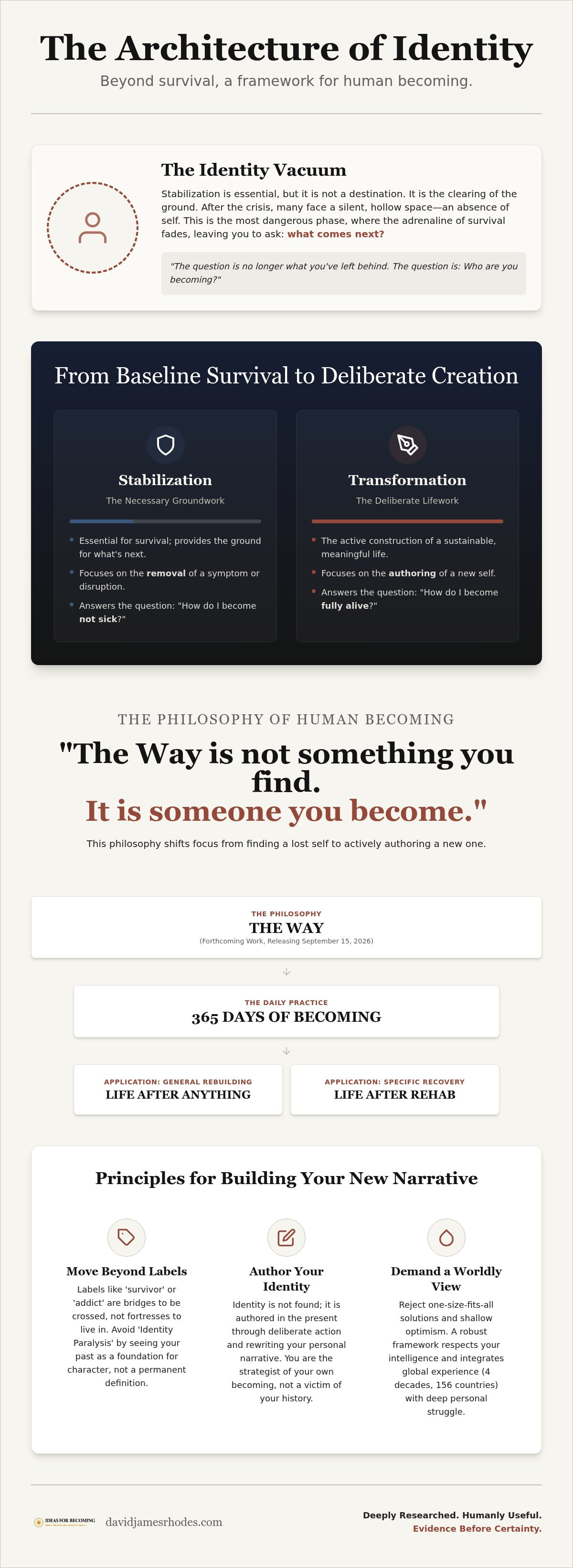
The crisis has passed. The noise has stopped. You're left with a silence that feels less like peace and more like an absence. This is the identity vacuum. It occurs the moment the immediate threat, whether it's addiction, burnout, or loss, is stabilized. You've survived the storm. Now, you must figure out how to live in the clearing. For many, this is the most dangerous phase. The adrenaline of survival has faded, leaving only a hollow space where a sense of self used to be.
For many, the label of being in recovery is a necessary bridge. It provides a map when the world is dark. But a bridge is meant to be crossed, not lived upon. This tension is at the heart of any effective recovery and identity book. It's the struggle to move beyond the label and into the self. While the traditional Recovery Model emphasizes the importance of personal agency and hope, it often stops at the point of stabilization. It tells you how to be not sick. It rarely tells you how to be fully alive.
The Problem with Labels
Labels like addict or survivor offer safety during the storm. They help you find your tribe. They provide a language for your pain. Over time, however, these same words can become a cage. You begin to build a life around what you're not doing. You aren't drinking. You aren't failing. You aren't crashing. But what are you actually doing? Identity Paralysis is the inability to see oneself beyond the previous crisis. It's the state of being a monument to your own past mistakes. It limits your horizon to the size of your trauma. You're more than the worst thing that's happened to you.
Stabilization is Not Transformation
Clinical success is a baseline. Sobriety is a foundation. Neither is a life. Rehab and therapy are essential for stabilization. They provide the necessary ground for what comes next. However, being not sick is not the same as being fully alive. Transformation requires a shift from the removal of the old to the deliberate authoring of the new. It's the difference between clearing a field and planting a harvest. It requires moving from the passive state of recovering to the active state of Human Becoming. The focus shifts from the past to the present. The question is no longer what you've left behind. The question is: Who are you becoming?
Why Most Recovery and Identity Books Fall Short
Walk into the self-help section of any bookstore. You'll see bright covers. You'll hear the loud, exuberant tone of a cheerleader. These books treat your crisis as a marketing problem. They offer shallow optimism where you need gravity. Rebuilding a life isn't a matter of positive thinking. It's a cold, intentional reconstruction. A generic recovery and identity book often fails because it assumes your struggle is a defect to be fixed. It isn't. It's a context to be integrated. You don't need a cheerleader. You need a witness and a strategist.
Most literature in this space ignores the high-stakes reality of your situation. They offer a one-size-fits-all path. This contradicts the unique process of becoming who you are. Your history is specific. Your failures are yours alone. Any framework that fails to respect your intelligence or your global context is a waste of your time. We must move beyond the clinical and into the existential. We must look at the person as a whole, not just a set of symptoms.
The Trap of Manufactured Profundity
The promise of unlocking your potential is a hollow one. It's a phrase without weight. Without a framework of character, potential is just raw material with no direction. It's noise. We operate on a different standard: Evidence Before Certainty. This isn't academic. It's grounded in the raw human experience. My work across 156 countries has taught me one thing. Human struggle doesn't follow a corporate script. It's somber. It's intentional. It requires a worldly perspective that understands the intersection of elite performance and deep personal struggle. You can't manufacture growth. You have to author it.
Clinical vs. Philosophical Approaches
Clinical evidence keeps you alive. It's the medicine. Philosophical strategy gives you a reason to stay alive. It's the purpose. Research from Michigan State University discusses the power of rewriting your identity through personal narrative. This is how you reframe your story. It's not about ignoring the past. It's about using it as a foundation. For those ready for the daily practice of change, using a companion guide for recovery can help shift identity from a thought to a habit. Identity isn't a destination to be found. It's a journey of navigation. You don't find yourself. You become yourself through deliberate action. If you're looking for a deeper philosophy, my forthcoming book, The Way, releasing September 15, 2026, explores these themes further.
Comparing Frameworks for Rebuilding Your Life
Not all literature in this field serves the same master. Some books fix the plumbing of your life while others redesign the entire architecture. When choosing a recovery and identity book, you must first understand what you're trying to build. We categorize these works into three main frameworks: clinical manuals, narrative memoirs, and philosophical strategies. Clinical works stabilize the crisis. Memoirs offer the comfort of resonance. Philosophical strategies, however, provide the blueprints for who you are capable of becoming.
There's a fundamental difference between step-based programs and identity-based growth. Step-based programs focus on the "what," providing a checklist to prevent a fall. Identity-based growth focuses on the "who," directing the climb toward a specific character. One is a safety net; the other is a compass. Your choice depends entirely on your stage of navigating life after adversity. If you've already achieved stabilization, you no longer need a manual for survival. You need a strategy for existence.
Clinical Manuals vs. Strategic Advisory
There's a time to see a therapist and a time to consult a strategist. A therapist helps you heal the wounds of the past. A strategist helps you architect the requirements of the future. This distinction is clear in the "Life After Anything" series. While Life After Rehab addresses the specific needs of sustainable recovery, Life After Anything provides a broader framework for rebuilding after any profound disruption. You should look for books that offer "Humanly Useful" guidance. This means practical, evidence-based insights that respect your intelligence rather than burying it under generic platitudes. A high-quality recovery and identity book won't just tell you to be better. It will show you how to be someone new.
The Role of Daily Practice
A single reading of a profound idea is a spark. It's not a fire. Identity change doesn't happen in the moment of realization; it happens in the months of application. This is why daily practice is non-negotiable. My work in 365 Days of Becoming is designed for this specific purpose. It moves the philosophy from the page to the pavement. Repetition builds the neural and spiritual pathways of a new self, turning fragile intentions into the iron of character. You don't think your way into a new identity. You practice your way there. Every day is an opportunity to answer the central question: Who are you becoming?
Human Becoming: The Core Question of Identity
The most important question you'll ever face is not "How do I stop?" or "Why did this happen?" It is: Who are you becoming? Most people look backward for their identity. They sift through the wreckage of their past, hoping to find a version of themselves that was once whole. This is a mistake. Identity is not a fossil to be excavated. It is a narrative to be authored. In any effective recovery and identity book, the focus must shift from the archaeology of the self to the architecture of the self.
This process of Human Becoming is a singular path. It doesn't distinguish between your professional life and your private character. Whether you're an executive in a boardroom or a person in a treatment room, the requirement is the same. You must integrate your experiences into a coherent sense of self. My perspective, shaped by work in 156 countries, has shown me that the human struggle for meaning is universal. It doesn't matter where you are. It matters who you're becoming in that space. A global perspective changes the scale. It moves you from a patient in a system to a participant in the human story.
The Way is Not a Path
We often look for a map. We want a set of directions that guarantees a destination. But the truth is more demanding. The Way is not something you find. It is someone you become. You must stop looking for a perfect path and start focusing on the perfect step. This shift in focus is the core of my forthcoming work, The Way book, releasing September 15, 2026. It's about the deliberate, daily practice of becoming. You don't arrive. You evolve.
Character Over Reputation
Rebuilding identity requires a brutal shift in priority. You must value internal integrity over external validation. Reputation is what others think of you. Character is what you know of yourself. Adversity is not a setback; it is a forge. It burns away the superficial and leaves only what's sturdier. This transition from "what you do" to "who you are" is where true resilience is born. It's the moment you stop performing for an audience and start living for a purpose. If you're ready to move beyond the label, discover the philosophy of The Way and start authoring your future today.
Starting the Journey: Resources for the New Narrative
Rebuilding a life is a sequence of deliberate acts. It begins with stabilization. It continues through daily practice. It culminates in a philosophy that can sustain the weight of your future. You can't skip these stages. You can't think your way out of a vacuum. This recovery and identity book serves as a map for that sequence. It bridges the gap between the clinical removal of symptoms and the strategic construction of a person. It's the difference between being a patient and being an author.
The life after rehab book provides the specific starting point for this reconstruction. It's designed for the individual standing at the exit of treatment, asking what comes next. It shifts the focus from staying sober to becoming worthy of the life you've been given. This is the first step in a larger progression of human becoming. It is where you stop being defined by what you've lost and start being defined by what you're building.
The Life After Anything Series
Disruption takes many forms. It might be the end of a career. The loss of a partner. The collapse of a health system. The Life After Anything series addresses these specific fractures. Each volume is a tool for rebuilding. The companion guides facilitate the hard work of reflection. They force you to answer the questions you've been avoiding. We aren't just helping individuals. We're rehabilitating the rehabilitation industry. We're moving the standard from simple survival to intentional evolution. These are not just books. They're strategic assets for your life.
The Way: Forthcoming September 15, 2026
The sequence finds its completion in The Way. This is my flagship work. It's a comprehensive philosophy for anyone in transition. Whether you're a global leader facing a legacy crisis or a survivor of personal trauma, the requirement is the same. You must decide who you are becoming. This book, releasing September 15, 2026, provides the framework for that decision. It's for those who are tired of generic self-help and are ready for a high-stakes reality. Your journey doesn't end with recovery. It begins there. Explore the works of David James Rhodes and begin the process of becoming who you are capable of being.
The Architecture of a New Self
Stabilization is a necessary floor, but it's a poor ceiling. You've cleared the ground of disruption. Now, the work of construction begins. This recovery and identity book is more than a manual for sobriety; it's a blueprint for character. We've explored why labels can become cages and why identity is something you author in the present rather than find in the past. Real transformation requires a shift from external reputation to internal integrity.
This philosophy is shaped by 40 years of global experience across 156 countries. It offers a unique integration of behavioral health and high-level leadership strategy. It's a grounded perspective for those who demand more than hollow optimism. My flagship work, The Way, releases September 15, 2026, providing a definitive guide to the process of becoming. You've survived the storm. Now, decide who you'll be in the clearing. Begin your journey of Human Becoming with the works of David James Rhodes. The path is yours to author. You're capable of more than you've been told.
Frequently Asked Questions
What is the difference between a recovery book and an identity book?
A recovery book typically focuses on the clinical removal of symptoms or the maintenance of sobriety. In contrast, an identity book focuses on the deliberate construction of a new self. One clears the ground while the other builds the architecture. Any high-quality recovery and identity book should bridge this gap. It moves the reader from the passive state of not being sick to the active state of becoming someone new.
Can I really change my identity after years of addiction or crisis?
You absolutely can author a new identity regardless of your past. Identity isn't a fossil to be excavated from your history; it is a narrative you write in the present. The process of Human Becoming is grounded in the belief that your past failures are simply the forge for your future character. You aren't fixing a defect. You're integrating your experience into a sturdier, more intentional version of yourself.
When is the best time to start reading about identity after rehab?
The best time to begin reading about identity is immediately after initial stabilization. Clinical interventions like rehab or therapy are essential for clearing the crisis. However, once the noise stops, the vacuum of identity appears. This is when a recovery and identity book becomes most effective. It provides the strategic framework needed to fill that silence with purpose rather than just the absence of a habit.
How does David James Rhodes’ approach differ from traditional 12-step programs?
Traditional 12-step programs are often step-based models designed for stabilization and safety. David’s approach is identity-based and strategic. It's a philosophical framework that asks: Who are you becoming? While 12-step programs focus on the what of behavior, David’s work focuses on the who of character. It integrates leadership strategy with behavioral health to create a sustainable, global perspective on personal growth.
Is "The Way" book suitable for someone who hasn’t experienced a major crisis?
Yes, The Way is designed for anyone navigating a transition or seeking deeper meaning. It's not limited to those who've faced addiction or medical trauma. Leaders, executives, and survivors all face the same existential questions of identity and evolution. The philosophy of Human Becoming applies to any individual ready to move from external reputation to internal integrity. It focuses on the universal human requirement for growth and navigation.
What does "Human Becoming" mean in the context of recovery?
Human Becoming is the core philosophy that identity is a continuous process of evolution rather than a static destination. In the context of recovery, it means you're no longer defined by the label of your disruption. You shift from archaeology to architecture. You stop looking for a lost version of yourself. Instead, you begin the deliberate, daily practice of authoring who you are capable of being.
How do I use a recovery workbook effectively?
Effectiveness comes from daily repetition rather than a single reading. A workbook like the Life After Anything Companion Guide should be used for consistent reflection. Repetition builds the neural and spiritual pathways of a new self. It turns fragile intentions into the iron of character. You don't think your way into a new identity. You practice your way there through honest, daily engagement with the text.
Where can I find a community focused on rebuilding identity?
You can find a community of like-minded individuals through the advisory services and publications of David James Rhodes. His work across 156 countries has built a global perspective on leadership and life reconstruction. While he doesn't offer life coaching or workshops, his books and keynote speaking events provide a space for survivors and leaders to engage with the question of who they are becoming.
Frequently Asked Questions
Related Articles

A Companion Guide for Recovery: Navigating the Process of Becoming
Beyond sobriety, what's next? This companion guide for recovery offers a structured path to build a worthy identity and navigate life after rehab.

Life After Rehab Book: A Guide to Rebuilding a Worthy Identity
A good life after rehab book is more than a survival guide. It's a map for rebuilding a worthy identity when sobriety feels like a void. Who are you becoming?

Navigating Life After Adversity: The Process of Human Becoming
Stop trying to 'bounce back.' Learn how navigating life after adversity is a process of becoming someone new, not returning to who you were. A new way forward.