
The wreckage of a life derailed is not a graveyard. It is a quarry. Most people view adversity as an interruption to their real life, a detour that must be survived so they can return to "normal." But what if the hardship is the work? What if the weight you're carrying is the primary tool for how to find meaning in hardship? What if the pressure isn't meant to break you, but to forge the person you're meant to be?
It's exhausting to perform optimism when your reality is heavy. You may feel that your identity vanished alongside a career, a relationship, or a sense of health. You're right to feel this way. The loss is real. The void is wide. You aren't just losing a role; you're losing the map you once used to navigate the world.
This article provides a philosophical and practical framework for sitting with the pain without being consumed by it. We'll move beyond shallow advice to look at the raw mechanics of evolution. My book, The Way posits that your path is not something you find. It is someone you become. We'll examine how to rebuild an identity that incorporates your struggle, treating it as the raw material for who you are becoming.
Key Takeaways
- Learn how to find meaning in hardship by shifting your focus from seeking a reason for your pain to actively creating meaning through your response to it.
- Understand that identity is not a fixed destination but a continuous process of human becoming. Adversity is the raw material for your evolution.
- Break the cycle of the victim narrative by replacing the question "Why me?" with the more purposeful inquiry: "Who am I becoming?"
- Establish a daily practice of rhythmic, small actions to ground yourself when life feels derailed. These habits help you sit with pain without being consumed by it.
- Explore a framework for rebuilding a new, integrated identity following major life disruptions, moving toward growth rather than a futile return to the past.
The Architecture of Adversity: Defining Meaning in the Void
Hardship is not a glitch in the system. It is the system. We often treat adversity as an unwelcome interruption, a detour that delays our real life from beginning. This is a fundamental error. Suffering is not a pause in your story; it is the ink with which the most critical chapters are written. When you are standing in the wreckage of a life you no longer recognize, the primary challenge is not survival, but construction. You aren't just looking for a way out. You're looking for how to find meaning in hardship so that the pain doesn't go to waste.
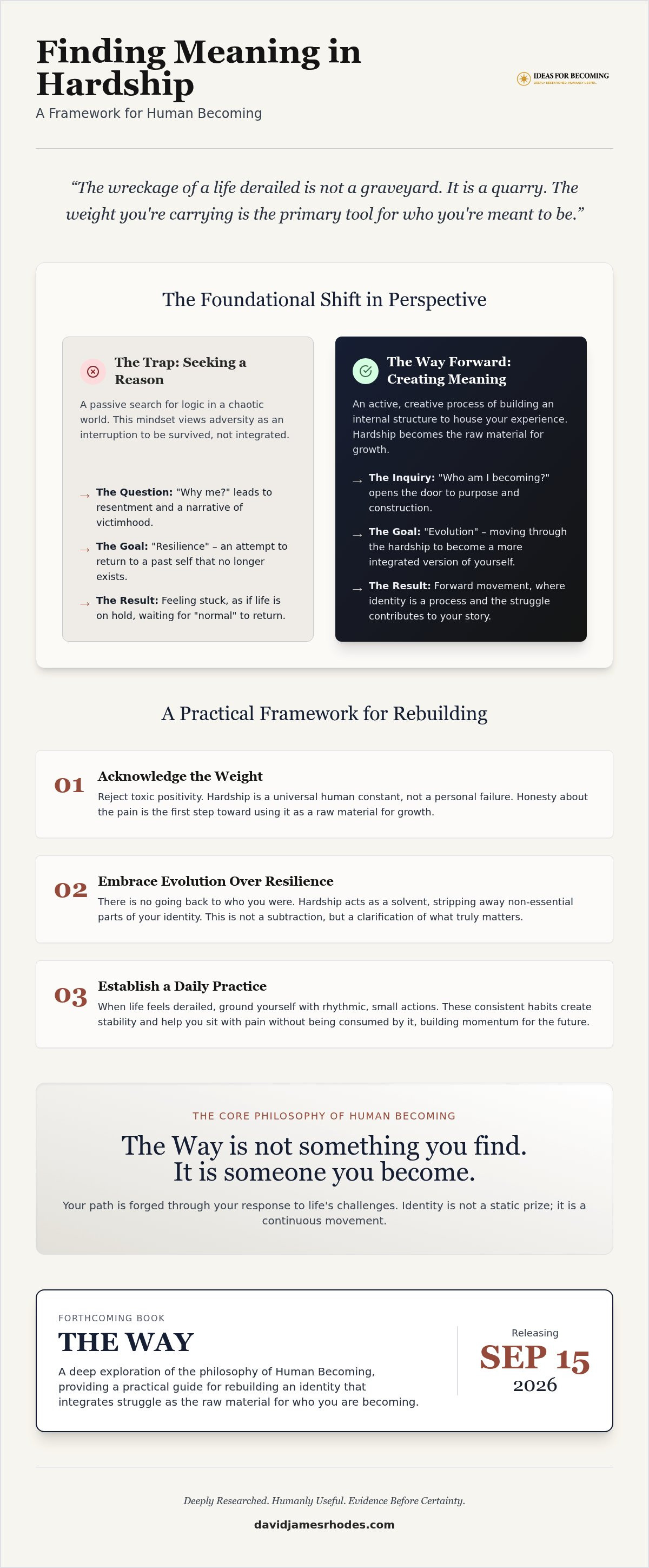
Most people spend their energy trying to find a "reason" for their suffering. They want to know why this happened. They seek a cosmic justification or a logical explanation that will make the loss feel fair. This is a trap. Finding a reason is a passive search for logic in a world that is often chaotic. Creating meaning, however is an active, creative process. Meaning is the internal structure we build to house our experiences. It is the architecture of the soul. Ultimately, the search for meaning is not a search for answers; it is a search for a new identity.
The Difference Between Logic and Meaning
Logic is a cold comfort when the world is burning. It fails to provide solace because it operates in the realm of facts, while hardship operates in the realm of gravity. You can't think your way out of a broken heart or a lost career. Asking "why" usually leads to a dead end of resentment. Shifting the question to "how" allows you to begin the work of integration. This shift is explored deeply in Viktor Frankl's 'Man's Search for Meaning', where he argues that we don't ask life what the meaning is, but rather, life asks us. Meaning is the bridge between experience and identity.
Hardship as a Universal Human Constant
In my work across 156 countries, I've seen that the void is a universal landscape. No culture, no matter how advanced or traditional is exempt from the weight of the struggle. The names of the hardships change, but the somber reality of the human condition remains the same. We must reject the shallow pull of toxic positivity. Telling someone to "stay positive" when their world has collapsed is not just unhelpful; it's a denial of their reality. Rebuilding requires honesty. It requires us to acknowledge the weight of the struggle. Only by sitting with the gravity of the situation can we begin to navigate the forthcoming transition toward who we are becoming. This is the foundation of the philosophy I explore in my book, The Way,. We don't ignore the dark. We use it as the raw material for the light.
Beyond Resilience: Hardship as the Catalyst for Human Becoming
Resilience is a common word. It suggests a return to a previous state. It implies a rubber band snapping back to its original shape. But when life breaks, there is no going back. There is only going through. This is the core of Human Becoming. It is the realization that how to find meaning in hardship isn't about recovery. It's about evolution. My flagship philosophy is simple: The Way is not something you find. It is someone you become. This philosophy, which I explore in my book, The Way (,), suggests that identity is not a static prize. It's a movement.
Hardship acts as a solvent. It dissolves the non-essential parts of our identity. We often define ourselves by our roles. We are the executive, the spouse, the athlete. When those roles vanish, we feel empty. But the void is not a vacuum. It's a space. It's the only place where something new can grow. In Viktor Frankl's search for meaning, we see that even in the most restricted environments, the freedom to become remains. The void is not the end of the story. It is the raw material for the next chapter.
The Process of Stripping Away
Major transitions reveal core character. In my work on Life After Loss, I discuss how disruption removes the masks we've worn for years. This is painful. It's a death of the former self. But you cannot become who you are meant to be while clinging to who you used to be. Reframing loss as a necessary stripping away changes the narrative. It's not a subtraction. It's a clarification of what truly remains when everything else is gone.
The Role of Character in Navigation
When the map is gone, character is the only compass left. It's the internal weight that keeps you upright. Throughout my four decades across 156 countries, I've observed that high-stakes reality requires a quiet authority over one's own story. This authority isn't loud. It's a steady presence. During recovery, the focus must shift from achieving to becoming. Achievement is external. Becoming is internal. It's the slow, methodical work of building a self that can carry the weight of the future. If you're seeking guidance through this transition, you may find David’s advisory work a steady hand in the process of your own becoming.
Shifting the Narrative: From "Why Me" to "Who Am I Becoming?"
The questions we ask ourselves in the dark determine the quality of the light we eventually find. When life collapses, the reflexive question is almost always "Why me?" This is the beginning of the Victim Narrative. It's a cycle that anchors us to the past. It demands a reason for the unreasonable. It seeks logic in the wreckage. But true navigation requires a different inquiry. We must move from the backward-looking "Why" to the forward-looking "Who am I becoming?"
This shift is the cornerstone of how to find meaning in hardship. It's not a denial of the pain. It's a refusal to let the pain have the final word. Your personal history is not a fixed script. It's a living document. You have the power to choose the frame. Will this event be the end of your story, or the raw material for a new one? The Becoming Narrative is the primary tool for this transition. It allows you to sit with the weight of reality while maintaining a focused direction toward the future.
The Trap of the "Why" Question
Searching for causal reasons often leads to a dead end of bitterness. It suggests that if we can find the "why," the pain will somehow be justified. It won't. Some questions are better left unanswered in favor of direct action. In the high-stakes reality of global leadership and personal recovery, stagnation is the greatest risk. Distinguishing between personal responsibility and cosmic blame is essential. You may not be responsible for the event, but you are responsible for the response. Action is the only antidote to the paralysis of "why."
Constructing a New Narrative
Authoring a new story requires radical honesty. It requires you to look at major setbacks not as failures, but as critical data points. This is the work of integration. By viewing adversity as a catalyst for insight and growth, you begin to build a story that holds real weight. It's a somber process, but it's the only one that leads to quiet authority.
Vulnerability is the foundation of this new narrative. It isn't weakness. It's the courage to be seen in the process of transition. When you lead from this place of integrated struggle, your influence deepens. Others don't follow you because you are perfect. They follow you because you have navigated the void and returned with a map. This is the essence of The Way. It's a path forged through the steady practice of personal evolution. Who are you becoming through this disruption? The answer to that question is the only meaning that lasts.
Practical Steps for Navigating the Void of Hardship
The initial shock of a life disruption eventually gives way to a long, quiet middle. This is the void. It is the space between what was and what will be. Most people try to rush through this period. They want to return to a state of "doing" to avoid the discomfort of "being." But the void is where the real work of integration happens. Knowing how to find meaning in hardship is not about grand gestures. It is about the steady, rhythmic application of effort when you feel least capable of it.
Recovery is not a linear event. It is a series of small, intentional choices. When reality feels heavy, big goals are often paralyzing. Instead, focus on the smallest possible unit of progress. This is the foundation of the daily practice I've developed. It is a framework designed to anchor you when the world feels anchorless. By focusing on who you are today, you stop mourning what you lost yesterday. The past is a reference point, not a residence.
The Discipline of Daily Practice
Repetition is the only way to build a sustainable life after a crisis. You cannot think your way into a new identity; you must act your way into it. Reflection is the primary tool for this construction. It forces you to look at the raw material of your day and ask: What did this require of me? The daily practice is the steady pulse of human becoming. It moves you from surviving the day to becoming through the day. It turns the passage of time into the progression of character. If you're ready to begin this work, you can ground your recovery in 365 Days of Becoming.
Navigating the Silence
Hardship is often loud in its arrival and silent in its aftermath. This silence can be terrifying. It feels like stagnation. In the aftermath of divorce or the loss of a long-held role, solitude becomes a mirror. You cannot hide from yourself in the void. Use this time. Reflection in the silence is not a luxury; it's a necessity. The Life After Anything companion guides and workbooks provide the structure for this silence. They offer a framework for the questions that the void demands. They help you navigate the periods where nothing seems to be happening, ensuring that even in the stillness, you are moving forward.
The Way Forward: Rebuilding Identity After Life Disruptions
The wreckage has been cleared. The silence of the void has been navigated. Now comes the most challenging phase: the integration. Rebuilding after a life disruption is not a search for a lost past. It's the construction of a new future. Many people wait for the hardship to end so they can return to "normal." This is a mistake. There is no normal to return to. The version of you that existed before the crisis is gone. The path forward is a move toward a new integration. It's where the struggle is no longer an enemy, but a part of your foundation. This is how to find meaning in hardship. You don't leave the pain behind. You carry it forward as wisdom.
Every mile of the struggle has shaped the way you see the world. The hardship was not the detour. It was the terrain. In my four decades of experience across 156 countries, I've found that the most resilient structures are those that have been tested by the elements. Your identity is no different. You're not just surviving a storm. You're being shaped by the wind.
Integrating the Struggle into Your Leadership
Personal adversity creates a perspective that cannot be taught in a boardroom. It fosters a global executive perspective rooted in reality rather than theory. When you have faced your own void, you stop leading by authority alone. You begin leading by being. You become a witness and a strategist of your own experience. This shift allows you to lead others with a quiet authority that is both compassionate and uncompromising. The most effective leaders aren't those who have avoided failure. They're the ones who have navigated it and returned with a new map for others to follow. They understand that how to find meaning in hardship is the ultimate leadership skill.
Committing to the Process of Becoming
The journey of human becoming never truly ends. It's a continuous movement. My book, The Way explores this in depth. It posits that the path is not something you find. It is someone you become. Maintaining this philosophy requires a commitment to the daily practice, even after the acute hardship has passed. It's a dedication to the long-term evolution of your character.
You've learned how to shift your narrative and establish a rhythmic life. Now, the question remains. It is the only question that matters as you move forward into this new landscape. Who are you becoming right now? The answer is not a destination. It's the way you walk.
The Architect of Your Own Evolution
Meaning isn't a treasure buried at the end of a struggle. It's a choice made within it. You've seen that the void is not emptiness, but a space for construction. You've learned that your narrative determines your recovery. Understanding how to find meaning in hardship requires a shift from seeking reasons to building character. It's the slow, rhythmic work of integration. The hardship wasn't a detour. It was the terrain required for your evolution.
This philosophy is grounded in 40 years of global leadership and recovery experience across 156 countries. It's the same reality that drives the "Life After Anything" series. If you're ready to move beyond survival, prepare for the release of The Way: Navigating the Process of Human Becoming, arriving September 15, 2026. The Way is not something you find. It's the person you're becoming right now. The path is yours to walk. Move forward with intention.
Frequently Asked Questions
How long does it take to find meaning after a major hardship?
The process is not governed by a calendar. Meaning is a byproduct of navigation, not a destination reached at a specific time. While neuroplasticity and habit formation require repetition, time alone creates nothing. It is the quality of your engagement with the void that determines the pace. Some find clarity in months; for others, it is the work of a decade. Patience is the primary requirement.
Is it possible to find meaning in a tragedy that seems completely senseless?
You don't find meaning in the event itself. You create meaning from your response to it. Senseless tragedies do not contain inherent logic or "reasons." They are raw, chaotic disruptions. Meaning is the internal architecture you build to house the experience. It is the bridge between the trauma and the person you are becoming after the wreckage has settled. You author the purpose.
What is the first step to take when everything in life feels like it has fallen apart?
The first step is to acknowledge the weight without trying to fix it. Stabilization is the priority. You must sit with the reality of the disruption before you can navigate it. Once you have stopped the immediate bleeding, establish one small, rhythmic action. This daily practice is the foundation for how to find meaning in hardship. It anchors you to the present moment.
Can I find meaning without professional therapy or counseling?
Professional therapy is essential for clinical stabilization, but the work of becoming is larger than any single treatment episode. Meaning is a philosophical and character-driven pursuit. You can build a sustainable life by engaging with frameworks like The Way and committing to daily reflection. While counselors offer valuable tools, the responsibility for authoring your new narrative remains yours alone. It is a personal evolution.
How do I help someone else find meaning in their suffering without sounding dismissive?
Be a witness, not a cheerleader. Avoid the urge to offer forced optimism or shallow reasons for their pain. Instead, offer a steady, quiet presence. Acknowledge the somber reality of their struggle without trying to "fix" it for them. You cannot find their meaning for them. You can only hold the space while they navigate their own void. Ask them who they feel they are becoming.
What is the difference between resilience and the process of human becoming?
Resilience is about returning to a previous state, while human becoming is about evolving into a new one. Resilience suggests a rubber band snapping back to its original shape. Becoming acknowledges that the old self is gone forever. It is a continuous process of integration where the hardship is used as raw material. You aren't bouncing back. You are moving forward into a different version of yourself.
Is finding meaning the same thing as being happy again?
No, meaning and happiness are different metrics. Happiness is a transient emotional state. Meaning is a structural trait of character. You can find deep meaning in a life that remains somber or difficult. How to find meaning in hardship is about discovering a purpose that can carry the weight of your history, regardless of your current mood. It provides the gravity and direction that happiness cannot.
Frequently Asked Questions
Related Articles

Best Leadership Guides for Executives: A Thoughtful 2026 Selection
Searching for the best leadership books for executives? Discover thoughtful leadership guides matched to real executive challenges, strategy, and character.

Executive Coach vs. Advisor: Which Kind of Support Does a Leader Need?
Choosing between an executive coach vs advisor? Learn how to match the right support to consequential leadership decisions and the leader you are becoming.

Executive Advisory on Purpose and Fulfillment: A More Human Way Forward
Seek executive advisory on purpose and fulfillment to align leadership choices with values and character. Discover who you are becoming beyond outward success.